

Canivet's Emerald vs Violet-headed Hummingbird
Cynanthus canivetii contro Klais guimeti
Fai un quiz con Canivet's Emerald e Violet-headed Hummingbird
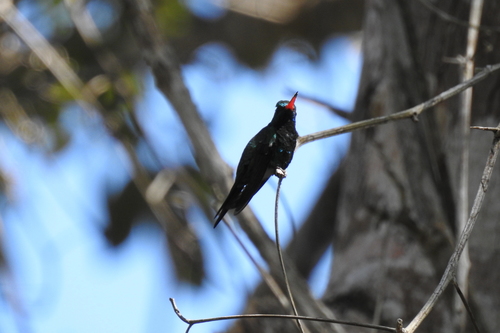 Canivet's Emerald
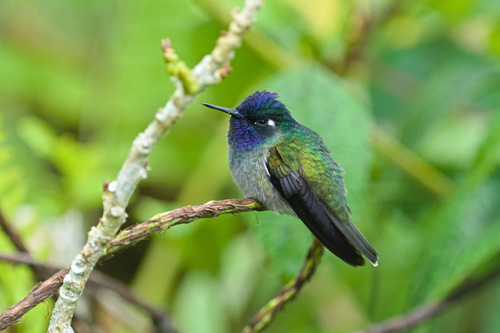 Violet-headed Hummingbird
In breve
The most reliable field mark between Canivet's Emerald and Violet-headed Hummingbird is the male's head color: Canivet's Emerald males have a brilliant golden to golden-green crown, while Violet-headed males show an intense violet or blue head and throat, often with a striking white spot behind the eye. Females of both species are duller, but Canivet's Emerald females have a metallic green to bronze-green back and a grayish-white post-ocular stripe, while Violet-headed females have a blue cap and a more uniform gray underpart. Bill color is also key: Canivet's Emerald males have a red bill with a black tip, while Violet-headed Hummingbirds have a short, straight, all-dark bill. Tail shape differs, with Canivet's Emerald showing a longer, more deeply forked tail in males. Both species are small, but Canivet's Emerald is slightly heavier and longer on average. Habitat overlap is possible, but Violet-headed Hummingbird is more tied to moist forests and edges, while Canivet's Emerald is more flexible.
Consigli di identificazione
- Head color (adult males): Canivet's Emerald males have a golden to golden-green crown; Violet-headed males show an intense violet or blue head and throat, often gleaming in sunlight. This is the single most striking difference in good light.
- Bill color and shape: Canivet's Emerald males have a red bill with a black tip; females have a black upper mandible and red lower with a black tip. Violet-headed Hummingbird has a short, straight, all-dark bill in both sexes. Bill color is visible at close range or in good light, especially when the bird is perched.
- White spot behind eye: Both species have a white post-ocular spot, but it is more prominent and contrasting on Violet-headed Hummingbird, especially against the dark head of the male.
- Tail shape (adult males): Canivet's Emerald males have a noticeably long, deeply forked tail with a blue-black or blue-glossed appearance. Violet-headed's tail is green with tiny white-grey spots and is not deeply forked.
- Tail pattern (females): Female Canivet's Emerald shows metallic green to bluish-green central tail feathers, with black bands and white tips on the outer feathers. Violet-headed females have a green tail with small white-grey spots, lacking the strong banding and fork.
- Crown color (females): Canivet's Emerald females have a duller green or bronze-green crown, while Violet-headed females have a blue cap.
- Underparts (females): Canivet's Emerald females have light gray underparts; Violet-headed females are gray throughout the throat, breast, and belly, often appearing more uniformly gray.
- Back color: Both are metallic green above, but Canivet's Emerald is a brighter golden or bronze-green, while Violet-headed is more bluish or bronze-green, depending on light.
- Cheek color: Canivet's Emerald females have dusky cheeks, while Violet-headed females' cheeks blend with the gray underparts.
- Tail wagging: Canivet's Emerald often wags its tail and holds it partly open while feeding; this behavior is less noted in Violet-headed.
- Size and structure: Canivet's Emerald is slightly larger and heavier, with a longer, more slender bill. Violet-headed is more compact with a shorter, stubbier bill.
- Habitat context: If seen in dense, moist forest understory or at forest edge, Violet-headed is more likely; in open woodland, gardens, or drier edges, Canivet's Emerald is favored.
- Jizz in flight: Canivet's Emerald males may show a longer, more deeply forked tail in flight, while Violet-headed appears compact with a shorter tail.
- Subspecies variation: Some Canivet's Emerald subspecies have shorter, less forked tails and darker tail tips, but still lack the violet head of Violet-headed.
- Immature/juvenile confusion: No distinctive juvenile wing or flight marks are described for either species; rely on head, bill, and tail pattern even in young birds.
Taglia
Canivet's Emerald is slightly larger and heavier: males measure 7.8–9.3 cm and weigh 2.1–2.8 g, females 7.5–8.6 cm and about 2.3 g [wikipedia]. Violet-headed Hummingbird averages 8.1 cm in length, with no weight given, but is generally lighter-billed and more compact [wikipedia]. Bill length is a subtle clue: Violet-headed's bill averages 13 mm and is short and straight, while Canivet's Emerald's is longer and more slender, especially in males.
Piumaggio
-
Juvenile/immature upperwing pattern: No distinctive age-specific upperwing or flight marks are described for either species; separation relies on head, bill, and tail even in young birds.
-
Adult males: Canivet's Emerald males have a golden to golden-green crown and upperparts, brilliant golden-green underparts, and a long, forked blue-black tail. The bill is red with a black tip. Violet-headed males have a vivid violet or blue head and throat (depending on angle), metallic bluish-green or bronze-green back, green breast fading to gray belly, and a green tail with tiny white-grey spots. The bill is short, straight, and all-dark. Both have a white spot behind the eye, but it is more prominent on Violet-headed.
-
Adult females: Canivet's Emerald females are metallic green to bronze-green above (duller on crown), with a grayish-white post-ocular stripe, dusky cheeks, light gray underparts, and a tail with metallic green/blue-green central feathers and white-tipped outer feathers. The bill is black above, red below with a black tip. Violet-headed females have a blue cap, green back, gray throat/breast/belly, and a white spot behind the eye, with green tail and small white-grey tail spots. The bill is all-dark and short.
-
Tail: Canivet's Emerald males have a longer, more deeply forked tail; females' tails are shorter and less forked, but still show a pattern of white tips and black bands. Violet-headed's tail is green with tiny white-grey spots, not deeply forked.
Comportamento
Canivet's Emerald often forages by trap-lining, visiting a circuit of flowers, and tends to feed from near the ground to mid-vegetation, sometimes wagging its tail while feeding. It prefers small flowers often ignored by other hummingbirds. Violet-headed Hummingbird also feeds on nectar and small insects, with a preference for understory flowering shrubs, and can be found at high densities on favored flower hedges. Both species hover and dart in typical hummingbird fashion, but Canivet's Emerald may be seen holding its tail partly open and wagging it while feeding.
Habitat
Canivet's Emerald is found in a range of habitats across Belize, Costa Rica, El Salvador, Guatemala, Honduras, Mexico, and Nicaragua, and is flexible in habitat choice, from open woodland to gardens and edges. Violet-headed Hummingbird is more closely associated with subtropical or tropical moist lowland and montane forests, as well as heavily degraded former forest, and is often found in the forest understory or at edges. Overlap is possible in Central America, but Violet-headed is more tied to wetter, forested environments.
Canivet's Emerald · Violet-headed Hummingbird · I miei uccelli difficili