

Blue-headed Coucal vs White-browed/Burchell's Coucal
Centropus monachus contro Centropus superciliosus
Fai un quiz con Blue-headed Coucal e White-browed/Burchell's Coucal
 Blue-headed Coucal
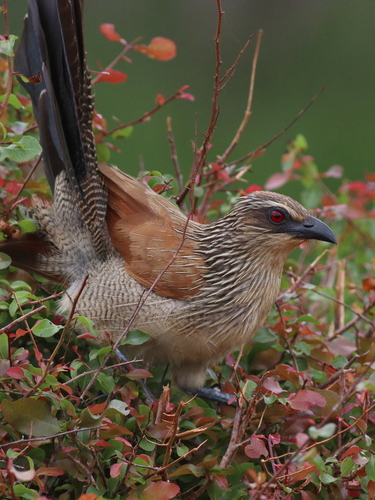 White-browed/Burchell's Coucal
In breve
The most reliable field mark between Blue-headed Coucal and White-browed Coucal is the presence of a bold white supercilium (eyebrow) in White-browed Coucal, which is absent in Blue-headed Coucal. Juvenile birds of both species can be confusing, but Blue-headed Coucal juveniles have a streaked rufous-buff head and more extensive dark barring on the wings and back, while White-browed Coucal juveniles show a faint buff supercilium and barred upperparts. Adults of Blue-headed Coucal have a glossy blue-black head and back, contrasting with the rufous-brown back and blackish crown of White-browed Coucal. Both species share similar structure and habitat preferences, but subtle differences in plumage and head pattern are key for separation.
Consigli di identificazione
- White supercilium (eyebrow): Only White-browed Coucal shows a bold white supercilium in adults; Blue-headed Coucal lacks this mark at all ages. In juveniles, White-browed Coucal has a faint buff supercilium, while Blue-headed Coucal never shows a pale eyebrow.
- Head and back color (adults): Blue-headed Coucal adults have a glossy blue-black head and back, which contrasts with the blackish crown and rufous-brown back of White-browed Coucal. Look for the color break between crown and back.
- Juvenile head pattern: Juvenile Blue-headed Coucal has a rufous-buff streaked head and dull blackish upperparts with heavy barring; White-browed Coucal juvenile has rufous streaking only on the crown, a faint buff supercilium, and overall paler barred upperparts.
- Wing pattern (juveniles): Blue-headed Coucal juveniles have dark chestnut wings heavily barred with dark brown, while White-browed Coucal juveniles have more evenly barred upperparts and wings, but less contrasty than Blue-headed.
- Tail tip: Adult White-browed Coucal has a white tip to the black tail, which Blue-headed Coucal lacks (tail is black with green/bronze gloss, no white tip).
- Underparts: Both species have pale underparts, but Blue-headed Coucal's are white or pale buff, while White-browed Coucal's are creamy-white; this is subtle and not always reliable.
- Size: Blue-headed Coucal is slightly larger (up to 52 cm) than White-browed (up to 42 cm), but size overlap is considerable and not a strong field mark unless both are seen together.
- Habitat context: If seen in a wetland or swamp, Blue-headed Coucal is more likely; in dry scrub or coastal thickets, White-browed Coucal is more probable, but both can occur in dense vegetation.
- Gloss on plumage: Blue-headed Coucal adults show a blue gloss on head/back and green/bronze gloss on tail; White-browed Coucal has a green gloss on the tail but not on the head/back.
- Crown color: White-browed Coucal's crown is blackish, but not as glossy or blue-toned as Blue-headed Coucal.
- Back color: White-browed Coucal has a rufous-brown back, contrasting with the black back of Blue-headed Coucal.
- Wing color (adults): Both have chestnut wings, but Blue-headed Coucal's are described as deep chestnut; this is subtle and best used in combination with other marks.
- Eye color: Both have red or dark red eyes as adults; this is not a separating feature.
- Leg and bill color: Both have black or greyish-black legs and black bills; not useful for separation.
- Sexes: Both species are sexually monomorphic; all field marks apply to both sexes.
Taglia
Both species are medium-sized coucals, but Blue-headed Coucal is slightly larger, reaching 45–52 cm in length compared to White-browed Coucal's 36–42 cm. Only White-browed Coucal has a documented average mass (170 g), but overall size difference is subtle and may not be obvious in the field unless both species are seen together. Structure is otherwise similar, with no strong differences in bill shape or tail length noted in the sources.
Piumaggio
- Juveniles: Blue-headed Coucal juveniles have a head streaked with rufous-buff, dull blackish upperparts with heavy barring (especially on wings and back), and black-spotted throat and breast. White-browed Coucal juveniles show rufous streaking on the crown, a faint buff supercilium, barred upperparts, and darker underparts. The presence or absence of a pale eyebrow is key in young birds.
- Adults: Blue-headed Coucal adults have a glossy blue-black head, neck sides, and back, with deep chestnut wings and a black, green- or bronze-glossed tail. Underparts are white or pale buff. White-browed Coucal adults have a blackish crown and nape, a prominent white supercilium, rufous-brown back, chestnut wings, blackish rump, and a black tail with a green gloss and a white tip. Underparts are creamy-white. The white supercilium and rufous-brown back are the best adult field marks for White-browed Coucal.
Comportamento
Both species are skulking, ground- or low-vegetation dwellers, often seen moving through dense cover or perching low. No behavioral differences are highlighted in the sources that reliably separate them in the field.
Habitat
Blue-headed Coucal prefers wetter habitats such as swamps, riverbanks, and forest edges, generally sticking to wet locations in tropical central Africa. White-browed Coucal is more broadly distributed in sub-Saharan Africa and favors thick cover in rank undergrowth and scrub, including coastal regions. While both can occur in dense vegetation, Blue-headed Coucal is more tied to wetland habitats, whereas White-browed Coucal can be found in drier scrub as well.
Blue-headed Coucal · White-browed/Burchell's Coucal · I miei uccelli difficili