

American Crow vs Allodola golagialla
Corvus brachyrhynchos contro Eremophila alpestris
Fai un quiz con American Crow e Allodola golagialla
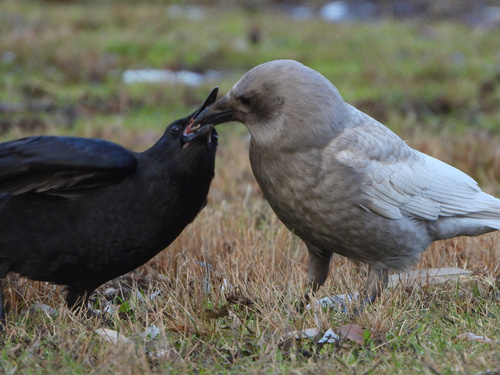 American Crow
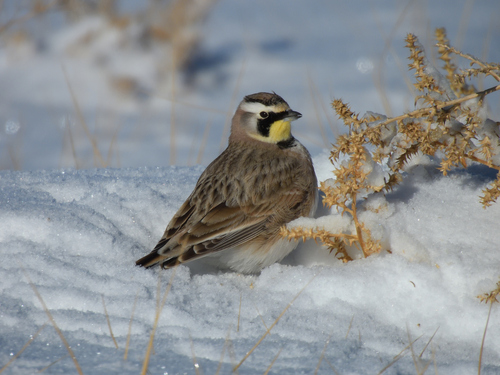 Allodola golagialla
In breve
The most reliable way to separate American Crow from Shore Lark (Horned Lark) is by overall structure and plumage: crows are large, all-black birds with heavy bills and no pale or patterned areas, while Shore Larks are much smaller, with a striking black-and-yellow (or black-and-white in some races) face pattern, pale underparts, and a contrasting black tail in flight. Juvenile or immature-specific upperwing patterns are not described for either species, so focus on size, bill, and plumage. In flight, American Crows show uniformly black wings and tail, while Shore Larks reveal a dark tail contrasting with paler body and wings. Their calls and typical habitats are also completely different, with crows giving harsh caws and larks producing high, tinkling songs, often in open ground. Even at a distance, the crow's bulk and uniform darkness are distinctive compared to the lark's delicate build and patterned face.
Consigli di identificazione
- Size is the first clue: American Crow is much larger than Shore Lark, with a bulkier body and heavier bill. If the bird looks crow-sized, it's not a lark.
- Uniform black plumage (crow) vs. patterned and pale (lark): Crows are all black, including wings, tail, legs, and bill. Shore Larks are brown-grey above, pale below, with a striking face pattern.
- Face pattern: Shore Lark has a black-and-yellow (or black-and-white) face with a mask and, in males, small black 'horns' in summer. American Crow's face is plain black with no pattern or tufts.
- Tail in flight: Shore Lark shows a mostly black tail with paler central feathers, contrasting with the rest of the body. Crow's tail is uniformly black and proportionally longer, making up about 40% of its body length.
- Bill shape: Crow has a thick, strong, all-black bill. Shore Lark has a much finer, pointed bill suited to picking seeds and insects.
- Legs and feet: Crow's legs are thick and strong, suited for walking and perching. Lark's legs are finer, and it is almost always seen on the ground.
- Perched vs. ground: Crows perch in trees or on structures; larks are almost always on the ground, rarely perching above knee height.
- Flight style: Crows have steady, direct flight with regular flapping. Larks have undulating, fluttery flight and may perform display dives.
- Vocalizations: Crow calls are harsh 'caaw' notes; lark calls are high-pitched, tinkling, and weak. Listen for these differences if the bird is vocalizing.
- Habitat context: Crows are found in almost any habitat except tundra; larks prefer open, bare ground, fields, or shorelines.
- Group size and behavior: Crows are often in family groups or larger flocks, especially outside breeding season. Larks are usually solitary or in small flocks.
- Seasonal variation: Shore Lark males show black 'horns' in summer; crows show no seasonal plumage change.
- Juvenile confusion: No distinctive juvenile or immature upperwing patterns are noted for either species, so focus on structure and plumage.
- Mistaking a distant lark for a small crow: At distance, a lark may appear dark and small, but the patterned face and pale underparts should be visible with binoculars.
- Mistaking a crow for a large, dark lark: The sheer size, uniform blackness, and heavy bill of the crow are diagnostic, even if seen briefly or in poor light.
Taglia
American Crow is dramatically larger: 40–53 cm (16–21 in) in length, with a wingspan of 85–100 cm (33–39 in) and weighing 316–620 g. In contrast, Shore Lark is only 16–20 cm (6.3–7.9 in) long, with a wingspan of 30–34 cm (11.8–13.4 in) and a weight of 28–48 g. The crow is more than twice as long and many times heavier than the lark, with a much more robust bill and body. Even at a distance, the crow's size and proportions are obvious when compared to the much smaller, sparrow-like lark.
Piumaggio
No age-specific upperwing or flight pattern marks are described for either species, so focus on adult and general plumage. American Crow is entirely black and glossy, with no pale or patterned areas at any age or season. Shore Lark is brown-grey above and pale below, with a striking black-and-yellow (or black-and-white in some races) face pattern, and a mostly black tail except for the central feathers. This tail contrast is especially noticeable in flight. Summer males have small black 'horns' (tufts) on the head. The lark's overall coloration is much paler and more patterned than the crow's uniform blackness.
Comportamento
American Crows are social, often seen in family groups or larger flocks, walking with a purposeful gait and sometimes thrusting their heads as they call. They rarely soar for long periods, usually flapping steadily. Shore Larks are more delicate, often found singly or in small flocks on open ground, feeding on seeds and insects. Their flight is undulating and they frequently sing in flight, sometimes performing display dives. Crows perch in trees or on structures, while larks are almost always on the ground.
Habitat
American Crows are habitat generalists, found in a wide variety of environments including woodlands, fields, urban areas, and agricultural land, but rarely in tundra. Shore Larks are birds of open ground: bare fields, shorelines, tundra, and grasslands, rarely in wooded or urban areas. If you see a bird in a tree or urban park, it's much more likely a crow; a small bird on bare ground or a windswept field is more likely a lark.
Voce
American Crow gives a loud, short, rapid 'caaw-caaw-caaw', often while thrusting its head. Their calls are harsh and varied, sometimes mimicking other animals. Shore Lark has high-pitched, lisping or tinkling calls, and its song is a weak, ascending trill often delivered in flight. The vocalizations are so different that confusion is unlikely if the bird is heard well.
American Crow · Allodola golagialla · I miei uccelli difficili