
Cisticole des joncs vs Hypolaïs bottée
Cisticola juncidis contre Iduna caligata
Faire un quiz avec Cisticole des joncs et Hypolaïs bottée
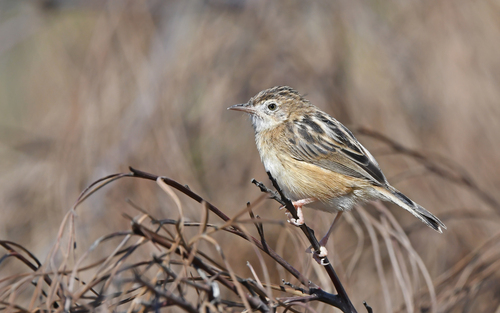 Cisticole des joncs
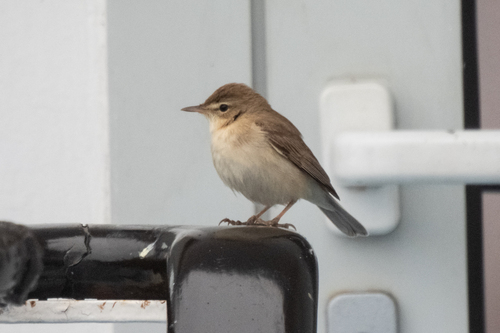 Hypolaïs bottée
En bref
The most reliable field mark to separate Zitting Cisticola from Booted Warbler is the cisticola's distinctive rufous rump and white-tipped tail, especially obvious in flight, versus the booted warbler's plain grey-brown upperparts and square-tipped tail. Zitting Cisticola also lacks any gold or warm tones on the collar, while Booted Warbler shows a clear pale supercilium and a generally more uniform, washed-out appearance. Structurally, Zitting Cisticola is a compact, short-tailed grassland bird, while Booted Warbler is longer-bodied, pot-bellied, and often appears short-winged with a squarer tail. Vocalizations and habitat can help: Zitting Cisticola gives a regular 'zit' call, often during its zigzagging display flight over grassland, while Booted Warbler is quieter and favors shrubby or reedy edges.
Conseils d’identification
- Rufous rump and white-tipped tail (all ages): Zitting Cisticola always shows a rufous rump and brownish tail with white tips, especially obvious in flight or when the tail is fanned. Booted Warbler lacks these features entirely.
- Tail shape: Zitting Cisticola has a rounded, often fanned tail; Booted Warbler's tail is square-tipped and usually held closed.
- Supercilium: Booted Warbler shows a clear, pale supercilium (eyebrow), while Zitting Cisticola does not have a strong supercilium.
- Upperpart color: Zitting Cisticola is warmer and more streaked above, while Booted Warbler is plain greyish-brown and uniform.
- Collar color: Zitting Cisticola lacks any gold or warm collar tones; Booted Warbler may show a slightly warmer tone but is generally washed-out.
- Bill: Booted Warbler has a short bill with a dark tip; Zitting Cisticola's bill is less contrasting and not as short.
- Jizz/structure: Zitting Cisticola is compact, short-tailed, and rounded; Booted Warbler is pot-bellied, longer-bodied, and appears short-winged with a squarer tail.
- Flight behavior: Zitting Cisticola performs zigzagging display flights with regular 'zit' calls; Booted Warbler rarely displays in flight and is more methodical.
- Perched behavior: Zitting Cisticola is restless, flicking its tail; Booted Warbler is calmer and moves more deliberately.
- Habitat: Zitting Cisticola is found in open grassland; Booted Warbler prefers shrubby or reedy edges, often near water.
- Vocalization: Listen for the cisticola's regular 'zit' calls, especially in display flight; Booted Warbler is much quieter.
- Seasonal context: In Western Europe, Booted Warbler is a rare vagrant, while Zitting Cisticola is a resident or regular breeder in suitable grassland.
- Pitfall – plain plumage: Both can look plain and brownish at a distance; focus on rump color, tail shape, and supercilium for reliable separation.
- Pitfall – size impression: Both are small, but Booted Warbler can look slightly larger and longer-bodied; use structure in combination with plumage.
- Age/sex: No strong age- or sex-specific marks are described, but the rump and tail pattern of Zitting Cisticola are reliable at all ages.
Taille
Both species are small warblers, but Booted Warbler is similar in size to a Common Chiffchaff and tends to look longer and slightly larger than Zitting Cisticola, which is notably compact and short-tailed. Zitting Cisticola's proportions are more rounded and stubby, while Booted Warbler appears pot-bellied with a longer, squarer tail. No precise measurements are provided, but structure and jizz are helpful for size impression.
Plumage
Juvenile and immature plumages are not described in detail for either species, but key contrasts apply to all ages: Zitting Cisticola of any age shows a rufous rump and brownish tail with white tips, especially obvious in flight. Booted Warbler, by contrast, is plain greyish-brown above and pale below, lacking any rufous or white in the tail. Booted Warbler has a clear pale supercilium, while Zitting Cisticola does not. Zitting Cisticola lacks gold or warm tones on the collar, and its upperparts are more streaked and warm-toned compared to the Booted Warbler's uniform, washed-out look. In perched birds, the cisticola's tail is often fanned, showing the white tips, while Booted Warbler's tail is square-tipped and less likely to be fanned.
Comportement
Zitting Cisticola is highly active in grassland, often seen performing a zigzagging display flight accompanied by its distinctive 'zit' call. It perches low in grasses and is restless, frequently flicking its tail. Booted Warbler is more sedate, typically found in shrubby or reedy edges, moving methodically through vegetation and rarely displaying in flight. Its movements are less erratic and more deliberate than the cisticola's.
Habitat
Zitting Cisticola is a specialist of open grasslands and grassy fields, rarely venturing into shrubby or wooded areas. Booted Warbler, on the other hand, prefers shrubby edges, reedbeds, and areas with scattered bushes, often near water. Habitat choice can be a strong clue: a small warbler in open grassland is more likely a cisticola, while one in a bushy or reedy margin is more likely a booted warbler.
Voix
Zitting Cisticola is very vocal, especially during the breeding season, giving a regular, mechanical 'zit – zit – zit' call, often in flight. This call is diagnostic and gives the species its English name. Booted Warbler is quieter and does not give a similar display call; its vocalizations are less distinctive and not described in detail here.
Cisticole des joncs · Hypolaïs bottée · Mes oiseaux difficiles