

Dendrocygne veuf vs Canard de Chiloé
Dendrocygna viduata contre Mareca sibilatrix
Faire un quiz avec Dendrocygne veuf et Canard de Chiloé
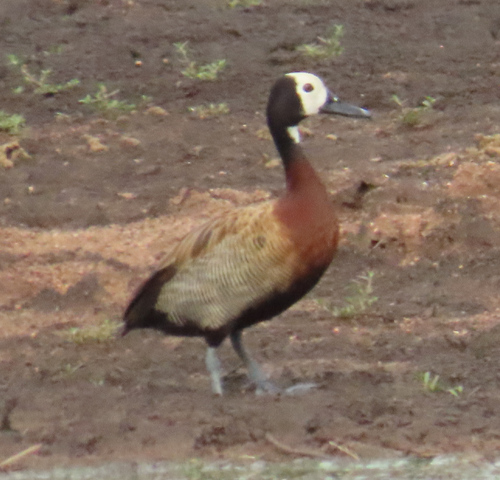 Dendrocygne veuf
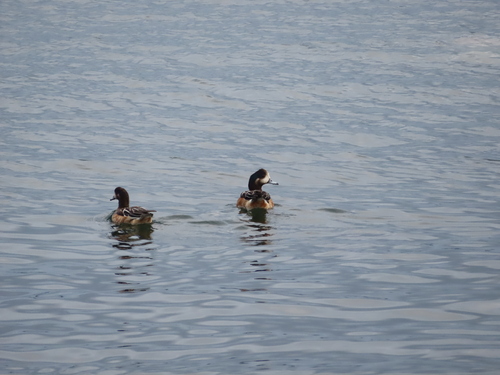 Canard de Chiloé
En bref
The most reliable field mark is the head pattern: White-faced Whistling-Duck shows a striking white face with a black head and neck, while Chiloe Wigeon has a white face but with a distinctive iridescent green-blue cap and a white auricular patch, plus a black neck and occiput. In flight or at rest, the whistling-duck is more uniformly dark with chestnut and barred flanks, whereas the wigeon is paler-bodied with a barred breast and, on males, rusty flanks. Juveniles of both are duller, but the whistling-duck's young lack the strong head contrast. Structure and posture also differ: the whistling-duck is long-necked and long-legged, often upright, while the wigeon is more compact and dabbling-duck-like. Both can be gregarious, but their habitat preferences and flocking behavior differ.
Conseils d’identification
- Head pattern is key: Adult White-faced Whistling-Duck shows a clean white face and throat with a black crown and neck; Chiloe Wigeon has a white face but with a green-blue iridescent cap, black neck/occiput, and a white auricular patch. This contrast is visible at all ages but is strongest in adults.
- Juvenile confusion: Juvenile whistling-ducks have a duller, less contrasted head, which can look more like a wigeon's white face. Look for the absence of the wigeon's green-blue crown and the whistling-duck's overall darker, chestnut neck sides.
- Neck and posture: Whistling-ducks are long-necked, long-legged, and often stand upright, especially when alert. Wigeons are shorter-necked, with a more horizontal, dabbling-duck posture.
- Bill color and shape: Whistling-ducks have a long, grey bill; Chiloe Wigeon has a bluish-grey bill with a black tip, which may be visible at close range.
- Body and wing color: Whistling-ducks are darker overall, with blackish back/wings and fine white barring on the flanks. Wigeons are paler, with a barred black-and-white breast and gray/white wings. Male wigeons have rusty flanks; females and juveniles have lighter brown flanks.
- Underparts: Whistling-ducks have black underparts with fine white barring on the flanks; wigeons have a barred breast and paler belly.
- Flight silhouette: Whistling-ducks show long necks and legs trailing in flight, giving a distinctive shape. Wigeons have a shorter neck and tail, with a more compact, typical duck profile.
- Leg color: Whistling-ducks have longish legs (color not specified); wigeons have gray legs and feet.
- Flock size and behavior: Large, dense flocks (hundreds to thousands) arriving at dawn suggest whistling-duck. Wigeons are social but less likely to form such massive groups.
- Habitat context: Whistling-ducks are more likely in tropical/subtropical open wetlands, often standing or walking in shallow water. Wigeons prefer temperate South American lakes and marshes, feeding by dabbling or grazing.
- Vocalizations: A clear, three-note whistle from a flock is diagnostic for whistling-duck. Wigeons are generally quieter.
- Sex differences: Both species have subtle sexual dimorphism. In wigeon, males are slightly brighter with more iridescence and rustier flanks, but this is not always obvious in the field.
- Geographic range: If seen in Africa, only White-faced Whistling-Duck is possible. In southern South America, both may occur, but wigeon is more likely in temperate southern regions.
- Confusion risk: Juvenile whistling-ducks and female/immature wigeons are the most likely to be confused due to duller head patterns. Focus on structure and posture in these cases.
- When in doubt: Use a combination of head pattern, neck length, posture, and flocking behavior for the most reliable separation, especially at distance or in poor light.
Taille
White-faced Whistling-Duck averages 674 g in body mass [wikidata], while Chiloe Wigeon is heavier at about 800 g [wikipedia]. The wigeon is also longer (46–56 cm) and has a broader wingspan (75–86 cm) compared to the whistling-duck (no length given, but generally more slender and upright). In the field, the whistling-duck appears slimmer, with a proportionally longer neck and legs, while the wigeon is stockier and more compact, typical of dabbling ducks.
Plumage
Juvenile White-faced Whistling-Ducks resemble adults but with a less contrasted head pattern, making the white face less obvious and potentially confusing with the wigeon's white cheeks. Adult whistling-ducks show a bold white face, black head and neck, chestnut neck sides, dark brown to black back and wings, and black underparts with fine white barring on the flanks. Chiloe Wigeon adults have a white forehead and cheeks, a glossy green-blue cap, black neck and occiput, barred black-and-white breast, gray and white wings, and rusty (male) or light brown (female) flanks. Juvenile wigeons lack the strong rust on the flanks and have a duller overall appearance, but still show the white face and dark cap. In all ages, the wigeon’s face pattern is more patchy (white cheeks, auricular patch, green-blue crown) compared to the whistling-duck’s clean white face and throat.
Comportement
White-faced Whistling-Ducks are highly gregarious, forming large flocks (sometimes thousands) and often seen standing upright with necks extended. They are noisy and active, frequently arriving at favored sites at dawn. Chiloe Wigeons are also social but less likely to form such massive flocks; they behave like typical dabbling ducks, swimming low in the water, grazing, and showing less upright posture. The wigeon’s feeding is more dabbling and grazing, while the whistling-duck is more likely to be seen standing or walking in shallow water or on the shore.
Habitat
White-faced Whistling-Ducks are found in sub-Saharan Africa and much of South America, favoring open wetlands and lakes, often in very large flocks. Chiloe Wigeon is restricted to southern South America, breeding in Argentina, Uruguay, Chile, and the Falklands, and wintering in southeastern Brazil. Wigeons prefer freshwater lakes, marshes, shallow lagoons, and slow rivers. While both occur on freshwater, the whistling-duck is more likely in tropical or subtropical open wetlands and may be seen in larger, denser flocks.
Voix
White-faced Whistling-Duck is very vocal, producing a clear three-note whistling call, often heard from flocks. Chiloe Wigeon’s vocalizations are not described in the notes, but wigeons generally have softer, more subdued calls compared to the piercing whistles of Dendrocygna. If you hear a loud, repeated whistling, the whistling-duck is more likely.
Dendrocygne veuf · Canard de Chiloé · Mes oiseaux difficiles