

Gorfou sauteur vs Gorfou des Snares
Eudyptes chrysocome contre Eudyptes robustus
Faire un quiz avec Gorfou sauteur et Gorfou des Snares
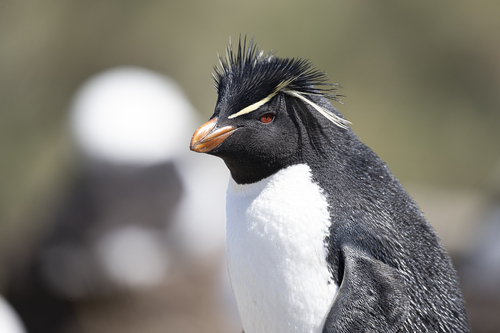 Gorfou sauteur
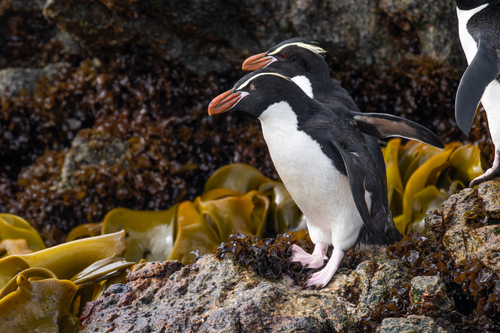 Gorfou des Snares
En bref
The most reliable way to separate Southern Rockhopper Penguin from Snares Penguin in the field is by location: Southern Rockhopper is found around southern South America and nearby subantarctic islands, while Snares Penguin is restricted to the Snares Islands south of New Zealand. Structurally, Snares Penguin is distinctly heavier and larger, with a thicker reddish-brown bill and a patch of pink skin at the base of the bill, which Southern Rockhopper lacks. Both have striking yellow crests, but the Snares Penguin's crest starts at the bill base and is more prominent. In direct observation, focus on bill color and face pattern, as plumage and behavior are otherwise quite similar.
Conseils d’identification
- Location is key: Southern Rockhopper Penguin is found in South America and nearby subantarctic islands; Snares Penguin is only on the Snares Islands, New Zealand region. If you know your location, this is the most reliable separator.
- Bill color and base: Snares Penguin has a thick reddish-brown bill with a distinct patch of pink skin at the base; Southern Rockhopper's bill is less robust and lacks the pink skin patch. This is visible at close range and in good light.
- Crest shape and origin: Both have yellow crests, but Snares Penguin's crest is bushier and starts at the bill base, running above the eye to the back of the head. Southern Rockhopper's crest is shorter and does not originate as far forward.
- Size and build: Snares Penguin is bulkier and heavier, with a more robust appearance and thicker neck. Southern Rockhopper is slightly smaller and more compact.
- Face pattern: Look for the pink skin at the base of the bill in Snares Penguin; this is absent in Southern Rockhopper.
- Underwing pattern: Not useful for separation; Snares Penguin shows individual variation, and no diagnostic marks are noted for either species.
- Eye color: Both have red-brown eyes, but this is variable and not a reliable field mark.
- Behavior: Both species hop among rocks; this is not a separator between them.
- Vocalizations: Both are noisy at colonies, with braying and trumpeting calls; no field-separable differences are described.
- Juvenile/immature plumage: No distinctive age-specific upperwing or flight marks are documented for either species, so immature birds are best separated by location and bill/face pattern.
- Habitat context: Both breed in dense colonies on rocky coasts, but only Snares Penguin is found on the Snares Islands.
- Pitfalls: Do not rely on general crest color or hopping behavior alone, as these are shared by all Eudyptes penguins. Bill structure and face pattern are more reliable at close range.
- Sex/season: No seasonal or sex-based plumage differences are noted that would aid separation.
- When in doubt: Use a combination of location, bill/face details, and overall size/structure for the most reliable identification.
Taille
Snares Penguin is substantially heavier and larger than Southern Rockhopper Penguin. Snares Penguin adults weigh 2.5–4 kg (notes) but the Wikidata value (323.5g) is likely erroneous; field sources and Wikipedia confirm the higher range. Southern Rockhopper Penguin averages about 2.5 kg (2470g). Snares Penguin is also longer (50–70 cm vs. Rockhopper's slightly smaller size, though exact length for Rockhopper is not specified here). In the field, Snares Penguin appears bulkier and more robust, with a thicker neck and heavier build.
Plumage
No age-specific upperwing or flight pattern differences are documented between these two species; both have the typical Eudyptes black upperparts and white underparts, with no mention of distinctive juvenile wing markings. Both species show a black head, back, and flippers, and a white belly. The most useful plumage distinction is the facial detail: Snares Penguin has a thick reddish-brown bill with a noticeable patch of pink skin at the base, and its yellow crest starts at the bill base and runs above the eye to the back of the head. Southern Rockhopper Penguin's crest is also yellow but may appear shorter and less bushy, and lacks the pink skin at the bill base. Underwing pattern is variable in Snares Penguin and not useful for separation. Both species have red-brown eyes, though this can be subtle and variable.
Comportement
Both species are agile among rocks and are known for hopping rather than sliding or waddling over obstacles, a trait typical of crested Eudyptes penguins. Southern Rockhopper Penguin is especially noted for this behavior, but Snares Penguin also displays it. Foraging behavior is complex in both, with a mix of pelagic and benthic dives, but these are not field-separable. Courtship and nest-building behaviors are broadly similar, with both species forming monogamous pairs and engaging in vocal and physical displays.
Habitat
Habitat is the strongest field clue: Southern Rockhopper Penguin is found on subantarctic islands off southern South America and nearby waters, while Snares Penguin is endemic to the Snares Islands near New Zealand. If you are on the Snares Islands, you are seeing Snares Penguin; if you are in the Falklands, Tierra del Fuego, or similar South American subantarctic islands, it is Southern Rockhopper. Both breed in dense colonies on rocky coasts, but their ranges do not overlap.
Voix
Both species are highly vocal, producing a range of braying, trumpeting, and hissing calls, especially at colonies. Snares Penguin is noted for a variety of explosive cries and rhythmical braying, but the notes do not provide a clear difference in vocalizations that would be diagnostic in the field.