

Engoulevent à queue en ciseaux vs Engoulevent ocellé
Hydropsalis torquata contre Nyctiphrynus ocellatus
Faire un quiz avec Engoulevent à queue en ciseaux et Engoulevent ocellé
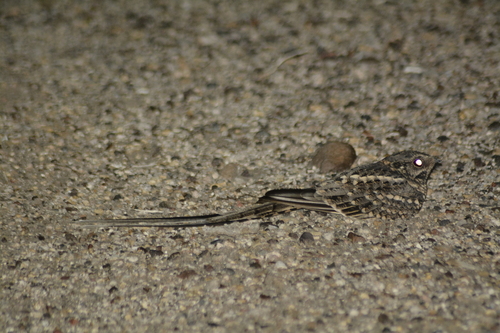 Engoulevent à queue en ciseaux
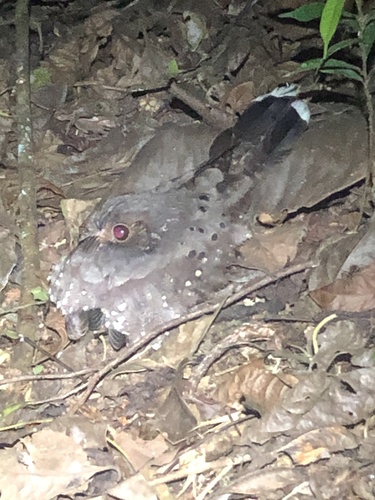 Engoulevent ocellé
En bref
The most reliable field mark is the male Scissor-tailed Nightjar’s spectacularly long outer tail feathers, which can be more than twice the body length—no other nightjar in the region, including Ocellated Poorwill, shows anything remotely similar. If the tail is not visible or the bird is a female or immature, focus on the throat and tail tip pattern: Ocellated Poorwill of all ages shows a bold white throat band and small white tail tips, while Scissor-tailed Nightjar has a broad tawny hindneck collar and, in males, broad white tips only on the very long outer tail feathers. In flight or at rest, the overall structure is also a strong clue: Scissor-tailed Nightjar is larger and more elongated, while Ocellated Poorwill is compact. Both species are nightjars, but their size, tail structure, and key plumage marks make confusion unlikely with a good view.
Conseils d’identification
- Male Scissor-tailed Nightjar’s tail streamers: If you see a nightjar with outer tail feathers more than twice the body length, it is a male Scissor-tailed Nightjar—no other nightjar in the region, including Ocellated Poorwill, shows this feature. This is diagnostic for adult males in breeding plumage.
- Tail length and shape (all ages/sexes): Even female Scissor-tailed Nightjars have slightly longer outer tail feathers than inner ones, but never as short and even as Ocellated Poorwill. Ocellated Poorwill always has a short, squared tail with only the outer three or four feathers showing narrow white tips.
- White in tail (sex/age specific): Male Scissor-tailed Nightjar has broad white tips on the very long outer tail feathers; females lack white in the tail. Ocellated Poorwill (both sexes) has narrow white tips on the outer three or four tail feathers, never broad or on all feathers.
- Throat pattern: Ocellated Poorwill always shows a bold, crisp white throat band (all ages, both morphs). Scissor-tailed Nightjar never shows a white throat band; instead, look for a broad tawny collar on the hindneck and a buff or whitish throat with brown spots or bars.
- Upperparts and collar: Scissor-tailed Nightjar has brown upperparts with grayish-white speckles, blackish streaks, and tawny spots, plus a broad tawny hindneck collar. Ocellated Poorwill is more uniformly dark grayish brown (brown morph) or reddish brown (rufous morph), lacking the tawny collar.
- Belly and breast: Scissor-tailed Nightjar’s underparts are buff with narrow (breast) and wide (belly/flanks) brown bars. Ocellated Poorwill has white spots on the belly, which can look like 'ocelli' or eyespots.
- Wing pattern: Neither species has a white wing band, but Scissor-tailed Nightjar’s wings are brown with tawny/buff streaks and spots, while Ocellated Poorwill’s wings are darker with blackish brown spots.
- Structure and jizz: Scissor-tailed Nightjar is large, elongated, and long-tailed (especially the male), with a more stretched appearance in flight or at rest. Ocellated Poorwill is compact, short-tailed, and small.
- Size: If you have a good sense of scale, Scissor-tailed Nightjar is much larger and heavier than Ocellated Poorwill. Use this only with direct comparison or known objects nearby.
- Sex differences: Only male Scissor-tailed Nightjar has the extremely long tail streamers and broad white tail tips; females are tawnier and lack white in the tail but are still larger and longer-tailed than Ocellated Poorwill. Ocellated Poorwill shows little sexual dimorphism in field marks.
- Color morphs (Ocellated Poorwill): If you see a reddish-brown nightjar with a white throat band and small white tail tips, it is a rufous morph Ocellated Poorwill. Scissor-tailed Nightjar is never rufous overall and never has a white throat band.
- Habitat context: Scissor-tailed Nightjar is more likely in open, scrubby, or grassy areas, sometimes near roads or urban parks. Ocellated Poorwill is more often in forested or denser habitats, but overlap is possible—do not rely solely on habitat.
- Behavior: If you observe a wing-clapping display or a bird sallying from a low perch in open country, consider Scissor-tailed Nightjar, especially if a long tail is visible. Ocellated Poorwill is less likely to display openly.
- Voice: If you hear a prolonged sequence of 'tsips' at dusk or dawn, it may indicate Scissor-tailed Nightjar, but Ocellated Poorwill’s voice is not described here—use with caution.
- Pitfalls: Female and immature Scissor-tailed Nightjars can be confused with Ocellated Poorwill if the tail is not visible; focus on size, structure, throat pattern (white band vs tawny collar), and belly markings to separate.
Taille
Scissor-tailed Nightjar is substantially larger, with males (excluding the tail streamers) measuring 25–30 cm and weighing 47.5–63 g, and females similar in length and 48–60 g. Including the male’s tail streamers, total length can reach up to 66 cm. Ocellated Poorwill is much smaller and lighter: 20–21 cm long, with males 35–43 g and females 29–44 g. The Nightjar’s size and especially the male’s tail length are immediately striking in the field; Ocellated Poorwill appears small and compact by comparison.
Plumage
- Juvenile/immature/first-winter birds: No age-specific upperwing or flight pattern marks are described for either species; separation relies on tail and throat pattern, overall color, and structure at all ages.
- Adult males: Scissor-tailed Nightjar males have extremely long, brown outer tail feathers with broad white tips; upperparts are brown with grayish-white speckles, blackish streaks, and tawny spots, plus a broad tawny collar on the hindneck. The wings are brown with tawny or buff streaks and spots, lacking a white wing band. The chin is buffy, throat buff or whitish with brown spots or bars, breast buff with narrow brown bars, and belly/flanks buff with wide brown bars. Ocellated Poorwill males (brown morph) are dark grayish brown with blackish brown spots on the wings, white spots on the belly, a bold white throat band, and narrow white tips on the outer three or four tail feathers. The rufous morph is paler and reddish brown. No long tail streamers.
- Adult females: Female Scissor-tailed Nightjars lack the long tail streamers and white in the tail, and are tawnier overall. Female Ocellated Poorwills are similar to males, with the same throat and tail tip pattern.
- Key contrasts: Only Scissor-tailed Nightjar males have extremely long outer tail feathers with broad white tips; Ocellated Poorwill never shows this. Ocellated Poorwill always shows a bold white throat band and small white tail tips (on outer feathers), regardless of age or sex. Scissor-tailed Nightjar shows a broad tawny hindneck collar, never a white throat band.
Comportement
Both species are nocturnal and forage by sallying from the ground or a perch. Scissor-tailed Nightjar males perform a wing-clapping display during breeding. Scissor-tailed Nightjar is often seen along roads and open areas, sometimes perching on the ground or low perches. Ocellated Poorwill’s behavior is less described in the notes, but as a typical poorwill, it is likely to be more secretive and less conspicuous in open areas compared to the nightjar. Neither species has a unique behavioral trait that is diagnostic in the field beyond the male nightjar’s display and tail.
Habitat
Scissor-tailed Nightjar prefers open and semi-open landscapes: second growth, arid scrub, grasslands, acacia groves, pastures, and even urban parks—often seen along roads, especially near sugar cane fields. Ocellated Poorwill is found in a broader range of forested habitats across Central and South America, but the notes do not specify habitat differences that are diagnostic in the field. Both can occur in overlapping regions in South America, so habitat alone is not a safe separator.
Voix
Scissor-tailed Nightjar’s song is a prolonged sequence of 'tsips' given at dusk and dawn from a perch or in flight, sometimes lasting minutes. It also gives an extremely high 'tsig' flight call and a low clucking sound. Ocellated Poorwill’s vocalizations are not described in the provided notes, so voice is not a reliable separator based on this information.
Engoulevent à queue en ciseaux · Engoulevent ocellé · Mes oiseaux difficiles