

Ermite tacheté vs Ermite à queue blanche
Ramphodon naevius contre Threnetes leucurus
Faire un quiz avec Ermite tacheté et Ermite à queue blanche
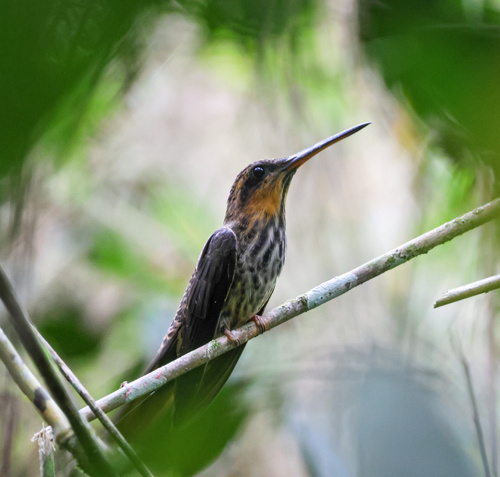 Ermite tacheté
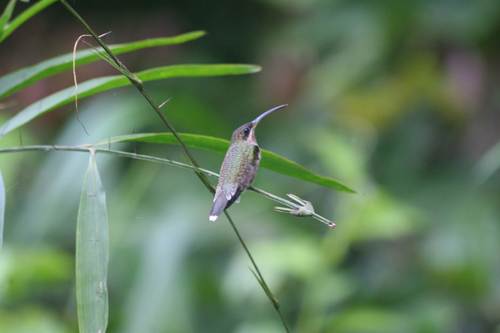 Ermite à queue blanche
En bref
The most reliable field mark between Saw-billed Hermit and Pale-tailed Barbthroat is the unique bill structure: Saw-billed Hermit has a long, decurved bill with saw-like serrations (and a hooked tip in males), while Pale-tailed Barbthroat's bill is nearly straight (slightly decurved in females) and lacks serrations. Both are medium-to-large hermits, but Saw-billed Hermit is larger and heavier, with scaly brown upperparts and bold striping below, versus the Barbthroat's bronze-green upperparts and less contrasting, grayish-ochre underparts. Tail pattern also differs: Saw-billed Hermit has a purplish-black tail above with buff on the underside outer feathers, while Barbthroat's tail is dark with variable pale on the outer feathers, depending on subspecies. Both species share a general hermit jizz, but bill shape and facial pattern are your best quick separators.
Conseils d’identification
- Bill shape and serration: Saw-billed Hermit has a long, decurved bill with obvious saw-like serrations on the mandible (visible at close range or in good photos), and the male's bill has a hooked tip. Pale-tailed Barbthroat's bill is nearly straight (slightly decurved in females) and smooth-edged. This is the single most diagnostic feature and works for all ages and sexes.
- Size and bulk: Saw-billed Hermit is larger and heavier than any Barbthroat—if the bird appears especially large for a hermit, favor Saw-billed. This is most reliable with direct comparison or experience.
- Facial pattern: Saw-billed Hermit shows a bold white supercilium and a strong dark eye-stripe, giving a 'striped face' look. Barbthroat has a pale malar stripe and a dark ear patch, but the face is less boldly patterned overall.
- Upperparts color: Saw-billed Hermit has scaly brown upperparts, while Barbthroat is bronze-green above. In poor light, Saw-billed may look duller and less green.
- Underparts pattern: Saw-billed Hermit has strongly striped (dark and pale) underparts, while Barbthroat's underparts are grayish with ochre tints and much less contrast, especially in females.
- Throat and breast: Saw-billed Hermit has a reddish ochre throat, often contrasting with the rest of the underparts. Barbthroat has a dark throat with a reddish patch below and a pale malar stripe, but the transition between throat, breast, and belly is less sharp, especially in females.
- Tail pattern: Saw-billed Hermit has a purplish-black tail above, with the underside of the outer feathers becoming increasingly buff toward the edges. Barbthroat's tail is dark with pale on the outer feathers, but the exact pattern varies by subspecies and is generally less striking than Saw-billed's buffy outer tail.
- Juvenile/immature marks: Barbthroat juveniles have ochraceous feather edges, which may give a warmer or scalloped look to the upperparts. Saw-billed Hermit juveniles are not described as differing from adults.
- Sex differences: Both species are sexually similar, but in Barbthroat, the female's bill is slightly more decurved and her throat/belly contrast is reduced. Saw-billed Hermit males have a more hooked bill tip.
- Behavioral context: If you see a hermit aggressively defending a feeding route, especially in the Atlantic Forest, Saw-billed Hermit is more likely. Barbthroat is not noted for this behavior.
- Habitat and range: Saw-billed Hermit is only found in the humid Atlantic Forest of southeast Brazil, below 500 m. Pale-tailed Barbthroat is Amazonian, in a wide range of humid lowland forests and plantations, and absent from the Atlantic Forest. If you are outside southeast Brazil, Saw-billed Hermit is ruled out.
- Vocalization: If you hear a very high, chattering twitter or rapid high 'bic' notes, suspect Saw-billed Hermit. Barbthroat's voice is not described here, so absence of these calls is not diagnostic.
- Trap-line defense: Saw-billed Hermit is notably aggressive for a hermit, defending its trap-line. Barbthroat is not described as doing this.
- Subspecies variation: Barbthroat shows some variation in tail and belly color by subspecies, but these are subtle and not as bold as Saw-billed Hermit's tail pattern.
- Potential pitfalls: In poor light, both can appear dull and brownish. Focus on bill shape and facial pattern first, then check for size and tail pattern if possible.
Taille
Saw-billed Hermit is notably larger: 14–16 cm long and 5.3–9 g, making it one of the heaviest hermits, with males heavier than females. Pale-tailed Barbthroat is smaller at 10–12.2 cm and 4–7 g (males), 4–6.5 g (females). In the field, Saw-billed Hermit will appear bulkier and longer-billed, especially when seen side-by-side or with experience of local hermit sizes. If the bird seems especially hefty for a hermit, Saw-billed is more likely.
Plumage
- Juvenile/immature plumage: Both species' young resemble adults, but Barbthroat juveniles have ochraceous feather edges, which may lend a slightly warmer or more scalloped look to the upperparts. Saw-billed Hermit juveniles are not described as differing much from adults in the sources.
- Adult plumage: Saw-billed Hermit shows scaly brown upperparts, a bold white supercilium, dark eye-stripe, reddish ochre throat, and strongly striped underparts (dark and pale). Its tail is purplish-black above, with increasing buff on the underside outer feathers. Pale-tailed Barbthroat has bronze-green upperparts and breast, a dark ear patch, a reddish patch below the throat, a pale malar stripe, and a grayish belly with ochre tints. Its tail is dark, with pale on the outer feathers (amount and shade vary by subspecies). Barbthroat's plumage is less contrasting overall, especially in females, where throat, breast, and belly blend more. Saw-billed Hermit is more boldly patterned and 'scaly' above, with a more dramatic face pattern.
Comportement
Both species are typical hermits in feeding style, using trap-line foraging to visit a circuit of flowers. However, Saw-billed Hermit is unusually aggressive for a trap-liner, defending its feeding route against other hummingbirds, while Barbthroat is not noted for this behavior. Saw-billed Hermit typically feeds within 6 m of the ground but can go as high as 15 m. Both species will also take small arthropods. In flight, both have the typical hermit jizz, but Saw-billed Hermit may appear heavier and longer-billed.
Habitat
Saw-billed Hermit is restricted to the humid coastal Atlantic Forest of southeastern Brazil, usually below 500 m elevation. Pale-tailed Barbthroat is widespread in the Amazon Basin, from the Andean foothills to the Atlantic, in a variety of humid lowland and tropical forest types, including gallery and swamp forests, and plantations, from sea level up to 1800 m depending on region. Thus, range and habitat are strong separators: Saw-billed Hermit is only in southeast Brazil's Atlantic Forest, while Barbthroat is Amazonian and absent from the Atlantic Forest.
Voix
Saw-billed Hermit's song is a very high, chattering twitter, with calls described as rapid, high 'bic' notes and descending 'seee' notes, often given during aggressive defense of feeding routes. No specific vocal description is provided for Pale-tailed Barbthroat in the notes, so vocalization is not a reliable separator unless the Saw-billed's distinctive twitter is heard.
Ermite tacheté · Ermite à queue blanche · Mes oiseaux difficiles