

Perdrix de Hey vs Perdrix choukar
Ammoperdix heyi contre Alectoris chukar
Faire un quiz avec Perdrix de Hey et Perdrix choukar
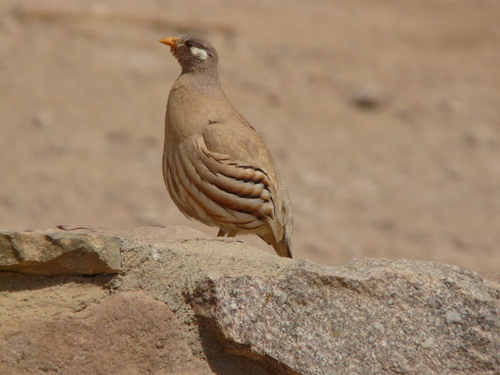 Perdrix de Hey
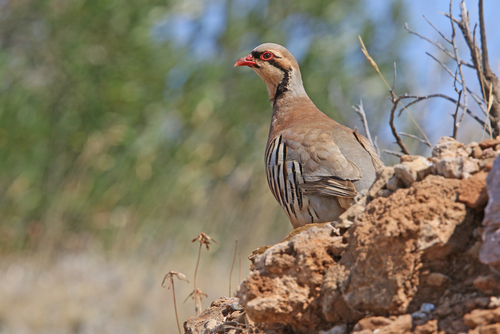 Perdrix choukar
En bref
The most reliable way to separate Sand Partridge from Chukar is by head and face pattern: Sand Partridge males have a plain grey head with a white cheek patch and a white stripe in front of the eye, lacking the bold black-and-white face and throat pattern of Chukar. Chukar shows a striking black band running from the forehead through the eye and down the neck, enclosing a white throat. In flight, both species are rotund and prefer to run, but Chukar is much larger and heavier. Females and immatures of Sand Partridge can be tricky, as their head pattern is weak, but Chukar’s extensive black gorget and rufous-barred flanks are still distinctive. Focus on face pattern and size for the most consistent separation.
Conseils d’identification
- Head Pattern (All Ages): Chukar shows a bold black band running from the forehead through the eye and down the neck, enclosing a white throat—this is the single most reliable mark. Sand Partridge males have a plain grey head with a white cheek patch and a white stripe in front of the eye, lacking any black band.
- Face and Neck (Females/Immatures): Sand Partridge females and juveniles have very weak head pattern and plain neck sides, with only faint pinkish bars. Chukar females and young still show a distinct black-and-white face and gorget, even if less sharply defined.
- Bill Color (Adults): Sand Partridge males have orange bills; females’ are dull yellowish. Chukar’s bill is coral red in both sexes. This is visible at close range.
- Flank Pattern: Sand Partridge has wavy white and brown stripes on the flanks. Chukar’s flanks are boldly barred black and white with rufous streaks—much more striking.
- Size and Structure: Chukar is much larger and heavier, with a longer body and more robust build. Sand Partridge is compact and lighter. If you see both together or have a good size reference, this is diagnostic.
- Leg Color: Chukar has red legs, visible at close range. Sand Partridge’s leg color is not distinctive.
- Flight Behavior: Both species prefer to run, but Chukar is capable of longer, faster flights, sometimes down slopes. Sand Partridge usually only flies briefly and close to the ground.
- Group Size: Chukar often forms large coveys outside the breeding season (10–50 birds). Sand Partridge is usually in smaller groups.
- Habitat Context: Sand Partridge is more likely in dry, rocky, hilly country in the Middle East and Arabia. Chukar is found in a wider range of open, rocky uplands and sometimes cultivated fields, especially at higher elevations.
- Vocalizations: Chukar’s loud, repeated "chuck-chuck-chukar-chukar" is distinctive and often heard at a distance. Sand Partridge’s call is a softer, slurred "kwa-kwa-kwa."
- Sexual Dimorphism: Sand Partridge males are larger than females and have brighter bills; Chukar sexes are similar, with females slightly smaller and lacking a spur.
- Tail and Wing Shape: Both have rounded wings and short tails, so this is not a strong separator.
- Pitfalls: Female and juvenile Sand Partridges can be confused with Chukar females/immatures due to weak head pattern, but Chukar’s black gorget and bolder face pattern are usually visible. In poor light or at distance, rely on size and group structure.
- Seasonal Movements: Chukar may descend to valleys in winter, increasing the chance of overlap with Sand Partridge in some areas.
- Hybridization: Chukar can hybridize with other Alectoris species, but not with Sand Partridge; hybrids are not a concern for this pair.
Taille
Chukar is substantially larger and heavier than Sand Partridge. Chukar averages around 607.5 g in body mass and measures 32–35 cm in length, making it a robust, bulky bird. Sand Partridge is much smaller, at 22–25 cm in length and significantly lighter (no precise mass given, but less than half the Chukar’s weight). In the field, Chukar appears more imposing and solid, while Sand Partridge is more compact and delicate. This size difference is especially apparent when birds are seen side by side or in similar habitat.
Plumage
-
Juvenile/Immature: Both species’ young resemble adult females, but Sand Partridge juveniles are especially drab and sandy-grey, with minimal head pattern and pinkish bars on the neck sides. Chukar juveniles already show some face pattern and start to develop the black gorget, though it may be less sharply defined than in adults.
-
Adult Male: Sand Partridge males have a plain grey head, a white cheek patch, and a white stripe in front of the eye, with orange bills. The neck sides are plain, not speckled. Chukar males (and females) have a bold black band running from the forehead through the eye and down the neck, enclosing a white throat, and rufous-barred flanks. Their bill and legs are coral red.
-
Adult Female: Sand Partridge females are paler and sandier, with weak head pattern and pinkish neck bars. Chukar females look like males but are slightly smaller and lack a spur. The bold black-and-white face and gorget are present in both sexes of Chukar.
-
Flank Pattern: Sand Partridge shows wavy white and brown stripes on the flanks, while Chukar has strong black-and-white barring with rufous streaks.
-
Bill Color: Sand Partridge males have orange bills; females’ are dull yellowish. Chukar’s bill is coral red in both sexes.
Comportement
Both species prefer to run when disturbed and only fly short distances, typically on rounded wings. Chukar is noted for its fast, strong flight and ability to fly some distance, especially when flushed. Sand Partridge tends to run more persistently and flies only when necessary. In the non-breeding season, Chukar often forms large coveys (10–50 birds), while Sand Partridge is usually seen in smaller groups. Chukar is more likely to be found in open, rocky slopes and may travel considerable distances for water, while Sand Partridge is more tied to dry, hilly terrain.
Habitat
Sand Partridge is found in dry, open, often hilly country from Egypt and Israel east to southern Arabia. It is more localized and prefers arid, rocky hillsides. Chukar occupies a broader Palearctic range, favoring upland, rocky, and grassy slopes, often at higher elevations. In winter, Chukar may descend into valleys and fields. While both can occur in arid landscapes, Chukar is generally found in more open, rocky, and sometimes cultivated areas, and is more widespread.
Voix
Sand Partridge gives a slurred "kwa-kwa-kwa" call. Chukar’s call is much louder and more varied, with repeated "chuck-chuck-chukar-chukar" notes, often given in duets and especially vocal at dawn and dusk. Chukar’s call is a key field clue and is more likely to be heard at a distance.