

Synallaxe roux vs Troglodyte à calotte noire
Synallaxis unirufa contre Cantorchilus nigricapillus
Faire un quiz avec Synallaxe roux et Troglodyte à calotte noire
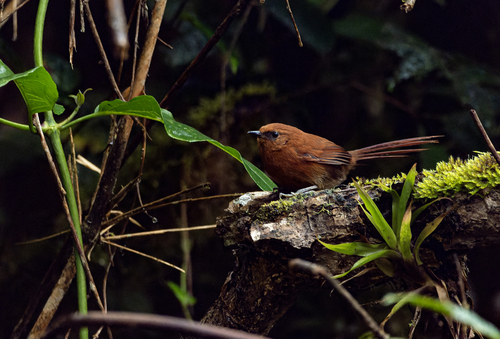 Synallaxe roux
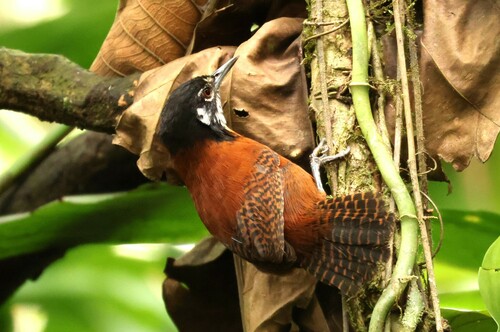 Troglodyte à calotte noire
En bref
The most reliable field mark between Rufous Spinetail and Bay Wren is the strong contrast in facial pattern: Bay Wren shows a bold black-and-white face with a white supercilium and cheek patch, while Rufous Spinetail has a plain, mostly rufous face with only sooty lores. Juvenile Rufous Spinetails are duller and browner but still lack the Bay Wren’s sharp facial markings. In flight or perched, Bay Wren’s barred tail and underparts, plus its white throat and breast, are distinctive, whereas Rufous Spinetail is overall rufous with little pattern. Habitat and behavior also differ: Rufous Spinetail is a skulking Andean forest bird, often in bamboo, while Bay Wren prefers dense low vegetation near water in lower elevations. Size overlap is considerable, but Bay Wren is slightly heavier and more compact.
Conseils d’identification
- Facial pattern is key: Bay Wren always shows a black face with a crisp white supercilium and cheek patch, even in juveniles; Rufous Spinetail’s face is plain rufous with only sooty lores and no white.
- Tail pattern: Bay Wren’s tail is brown with bold black bars, visible when perched or in flight; Rufous Spinetail’s tail is plain rufous with no barring.
- Underparts: Bay Wren has a white throat and breast, rufous brown belly/flanks, and black barring from breast to vent. Rufous Spinetail is uniformly rufous below (juveniles paler), without barring or white.
- Upperparts: Rufous Spinetail is overall bright rufous above (adults) or brownish (juveniles), with a slightly paler forehead; Bay Wren has a black crown/nape and rich chestnut back.
- Juvenile confusion: Young Bay Wrens are paler but still show the facial pattern and barring; young Rufous Spinetails are browner, sometimes with an olivaceous head, but lack any facial contrast or barring.
- Bill and structure: Both have fairly short, straight bills, but Bay Wren’s is proportionally stubbier, matching its more compact, round-bodied jizz. Rufous Spinetail is longer and slimmer, with a longer tail often held cocked.
- Flight views: Bay Wren’s barred tail and underparts can be seen in flight; Rufous Spinetail remains plain and rufous.
- Habitat context: If you are in dense bamboo or high-elevation Andean forest, Rufous Spinetail is likely; if in lowland/foothill thickets near water, Bay Wren is expected.
- Vocalizations: A loud, complex, whistled duet points to Bay Wren; Rufous Spinetail’s song is less musical and more variable by region.
- Perched behavior: Rufous Spinetail is more likely to flick and fan its tail, often staying hidden; Bay Wren may sing from more exposed perches in dense tangles.
- Supercilium: Bay Wren’s white supercilium is always present and diagnostic; Rufous Spinetail lacks any pale eyebrow.
- Cheek patch: Only Bay Wren has a white patch at the rear of the cheek; Rufous Spinetail’s cheek is plain rufous.
- Iris color: Rufous Spinetail has a dark brown to reddish-brown iris; Bay Wren’s iris color is not distinctive for field separation.
- Sexes: Both species are sexually monomorphic in plumage, so sex does not help with identification.
- Subspecies variation: Rufous Spinetail subspecies vary in paleness and throat markings, but none approach the Bay Wren’s facial pattern or barring.
Taille
Bay Wren is slightly heavier (mean ~24 g vs. Rufous Spinetail’s ~18 g) and a bit shorter (12.6–15.6 cm vs. 16–18 cm), making it more compact and round-bodied compared to the longer, slimmer Rufous Spinetail. In the hand or with a clear view, Bay Wren appears chunkier, but in the field, size alone is not a reliable separator due to overlap and posture effects.
Plumage
Juvenile and adult Rufous Spinetails are mostly plain rufous above and below, with a slightly paler forehead, sooty lores, and (in juveniles) browner, sometimes olivaceous-tinged upperparts and paler underparts. There is no strong facial pattern at any age. Bay Wren of all ages shows a striking black face with a narrow white supercilium, partial eyering, and a white patch at the rear of the cheek; the crown and nape are black, upperparts rich chestnut, and the tail is brown with bold black bars. Underparts are white on the throat and breast, grading to rufous brown on the belly and flanks, with black barring from breast to vent. Juveniles are paler and less crisply marked but retain the facial pattern and barring. In flight, Bay Wren’s tail barring and underpart pattern are visible, while Rufous Spinetail remains plain rufous with no barring or strong contrast.
Comportement
Rufous Spinetail is a furtive understory bird, often found in dense bamboo or cloudforest undergrowth, moving with a restless, mouse-like jizz and frequently flicking its long tail. It tends to stay low and is hard to see well. Bay Wren is also a skulker but prefers dense tangles near water, often in secondary growth or thickets, and is more likely to be detected by its loud, complex song. Bay Wrens often forage in pairs, probing and gleaning in low vegetation, and may be more confiding than the spinetail when singing.
Habitat
Rufous Spinetail is a montane species of the Andes (Colombia, Ecuador, Peru, Venezuela), found in cloudforest, elfin forest, and especially bamboo stands between 1,700–3,700 m elevation. It avoids lowland habitats. Bay Wren is found from Nicaragua to Ecuador, mainly in lowland and foothill areas, always associated with dense vegetation near water (thickets, overgrown clearings, roadsides, secondary forest). It is absent from high-elevation Andean forests, so context can be a strong clue.
Voix
Bay Wren has a loud, rich, and complex song with repeated whistles, trills, and warbles, often given antiphonally by pairs. Rufous Spinetail vocalizations vary by subspecies and are less well known, but generally lack the Bay Wren’s musical quality and complexity. If you hear a loud, ringing, back-and-forth duet, Bay Wren is much more likely.
Synallaxe roux · Troglodyte à calotte noire · Mes oiseaux difficiles