

Timalie à gorge striée vs Timalie chamasa
Mixornis gularis contre Macronus ptilosus
Faire un quiz avec Timalie à gorge striée et Timalie chamasa
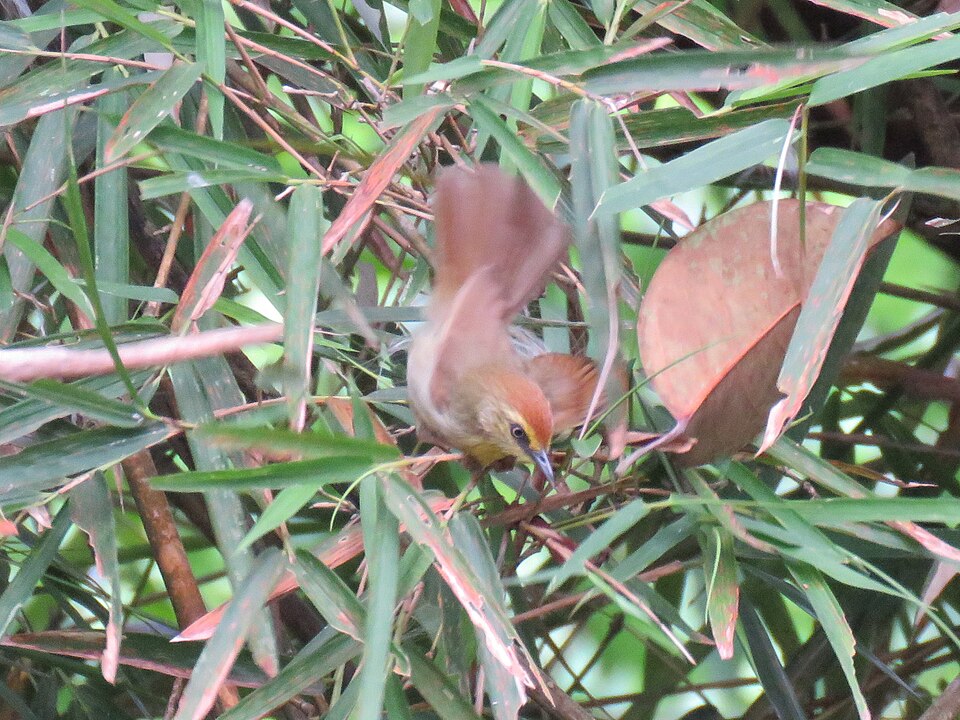 Timalie à gorge striée
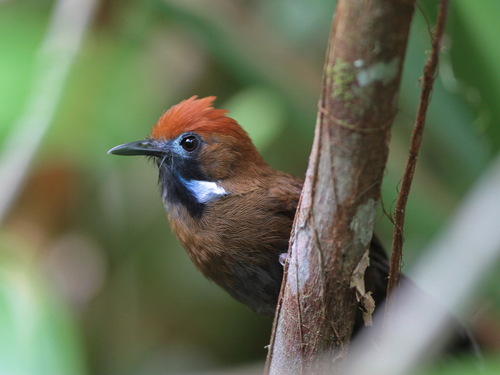 Timalie chamasa
En bref
The most reliable way to separate Pin-striped Tit-Babbler from Fluffy-backed Tit-Babbler is by size and overall plumage impression: Fluffy-backed is noticeably heavier-bodied and lacks the Pin-striped's distinctive yellow supercilium and streaked yellow throat. In the field, Pin-striped appears smaller, with a more delicate structure and a clear yellowish eyebrow and rufous crown, while Fluffy-backed is bulkier and does not show these facial contrasts. Both species may be seen in similar low vegetation, but their structure and facial pattern are the quickest field cues. There are no age-specific wing or flight marks described for either species, so focus on perched views and overall jizz.
Conseils d’identification
- Size is a strong separator: Fluffy-backed is more than twice as heavy as Pin-striped. In mixed flocks or similar habitat, look for the bulkier, heavier-bodied bird for Fluffy-backed.
- Facial pattern is key: Pin-striped shows a clear yellowish supercilium (eyebrow) and a rufous crown, making its face look brighter and more marked. Fluffy-backed lacks these features and has a plainer face.
- Throat and underparts: Pin-striped has a yellowish throat with brown streaks and generally yellowish underparts. Fluffy-backed does not show this combination; its throat and underparts are plainer.
- Back texture: Fluffy-backed is named for its 'fluffy' back, but this is subtle and not always obvious in the field. Do not rely on this unless the bird is very close and fluffed up.
- No age-specific wing or flight marks: Neither species shows distinctive juvenile or immature wing patterns that can be used in flight. Focus on perched birds and facial/structural features.
- Structure and jizz: Pin-striped appears more delicate and active, with a smaller, finer bill and body. Fluffy-backed is more robust and less dainty.
- Voice: If you hear a repeated 'chonk-chonk-chonk-chonk-chonk' call, you are likely hearing Pin-striped. Lack of this call is not diagnostic for Fluffy-backed.
- Habitat overlap: Both species can occur in similar lowland forest and edge habitats, but Fluffy-backed may be more tied to wetter or denser forest. Use habitat only as a supporting clue.
- Group behavior: Both species can forage in small groups or flocks, so flocking alone is not a separator.
- Bill and head shape: Pin-striped's bill is finer and its head appears more angular due to the supercilium and crown contrast. Fluffy-backed's head is rounder and bill stouter.
- Rufous crown: Only Pin-striped shows a rufous crown; Fluffy-backed's crown is not rufous.
- Supercilium: The yellowish eyebrow is a quick field mark for Pin-striped, absent in Fluffy-backed.
- Throat streaking: Pin-striped's brown-streaked yellow throat is unique; Fluffy-backed's throat is plain.
- Plumage pitfalls: In poor light, Pin-striped's yellow tones may appear dull, but the facial pattern usually remains visible. Be cautious with worn or molting birds, but the supercilium and crown color are reliable.
- Sex and season: No sexual dimorphism or strong seasonal plumage differences are described for either species, so these marks apply year-round to both sexes.
Taille
Fluffy-backed Tit-Babbler is more than twice as heavy as Pin-striped Tit-Babbler (26g vs 12g [wikidata]), making it appear much bulkier and more robust in the field. This size difference is obvious when both species are seen in similar habitat or foraging style. Pin-striped is noticeably smaller and lighter-bodied, with a daintier appearance.
Plumage
No age-specific wing or flight pattern differences are described for either species, so separation relies on adult plumage and facial pattern. Pin-striped Tit-Babbler shows a distinctive yellowish supercilium (eyebrow) and a rufous crown, with a yellowish throat streaked brown. Its underparts are generally yellowish. Fluffy-backed Tit-Babbler lacks the strong facial contrasts: it does not have a yellow supercilium or rufous crown, and its back is described as 'fluffy' but without the Pin-striped's clean facial pattern. Both are brownish birds, but Pin-striped's face and throat are much more marked and colorful. There are no detailed notes on juvenile or immature plumage differences, so these marks apply to all ages unless otherwise noted.
Comportement
Both species forage in low vegetation and may move in small groups. Pin-striped Tit-Babbler is noted for creeping and clambering through dense undergrowth, often in small flocks. There is no specific behavioral trait described for Fluffy-backed Tit-Babbler that would reliably separate it from Pin-striped in the field. Both can be active and social, so behavior is not a strong separator.
Habitat
Both species occur in Southeast Asia and can overlap in range (especially in Malaysia, Thailand, and Indonesia). Pin-striped Tit-Babbler is found in a wider range across South and Southeast Asia, while Fluffy-backed is more restricted to Brunei, Indonesia, Malaysia, and Thailand. Fluffy-backed is associated with subtropical or tropical moist lowland forest and swampland, while Pin-striped is generally found in low vegetation and secondary growth. Habitat alone is not diagnostic where their ranges overlap, but Fluffy-backed may be more tied to wetter or denser forest.
Voix
Pin-striped Tit-Babbler has a loud, repeated 'chonk-chonk-chonk-chonk-chonk' call, somewhat reminiscent of a common tailorbird. There is no vocal description provided for Fluffy-backed Tit-Babbler, so voice is only useful for confirming Pin-striped when this call is heard. Absence of this call does not confirm Fluffy-backed.
Timalie à gorge striée · Timalie chamasa · Mes oiseaux difficiles