

Grand-duc ascalaphe vs Chevêche d'Athéna
Bubo ascalaphus contre Athene noctua
Faire un quiz avec Grand-duc ascalaphe et Chevêche d'Athéna
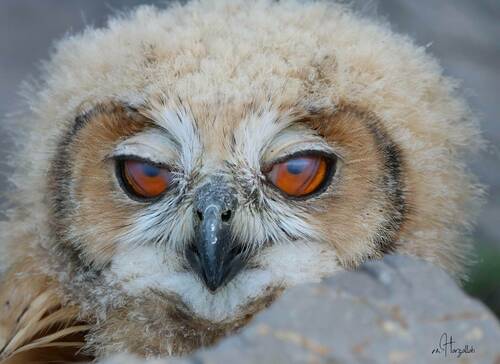 Grand-duc ascalaphe
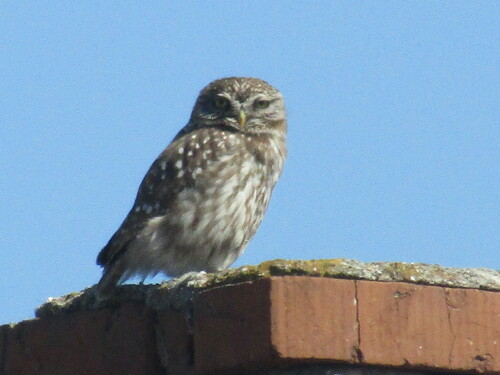 Chevêche d'Athéna
En bref
The most reliable field mark to separate Pharaoh Eagle Owl from Little Owl is size: Pharaoh Eagle Owl is more than twice as long and many times heavier than Little Owl, with a much more robust build. If seen in flight or perched, look for the Pharaoh Eagle Owl’s large orange-yellow eyes, prominent ear tufts, and pale creamy underparts with bold dark streaks, versus the Little Owl’s yellow eyes, flat-topped head, and compact, spotted brown-and-white body. Juvenile Little Owls lack the adult’s white crown spots, but even young birds are much smaller and differently shaped than any eagle-owl. Both species can occur in North Africa, but Pharaoh Eagle Owl is a bird of open desert and rocky outcrops, while Little Owl prefers farmland, orchards, and villages.
Conseils d’identification
- Size is the most immediate clue: Pharaoh Eagle Owl is more than twice as long as Little Owl and much bulkier. If you see a bird that looks small and compact, it is not Pharaoh Eagle Owl.
- Structure and posture: Pharaoh Eagle Owl has a robust, upright stance, large head, and long wings. Little Owl is squat, with a flat-topped head and short tail, often appearing hunched.
- Facial features: Pharaoh Eagle Owl has a strong facial disc with a dark rim, large orange-yellow eyes, and small but visible ear tufts. Little Owl has a less defined facial disc, yellow eyes, and no ear tufts. Its white 'eyebrows' give a stern or frowning look.
- Plumage above: Pharaoh Eagle Owl is tawny with dense black and creamy-white streaks and blotches. Little Owl is greyish-brown, heavily spotted and streaked with white, and lacks the tawny tones.
- Plumage below: Pharaoh Eagle Owl’s underparts are pale creamy-white with black streaks on the upper breast and fine reddish-brown vermiculations below. Little Owl is brown-streaked white below, with more uniform streaking and less contrast.
- Juvenile confusion: Juvenile Little Owls are duller and lack white crown spots, but still have the compact, spotted look and small size. There is no risk of confusing a juvenile Little Owl for a Pharaoh Eagle Owl on size or structure.
- Ear tufts: Only Pharaoh Eagle Owl shows ear tufts, though they are small. Little Owl always lacks ear tufts.
- Bill color: Pharaoh Eagle Owl has a black, hooked bill; Little Owl’s bill is less prominent and not described as black.
- Flight style: Little Owl has a bounding, woodpecker-like flight with rapid wingbeats and short glides. Pharaoh Eagle Owl’s flight is stronger, more direct, and befitting a large raptor.
- Habitat context: Pharaoh Eagle Owl is found in open desert and rocky hills, away from people. Little Owl is common in farmland, orchards, villages, and open countryside, often near human habitation.
- Perching behavior: Pharaoh Eagle Owl perches on rocks or cliffs, often upright and exposed. Little Owl perches on posts, buildings, or low branches, often in open view but at lower heights.
- Vocalizations: Little Owl gives a repeated 'kiew, kiew' and various trilling or chattering calls, especially near nests. Pharaoh Eagle Owl’s voice is deeper and not described as similar.
- Eye color: Pharaoh Eagle Owl has large orange-yellow eyes; Little Owl has yellow eyes, but the difference is subtle compared to size and structure.
- Facial disc: Pharaoh Eagle Owl’s facial disc is more pronounced and rimmed; Little Owl’s is flatter and less defined.
- Pitfalls: In poor light or at great distance, size and structure remain the best clues. If you lack scale, look for ear tufts and facial disc for Pharaoh Eagle Owl, and compact, flat-topped head with white 'eyebrows' for Little Owl.
Taille
Pharaoh Eagle Owl is a large owl, 46–50 cm (18–20 in) in length, making it one of the smaller eagle-owls but still much larger than Little Owl, which is only about 22 cm (8.7 in) long. The difference is stark: Pharaoh Eagle Owl is over twice the length and many times the mass of Little Owl. In the field, Pharaoh Eagle Owl appears bulky, long-winged, and powerfully built, while Little Owl is compact, short-tailed, and small-headed. Even at a distance or in poor light, the size gap is usually obvious unless the observer lacks scale.
Plumage
No age-specific upperwing patterns are described for either species, so focus on overall coloration and markings. Pharaoh Eagle Owl has tawny upperparts with dense black and creamy-white streaks and blotches, pale creamy-white underparts with black streaks on the upper breast and fine reddish-brown vermiculations below. The facial disc is well-defined with a dark rim, and the bill is black. Ear tufts are present but small. Little Owl, in contrast, is greyish-brown above, heavily spotted and streaked with white, and brown-streaked white below. Its facial disc is less pronounced, the head is flat-topped, and it has obvious white 'eyebrows' above yellow eyes, giving a stern or frowning look. Juvenile Little Owls are duller, lacking the adult’s white crown spots, but still show the compact, spotted look. Pharaoh Eagle Owl’s orange-yellow eyes and strong facial disc are never matched by Little Owl.
Comportement
Pharaoh Eagle Owl typically perches upright on rocks or cliffs, often in open desert or arid hills, and is usually seen singly or in pairs. Its flight is strong and direct, befitting its size. Little Owl perches on posts, buildings, or low branches, often in farmland or near human habitation, and is frequently seen during the day. Its flight is bounding and woodpecker-like, with rapid wingbeats and short glides, reflecting its small, compact build. Little Owl often appears more approachable and active in daylight, while Pharaoh Eagle Owl is more crepuscular or nocturnal and wary.
Habitat
Pharaoh Eagle Owl is found in open desert, rocky outcrops, and arid hills of North Africa and the Middle East. It avoids areas with dense vegetation or close human habitation. Little Owl prefers farmland, orchards, villages, and open countryside with scattered trees or buildings, and is much more likely to be found near people. In North Africa, both can occur, but context is helpful: a large owl on a remote rocky hillside is likely Pharaoh Eagle Owl, while a small owl on a farm wall or orchard post is almost certainly Little Owl.
Voix
Little Owl gives a querulous 'kiew, kiew' and a variety of whistling, trilling, yelping, or chattering calls, especially near the nest. Its calls are higher-pitched and more varied than those of large eagle-owls. Pharaoh Eagle Owl’s voice is not described in the provided notes, but as an eagle-owl, it is expected to have deeper, more resonant hoots or barks. In any case, the Little Owl’s distinctive, repeated 'kiew' is not matched by Pharaoh Eagle Owl.
Grand-duc ascalaphe · Chevêche d'Athéna · Mes oiseaux difficiles