

Motmot

Pigeon marron vs Tourterelle à tête grise

Columba punicea contre Streptopelia tranquebarica

Faire un quiz avec Pigeon marron et Tourterelle à tête grise
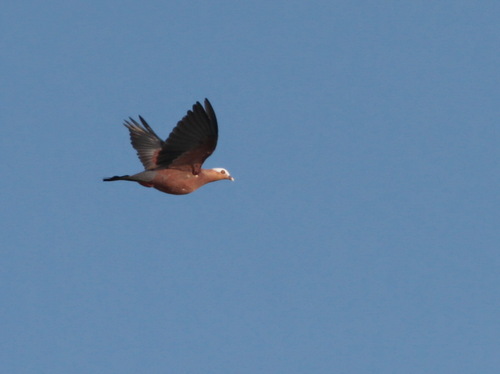
Pigeon marron (Columba punicea) Pigeon marron
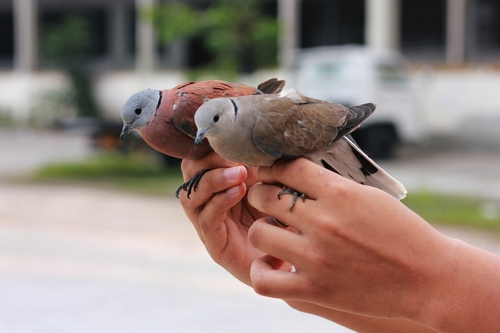
Tourterelle à tête grise (Streptopelia tranquebarica) Tourterelle à tête grise

Médias

Chargement…

En bref

The most reliable field mark to separate Pale-capped Pigeon from Red Collared Dove is overall size and structure: Pale-capped Pigeon is a much larger, heavier bird with a bulkier body and a distinctly pale crown, while Red Collared Dove is small, slim, and never shows a pale crown. In all plumages, Pale-capped Pigeon is deep chestnut with a strong iridescent gloss and a contrasting pale (whitish-grey or brownish-grey) crown, whereas Red Collared Dove males have a blue-grey head and red-brown body, and females are plain pale brown. Juvenile Pale-capped Pigeons lack the pale crown but are still large, dark, and lack the black neck collar of Red Collared Dove. These two species are unlikely to be confused by size alone, but distant or perched views can cause confusion if size is misjudged.

Conseils d’identification

  1. Size is the most immediate separator: Pale-capped Pigeon is much larger and bulkier than Red Collared Dove. If you see a pigeon-sized bird, rule out Red Collared Dove.
  2. Crown color: Adult Pale-capped Pigeon always shows a pale crown (whitish-grey in males, brownish-grey in females), sharply contrasting with the darker body. Red Collared Dove never shows a pale crown; males have a blue-grey head, females are plain brown.
  3. Neck collar: Red Collared Dove males have a distinct black collar on the hindneck, absent in all ages and sexes of Pale-capped Pigeon.
  4. Upperparts gloss: Pale-capped Pigeon has a strong green or amethyst gloss on the mantle and back (especially in males), while Red Collared Dove is matte and lacks iridescence.
  5. Underparts color: Pale-capped Pigeon is deep chestnut below, with slaty-grey undertail-coverts; Red Collared Dove males are light red-brown, females pale brown, never deep chestnut.
  6. Tail and flight feathers: Pale-capped Pigeon has blackish tail and flight feathers; Red Collared Dove's tail is not as dark and is proportionally shorter.
  7. Leg and eye color: Adult Pale-capped Pigeon has crimson legs and creamy-yellow iris, with magenta skin around the eyes and ceres; these details are hard to see at a distance but can help at close range. Red Collared Dove has more typical duller bare part colors.
  8. Juvenile confusion: Juvenile Pale-capped Pigeon lacks the pale crown but is still large, dark, and lacks a neck collar; juvenile Red Collared Dove is small, pale, and never shows a pale crown or strong gloss.
  9. Perched posture: Pale-capped Pigeon sits heavily, often hunched in dense foliage; Red Collared Dove is more upright and perches in the open.
  10. Flight style: Pale-capped Pigeon flies slowly and heavily, while Red Collared Dove is quicker and more agile.
  11. Habitat context: Pale-capped Pigeon is almost always in mature riverine or lowland forest, often in fruiting trees; Red Collared Dove prefers open country, farmland, and roadside plantations.
  12. Group size: Both can be in small groups, but Red Collared Dove often breaks into pairs quickly in breeding season.
  13. Vocalization: If heard, Pale-capped Pigeon's call is low and short, unlike the repeated coos of Red Collared Dove.
  14. Seasonal context: Red Collared Dove may be more common in summer as a migrant in some regions, while Pale-capped Pigeon is always scarce and local.
  15. Common pitfalls: Distant or poorly seen perched birds may appear similar in color, but check for size, crown color, and neck collar as the quickest separators.

Taille

Pale-capped Pigeon is dramatically larger and heavier (body mass ~440g, length 36–40.5 cm) compared to Red Collared Dove (length 20.5–23 cm, mass ~104g). The pigeon is nearly twice as long and over four times as heavy. This difference is obvious in direct comparison, but can be underestimated at a distance or with no size reference. Pale-capped Pigeon appears bulky and robust, while Red Collared Dove is small, slim, and delicate.

Plumage

Juvenile and immature Pale-capped Pigeons lack the pale crown of adults, but remain all-dark chestnut with duller upperparts and rufous fringes to the wing-coverts and scapulars; they never show a black neck collar. Adult Pale-capped Pigeons have a striking pale crown (whitish-grey in males, brownish-grey in females), deep purplish-maroon upperparts with a faint green gloss, and chestnut underparts. Their tail and flight feathers are blackish, and the undertail-coverts are slaty-grey. Red Collared Dove males have a blue-grey head, red-brown body, and a distinctive black collar on the neck; females are plain pale brown overall, lacking strong contrast or gloss, and have no pale crown. Juvenile Red Collared Doves resemble females but are even duller, always much paler and smaller than any Pale-capped Pigeon. In flight, neither species shows a strong wing panel or pattern, but Pale-capped Pigeon is uniformly dark and glossy, while Red Collared Dove is paler and more contrasting, especially in the male.

Comportement

Pale-capped Pigeon is slow-flying, often seen sitting motionless in the canopy of large fruiting trees, sometimes in small groups. It tends to be inconspicuous and secretive. Red Collared Dove is more active, often seen in pairs or small flocks, especially when arriving in new areas; it quickly disperses to breed. Both species can be seen perched, but the pigeon is more likely to be high in dense foliage, while the dove uses more open perches.

Habitat

Pale-capped Pigeon favors riverine forests on plains, especially in large fruiting trees, and is patchily distributed in South and Southeast Asia. Red Collared Dove is a widespread plains species, common in cultivated areas, roadside plantations, and well-wooded tracts, but avoids dense forests and rocky foothills. It is much more likely to be found in open country, farmland, or urban edges, while Pale-capped Pigeon is tied to mature forest habitats.

Voix

Pale-capped Pigeon has a low, short call, somewhat like that of a Green Imperial Pigeon but briefer. Red Collared Dove's vocalizations are not described in detail here, but as a typical collared dove, it is likely to give soft, repeated coos. Voice is not a primary field mark for separation, but Pale-capped Pigeon's call is lower and less prolonged.

Envoyer une meilleure description

Utilise les mêmes sections que la comparaison. Ton texte est publié tout de suite.

The most reliable field mark to separate Pale-capped Pigeon from Red Collared Dove is overall size and structure: Pale-capped Pigeon is a much larger, heavier bird with a bulkier body and a distinctly pale crown, while Red Collared Dove is small, slim, and never shows a pale crown. In all plumages, Pale-capped Pigeon is deep chestnut with a strong iridescent gloss and a contrasting pale (whitish-grey or brownish-grey) crown, whereas Red Collared Dove males have a blue-grey head and red-brown body, and females are plain pale brown. Juvenile Pale-capped Pigeons lack the pale crown but are still large, dark, and lack the black neck collar of Red Collared Dove. These two species are unlikely to be confused by size alone, but distant or perched views can cause confusion if size is misjudged.

  1. Size is the most immediate separator: Pale-capped Pigeon is much larger and bulkier than Red Collared Dove. If you see a pigeon-sized bird, rule out Red Collared Dove.
  2. Crown color: Adult Pale-capped Pigeon always shows a pale crown (whitish-grey in males, brownish-grey in females), sharply contrasting with the darker body. Red Collared Dove never shows a pale crown; males have a blue-grey head, females are plain brown.
  3. Neck collar: Red Collared Dove males have a distinct black collar on the hindneck, absent in all ages and sexes of Pale-capped Pigeon.
  4. Upperparts gloss: Pale-capped Pigeon has a strong green or amethyst gloss on the mantle and back (especially in males), while Red Collared Dove is matte and lacks iridescence.
  5. Underparts color: Pale-capped Pigeon is deep chestnut below, with slaty-grey undertail-coverts; Red Collared Dove males are light red-brown, females pale brown, never deep chestnut.
  6. Tail and flight feathers: Pale-capped Pigeon has blackish tail and flight feathers; Red Collared Dove's tail is not as dark and is proportionally shorter.
  7. Leg and eye color: Adult Pale-capped Pigeon has crimson legs and creamy-yellow iris, with magenta skin around the eyes and ceres; these details are hard to see at a distance but can help at close range. Red Collared Dove has more typical duller bare part colors.
  8. Juvenile confusion: Juvenile Pale-capped Pigeon lacks the pale crown but is still large, dark, and lacks a neck collar; juvenile Red Collared Dove is small, pale, and never shows a pale crown or strong gloss.
  9. Perched posture: Pale-capped Pigeon sits heavily, often hunched in dense foliage; Red Collared Dove is more upright and perches in the open.
  10. Flight style: Pale-capped Pigeon flies slowly and heavily, while Red Collared Dove is quicker and more agile.
  11. Habitat context: Pale-capped Pigeon is almost always in mature riverine or lowland forest, often in fruiting trees; Red Collared Dove prefers open country, farmland, and roadside plantations.
  12. Group size: Both can be in small groups, but Red Collared Dove often breaks into pairs quickly in breeding season.
  13. Vocalization: If heard, Pale-capped Pigeon's call is low and short, unlike the repeated coos of Red Collared Dove.
  14. Seasonal context: Red Collared Dove may be more common in summer as a migrant in some regions, while Pale-capped Pigeon is always scarce and local.
  15. Common pitfalls: Distant or poorly seen perched birds may appear similar in color, but check for size, crown color, and neck collar as the quickest separators.

Pale-capped Pigeon is dramatically larger and heavier (body mass ~440g, length 36–40.5 cm) compared to Red Collared Dove (length 20.5–23 cm, mass ~104g). The pigeon is nearly twice as long and over four times as heavy. This difference is obvious in direct comparison, but can be underestimated at a distance or with no size reference. Pale-capped Pigeon appears bulky and robust, while Red Collared Dove is small, slim, and delicate.

Juvenile and immature Pale-capped Pigeons lack the pale crown of adults, but remain all-dark chestnut with duller upperparts and rufous fringes to the wing-coverts and scapulars; they never show a black neck collar. Adult Pale-capped Pigeons have a striking pale crown (whitish-grey in males, brownish-grey in females), deep purplish-maroon upperparts with a faint green gloss, and chestnut underparts. Their tail and flight feathers are blackish, and the undertail-coverts are slaty-grey. Red Collared Dove males have a blue-grey head, red-brown body, and a distinctive black collar on the neck; females are plain pale brown overall, lacking strong contrast or gloss, and have no pale crown. Juvenile Red Collared Doves resemble females but are even duller, always much paler and smaller than any Pale-capped Pigeon. In flight, neither species shows a strong wing panel or pattern, but Pale-capped Pigeon is uniformly dark and glossy, while Red Collared Dove is paler and more contrasting, especially in the male.

Pale-capped Pigeon is slow-flying, often seen sitting motionless in the canopy of large fruiting trees, sometimes in small groups. It tends to be inconspicuous and secretive. Red Collared Dove is more active, often seen in pairs or small flocks, especially when arriving in new areas; it quickly disperses to breed. Both species can be seen perched, but the pigeon is more likely to be high in dense foliage, while the dove uses more open perches.

Pale-capped Pigeon favors riverine forests on plains, especially in large fruiting trees, and is patchily distributed in South and Southeast Asia. Red Collared Dove is a widespread plains species, common in cultivated areas, roadside plantations, and well-wooded tracts, but avoids dense forests and rocky foothills. It is much more likely to be found in open country, farmland, or urban edges, while Pale-capped Pigeon is tied to mature forest habitats.

Pale-capped Pigeon has a low, short call, somewhat like that of a Green Imperial Pigeon but briefer. Red Collared Dove's vocalizations are not described in detail here, but as a typical collared dove, it is likely to give soft, repeated coos. Voice is not a primary field mark for separation, but Pale-capped Pigeon's call is lower and less prolonged.

Abandonner tes modifications ?

Tu as des modifications non enregistrées. Si tu pars maintenant, elles seront perdues.

Pigeon marron · Tourterelle à tête grise · Mes oiseaux difficiles