

Motmot

Martinet d'Ussher vs Circaète brun

Telacanthura ussheri contre Circaetus cinereus

Faire un quiz avec Martinet d'Ussher et Circaète brun
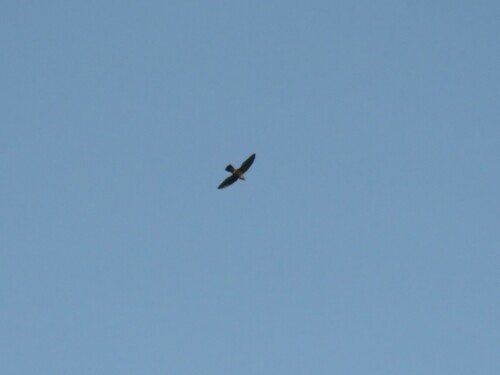
Martinet d'Ussher (Telacanthura ussheri) Martinet d'Ussher
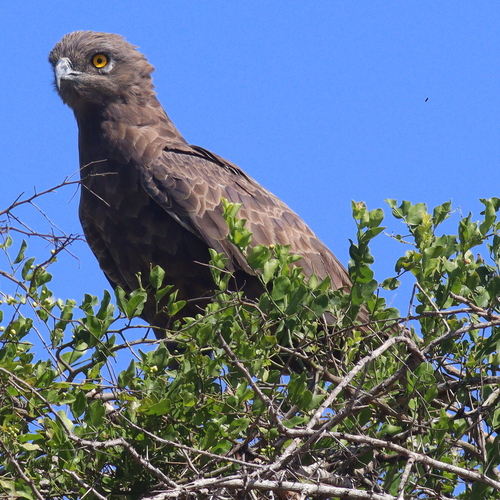
Circaète brun (Circaetus cinereus) Circaète brun

Médias

Chargement…

En bref

The most reliable way to separate Mottled Spinetail from Brown Snake-Eagle is by overall structure and flight style: the spinetail is a small, fast-flying swift with a compact body and pointed wings, while the snake-eagle is a massive, broad-winged raptor with a heavy build and slow, soaring flight. Even at a distance or in poor light, the eagle's size and shape are unmistakable compared to the tiny, agile swift. Juvenile plumage is not a confusion point here; differences are structural and behavioral, not subtle feather details. If you see a bird gliding or flapping high overhead, check for the eagle's broad wings and short, barred tail versus the spinetail's narrow, sickle-shaped wings and rapid, erratic flight.

Conseils d’identification

  1. Size is the single most obvious separator: Brown Snake-Eagle is enormous compared to Mottled Spinetail. If you can estimate size against known objects or other birds, this is decisive.
  2. Shape and structure: The eagle has broad, rounded wings and a short, broad tail; the spinetail has narrow, pointed wings and a longer, more squared or slightly forked tail. In flight, the swift looks like a flying sickle, the eagle like a glider.
  3. Flight style: Mottled Spinetail is fast, agile, and erratic, rarely gliding for long; Brown Snake-Eagle soars or glides on flat wings, often circling high or perching for long periods.
  4. Perching behavior: Eagles perch upright in trees or on posts, often conspicuous; swifts almost never perch in the open and are almost always seen in flight.
  5. Plumage details: The eagle is dark brown with contrasting pale, unmarked flight feathers and a barred tail; the spinetail is more uniformly dark with some mottling, lacking the eagle's pale wing panels or tail barring.
  6. Juvenile confusion: Juvenile Brown Snake-Eagles may show some white speckling but still have the same structure and flight as adults; Mottled Spinetail juveniles do not mimic eagle plumage or structure.
  7. Bill and head: The eagle has a large, hooked bill and a massive head; the swift has a tiny, flat bill and a small head relative to body.
  8. Legs and feet: The eagle's bare, thick legs are visible when perched; swifts' legs are tiny and not visible in flight.
  9. Tail pattern: Eagle's tail is short and barred; spinetail's tail is longer and lacks barring.
  10. Vocalizations: If you hear a deep, guttural call, it's the eagle; swifts are mostly silent or give high, twittering calls.
  11. Context and behavior: Eagles are solitary and hunt from perches or in slow flight; swifts are often in groups, constantly flying.
  12. Habitat use: Eagles are in open woodland and savanna, rarely urban; swifts are more flexible and may be seen over towns, water, or forest edges.
  13. Relative abundance: Both species can be locally common, but the eagle is much less likely to be seen in towns or over water.
  14. When in doubt, trust the combination of size, shape, and behavior: No swift will ever approach the bulk, wing shape, or flight style of a snake-eagle, and no eagle will ever show the speed or agility of a spinetail.
  15. If only a silhouette is seen, check for the eagle's broad wings and short tail versus the spinetail's narrow wings and longer tail.

Taille

Brown Snake-Eagle is vastly larger, with an average body mass around 2 kg and a wingspan up to 185–200 cm, dwarfing the Mottled Spinetail, which is a small swift (exact mass not given, but typical for swifts is under 100 g). The eagle is one of the largest raptors in its range, while the spinetail is among the smallest aerial insectivores. Even at a distance, the eagle's bulk and wingspan are obvious, and it will appear much larger than any swift or swallow.

Plumage

Plumage is not the main confusion point, but for completeness: Brown Snake-Eagle is dark brown overall with unmarked body and wings, but with contrasting pale, unmarked flight feathers and a short, barred tail visible in flight. Juveniles are similar but may show some white speckling, especially on the abdomen and head. Mottled Spinetail, like most swifts, is generally dark with some mottling, but lacks the eagle's pale flight feathers and barred tail. No age-specific wing or tail patterns in the spinetail are noted that would mimic the eagle's pattern. In all ages, the eagle's plumage is uniform and lacks the sharply contrasting wing and tail shapes of the swift.

Comportement

Behavior is a key separator. Mottled Spinetail is almost always seen in rapid, agile flight, often high overhead, catching insects on the wing. It rarely perches in the open. Brown Snake-Eagle is typically seen soaring or perched upright in trees or on exposed perches, scanning for prey. Its flight is slow and buoyant, with occasional butterfly-like display flights. It hunts mainly from perches, dropping to the ground to catch snakes and other prey. The eagle is solitary and rarely seen in pairs, while swifts often occur in small groups.

Habitat

Both species overlap broadly in West, East, and southern Africa, but their microhabitat use differs. Mottled Spinetail is found over a wide range of habitats, often near open areas, water, or woodland edges where aerial insects are abundant. Brown Snake-Eagle prefers open woodlands and savannas where it can hunt snakes on the ground, and is often seen perched high in trees or soaring over open country. The eagle is rarely encountered in dense forest or urban areas, while the spinetail is more flexible in habitat.

Voix

Brown Snake-Eagle gives a hoarse, guttural 'hok-hok-hok-hok' in territorial displays and a soft 'kwee-oo' as a contact call near the nest. Mottled Spinetail, like most swifts, is generally silent or gives high-pitched, twittering calls, but no distinctive vocalizations are noted in the sources. If you hear a deep, crow-like call, you are likely hearing the eagle, not the swift.

Envoyer une meilleure description

Utilise les mêmes sections que la comparaison. Ton texte est publié tout de suite.

The most reliable way to separate Mottled Spinetail from Brown Snake-Eagle is by overall structure and flight style: the spinetail is a small, fast-flying swift with a compact body and pointed wings, while the snake-eagle is a massive, broad-winged raptor with a heavy build and slow, soaring flight. Even at a distance or in poor light, the eagle's size and shape are unmistakable compared to the tiny, agile swift. Juvenile plumage is not a confusion point here; differences are structural and behavioral, not subtle feather details. If you see a bird gliding or flapping high overhead, check for the eagle's broad wings and short, barred tail versus the spinetail's narrow, sickle-shaped wings and rapid, erratic flight.

  1. Size is the single most obvious separator: Brown Snake-Eagle is enormous compared to Mottled Spinetail. If you can estimate size against known objects or other birds, this is decisive.
  2. Shape and structure: The eagle has broad, rounded wings and a short, broad tail; the spinetail has narrow, pointed wings and a longer, more squared or slightly forked tail. In flight, the swift looks like a flying sickle, the eagle like a glider.
  3. Flight style: Mottled Spinetail is fast, agile, and erratic, rarely gliding for long; Brown Snake-Eagle soars or glides on flat wings, often circling high or perching for long periods.
  4. Perching behavior: Eagles perch upright in trees or on posts, often conspicuous; swifts almost never perch in the open and are almost always seen in flight.
  5. Plumage details: The eagle is dark brown with contrasting pale, unmarked flight feathers and a barred tail; the spinetail is more uniformly dark with some mottling, lacking the eagle's pale wing panels or tail barring.
  6. Juvenile confusion: Juvenile Brown Snake-Eagles may show some white speckling but still have the same structure and flight as adults; Mottled Spinetail juveniles do not mimic eagle plumage or structure.
  7. Bill and head: The eagle has a large, hooked bill and a massive head; the swift has a tiny, flat bill and a small head relative to body.
  8. Legs and feet: The eagle's bare, thick legs are visible when perched; swifts' legs are tiny and not visible in flight.
  9. Tail pattern: Eagle's tail is short and barred; spinetail's tail is longer and lacks barring.
  10. Vocalizations: If you hear a deep, guttural call, it's the eagle; swifts are mostly silent or give high, twittering calls.
  11. Context and behavior: Eagles are solitary and hunt from perches or in slow flight; swifts are often in groups, constantly flying.
  12. Habitat use: Eagles are in open woodland and savanna, rarely urban; swifts are more flexible and may be seen over towns, water, or forest edges.
  13. Relative abundance: Both species can be locally common, but the eagle is much less likely to be seen in towns or over water.
  14. When in doubt, trust the combination of size, shape, and behavior: No swift will ever approach the bulk, wing shape, or flight style of a snake-eagle, and no eagle will ever show the speed or agility of a spinetail.
  15. If only a silhouette is seen, check for the eagle's broad wings and short tail versus the spinetail's narrow wings and longer tail.

Brown Snake-Eagle is vastly larger, with an average body mass around 2 kg and a wingspan up to 185–200 cm, dwarfing the Mottled Spinetail, which is a small swift (exact mass not given, but typical for swifts is under 100 g). The eagle is one of the largest raptors in its range, while the spinetail is among the smallest aerial insectivores. Even at a distance, the eagle's bulk and wingspan are obvious, and it will appear much larger than any swift or swallow.

Plumage is not the main confusion point, but for completeness: Brown Snake-Eagle is dark brown overall with unmarked body and wings, but with contrasting pale, unmarked flight feathers and a short, barred tail visible in flight. Juveniles are similar but may show some white speckling, especially on the abdomen and head. Mottled Spinetail, like most swifts, is generally dark with some mottling, but lacks the eagle's pale flight feathers and barred tail. No age-specific wing or tail patterns in the spinetail are noted that would mimic the eagle's pattern. In all ages, the eagle's plumage is uniform and lacks the sharply contrasting wing and tail shapes of the swift.

Behavior is a key separator. Mottled Spinetail is almost always seen in rapid, agile flight, often high overhead, catching insects on the wing. It rarely perches in the open. Brown Snake-Eagle is typically seen soaring or perched upright in trees or on exposed perches, scanning for prey. Its flight is slow and buoyant, with occasional butterfly-like display flights. It hunts mainly from perches, dropping to the ground to catch snakes and other prey. The eagle is solitary and rarely seen in pairs, while swifts often occur in small groups.

Both species overlap broadly in West, East, and southern Africa, but their microhabitat use differs. Mottled Spinetail is found over a wide range of habitats, often near open areas, water, or woodland edges where aerial insects are abundant. Brown Snake-Eagle prefers open woodlands and savannas where it can hunt snakes on the ground, and is often seen perched high in trees or soaring over open country. The eagle is rarely encountered in dense forest or urban areas, while the spinetail is more flexible in habitat.

Brown Snake-Eagle gives a hoarse, guttural 'hok-hok-hok-hok' in territorial displays and a soft 'kwee-oo' as a contact call near the nest. Mottled Spinetail, like most swifts, is generally silent or gives high-pitched, twittering calls, but no distinctive vocalizations are noted in the sources. If you hear a deep, crow-like call, you are likely hearing the eagle, not the swift.

Abandonner tes modifications ?

Tu as des modifications non enregistrées. Si tu pars maintenant, elles seront perdues.

Martinet d'Ussher · Circaète brun · Mes oiseaux difficiles