

Bécasseau minute vs Bécasseau à croupion blanc
Calidris minuta contre Calidris fuscicollis
Faire un quiz avec Bécasseau minute et Bécasseau à croupion blanc
 Bécasseau minute
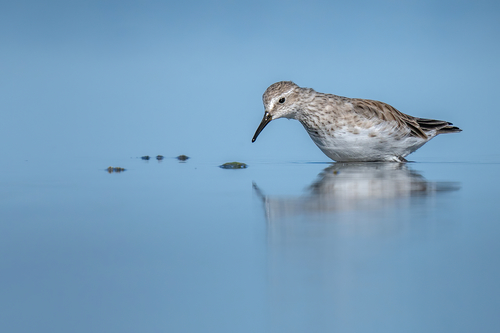 Bécasseau à croupion blanc
En bref
The most reliable field mark to separate Little Stint from White-rumped Sandpiper is the prominent white rump and uppertail coverts of White-rumped Sandpiper, which is obvious in flight but never shown by Little Stint. For perched birds, Little Stint is distinctly smaller and more delicate, with a finer bill and faster, more frenetic feeding action. Juvenile and non-breeding plumages can be confusing, but careful attention to structure, leg color, and especially the presence or absence of the white rump in flight will resolve most confusion. Both species can show a white 'V' on the back in juvenile plumage, so this alone is not diagnostic.
Conseils d’identification
- White rump in flight: Only White-rumped Sandpiper shows a bright white rump and uppertail coverts in flight, visible in all ages and plumages. Little Stint never shows this feature. Always try to flush the bird or watch for take-off if unsure.
- Size and structure: White-rumped Sandpiper is larger, longer-bodied, and heavier than Little Stint. Little Stint is compact, dainty, and more delicate overall. This is most obvious in direct comparison.
- Bill shape: Little Stint has a fine, needle-like bill with a delicate tip, while White-rumped Sandpiper's bill is longer, medium-length, and slightly stouter. This difference is subtle but useful at close range.
- Leg color: Both species have dark legs, so this is not a reliable separator.
- Primary projection: Both species have long primary projection, but White-rumped Sandpiper's wings are especially long, often extending well beyond the tail when perched. Little Stint's projection is also long for its size, but the overall effect is less pronounced due to its smaller body.
- Juvenile plumage: Both species can show a white 'V' on the mantle and pale-edged scapulars, so this is not diagnostic. Look for the white rump in flight for confirmation.
- Breast pattern: Little Stint juveniles often have a pinkish wash to the breast, while White-rumped Sandpiper juveniles have a finely streaked breast. In adults, Little Stint in breeding plumage has an orange wash to the breast, while White-rumped Sandpiper is streaked and duller.
- Crown and supercilium: Little Stint juveniles have pale crown stripes; White-rumped Sandpiper juveniles have a brownish crown and a whiter, more prominent supercilium.
- Feeding behavior: Little Stint is more active and frenetic, often feeding rapidly in tight groups. White-rumped Sandpiper is steadier and more methodical.
- Toe webbing: Little Stint has unwebbed toes, but this is rarely visible in the field and not practical for most observations.
- Context and range: In Europe, Little Stint is common, while White-rumped Sandpiper is a rare vagrant. In the Americas, the reverse is true. Consider the likelihood but do not rely on range alone for identification.
- Voice: Little Stint gives a sharp 'stit' call. White-rumped Sandpiper's call is not described here, so do not use voice as a primary separator.
- Plumage seasonality: Both species become greyer and less distinct in winter, making structure and rump pattern even more important.
- Group association: Little Stint is more likely to be in mixed flocks with other small stints; White-rumped Sandpiper is often with larger peeps or alone.
- When in doubt: If you cannot see the rump in flight, rely on the combination of size, bill shape, feeding action, and subtle plumage features, but beware of overlap and always try to confirm with flight views.
Taille
White-rumped Sandpiper is noticeably larger and heavier than Little Stint: average mass is about 43 g versus 26 g ([wikidata]). In the field, White-rumped Sandpiper appears longer-bodied and longer-winged, with a more robust build, while Little Stint is compact and dainty. This size difference is usually apparent when birds are side by side, but can be subtle at a distance or when only one bird is present.
Plumage
- Juvenile/First-year: Both species can show a white 'V' on the mantle and pale-edged scapulars, but only White-rumped Sandpiper shows a bright white rump and uppertail coverts in flight at all ages. Little Stint juveniles have pale crown stripes and a pinkish wash to the breast, while White-rumped Sandpiper juveniles have a finely streaked breast and a whiter supercilium.
- Adult breeding: Little Stint has a strong orange wash to the breast and a white throat, with a white 'V' on the back. White-rumped Sandpiper in breeding plumage is duller overall, with a brownish crown and face, streaked breast and flanks, and a white supercilium.
- Adult non-breeding: Both species become greyer and less distinct, but White-rumped Sandpiper retains the white rump in flight. Little Stint is plainer, with a fine bill and unwebbed toes, and lacks the white rump.
- In flight: The white rump and uppertail of White-rumped Sandpiper is diagnostic and visible in all plumages and ages. Little Stint never shows this feature.
Comportement
Little Stint is more active and moves with quicker, more frenetic feeding action compared to the steadier, slower-moving White-rumped Sandpiper. Little Stint often feeds in tight flocks and is more likely to be seen in mixed groups with other small stints. White-rumped Sandpiper is often found singly or in small groups and may appear more deliberate in its movements.
Habitat
Both species are long-distance migrants and can overlap on migration, especially on coastal mudflats and wetland edges. Little Stint breeds in arctic Eurasia and winters in Africa and southern Asia, while White-rumped Sandpiper breeds in arctic North America and winters in South America. In the Western Palearctic, White-rumped Sandpiper is a scarce but regular vagrant, while Little Stint is common. Both use similar muddy or sandy habitats during migration.
Voix
Little Stint gives a sharp, high-pitched 'stit' call. White-rumped Sandpiper's call is not described in the provided notes, so vocalizations are not a reliable separation point based on current information.
Bécasseau minute · Bécasseau à croupion blanc · Mes oiseaux difficiles