

Padda de Java vs Tiaris grand-chanteur
Padda oryzivora contre Tiaris olivaceus
Faire un quiz avec Padda de Java et Tiaris grand-chanteur
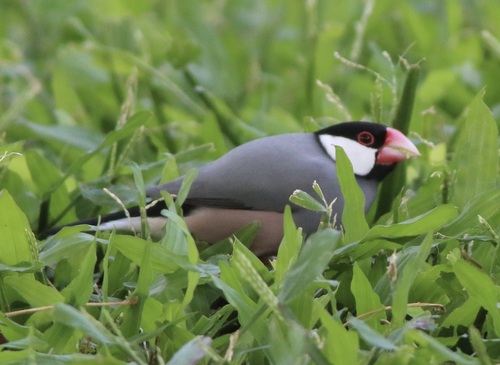 Padda de Java
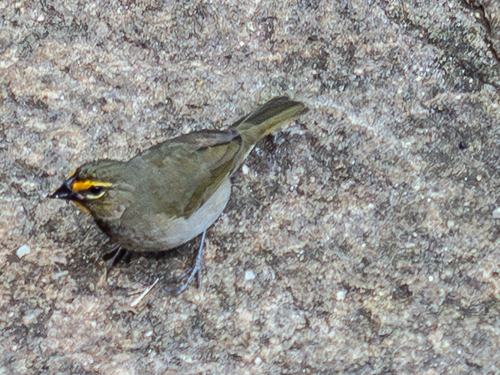 Tiaris grand-chanteur
En bref
The most reliable field mark is the Java Sparrow’s bold, white cheek patch and thick, bright red bill in adults, which are never shown by Yellow-faced Grassquit of any age. Immature Java Sparrows are plain-faced brown birds, while even young Yellow-faced Grassquits show some yellow on the face (males) or at least a greenish-olive wash (females and juveniles). Java Sparrow is much larger and heavier-bodied, with a thick, conical bill, while Yellow-faced Grassquit is noticeably smaller, slimmer, and has a more pointed bill. If you see a chunky, gray bird with a black head and white cheeks, it’s a Java Sparrow; a small, olive bird with a yellow face or dull olive face is a Yellow-faced Grassquit. Both species can be found in grassy or open areas, but their size, bill shape, and face pattern are decisive.
Conseils d’identification
- Adult Java Sparrow’s white cheek patch and black head are unique—no age or sex of Yellow-faced Grassquit ever shows a white cheek or solid black cap.
- Bill shape and color: Java Sparrow has a thick, bright red bill (adults) or blackish with pink base (juveniles); Yellow-faced Grassquit has a thinner, sharply conical dark bill (lower mandible light grey in females/immatures).
- Size and structure: Java Sparrow is much larger and bulkier than Yellow-faced Grassquit; use this especially when birds are side by side or near familiar species.
- Plumage of immatures: Immature Java Sparrows are plain brown above and below with a plain head and no yellow or olive tones; immature Yellow-faced Grassquits are dull olive-green with at least a faint yellowish or greenish face, never plain brown.
- Adult male Yellow-faced Grassquit has a yellow face and throat with black mask—Java Sparrow never shows yellow on the face or throat.
- Adult female Yellow-faced Grassquit is dull olive with faint yellow face pattern—Java Sparrow females look like males, with bold white cheeks and black head.
- Underparts: Java Sparrow has a pink belly and grey breast; Yellow-faced Grassquit is greyish-olive below, never pink.
- Leg color: Java Sparrow has pink feet; Yellow-faced Grassquit has grey legs.
- Eye color: Java Sparrow adults have a red eye-ring; Yellow-faced Grassquit has dark eyes without a colored ring.
- Flight and wing pattern: No distinctive upperwing or flight pattern is described for either species; rely on size, structure, and face pattern in flight.
- Voice: Java Sparrow’s chip and rapid song are louder and more mechanical; Yellow-faced Grassquit’s song is subdued and given during close courtship.
- Behavior: Java Sparrow appears heavy and deliberate, often in flocks; Yellow-faced Grassquit is more active, often low in grass or on stems, and males may vibrate wings while singing.
- Habitat: Java Sparrow is native to Indonesia (introduced elsewhere), often near rice fields and open country; Yellow-faced Grassquit is native to the Americas, in grassy and weedy fields.
- Season and sex: Java Sparrow sexes are similar; Yellow-faced Grassquit males are more colorful, females and immatures are duller but still olive, not brown.
- Quiz pitfall: Immature Java Sparrow’s plain brown plumage can be confused with dull female/immature Yellow-faced Grassquit, but the latter always shows some olive or yellowish on the face and never a plain brown head.
Taille
Java Sparrow is significantly larger (15–17 cm, 24.5 g [wikipedia][avonet]) than Yellow-faced Grassquit (10–10.7 cm, 8–10 g [wikipedia][avonet]). Java Sparrow is about the size of a House Sparrow and appears chunky, while Yellow-faced Grassquit is much smaller, lighter, and more delicate in structure. The Java Sparrow’s bill is thick and heavy, while the grassquit’s is sharply conical but noticeably thinner and more pointed.
Plumage
- Juvenile/immature birds: Immature Java Sparrows are brown above and pale brown below, with a plain, unmarked head and a dark beak with a pink base. They lack any yellow or olive tones. Young Yellow-faced Grassquits resemble adult females: dull olive-green above, paler grey below, and may show faint yellow on the face (especially in young males), but never have a plain brown face.
- Adult males: Java Sparrow adults have a striking combination of a black head, bright white cheek patch, grey upperparts and breast, pink belly, and a thick red bill. Yellow-faced Grassquit adult males are olive-green above, black on the face and breast, with a bright yellow throat, supercilium, and lower eyelid spot, and a dark, sharply conical bill.
- Adult females: Female Java Sparrows look like males, while female Yellow-faced Grassquits are dull olive-green above, paler below, with only a faint or nearly absent yellow face pattern.
- Bill color: Java Sparrow adults have a thick, bright red bill; young have a blackish bill with a pink base. Yellow-faced Grassquit has a dark bill (lower mandible light grey in females/immatures).
- No distinctive upperwing or flight pattern is described for either species at any age.
Comportement
Java Sparrows are often seen in flocks, feeding on the ground or perched in open areas, and appear heavy-bodied and deliberate in movement. Yellow-faced Grassquits are more likely to be seen singly or in loose groups, often low in grass or perched on stems, and are more active and agile. During courtship, male Yellow-faced Grassquits vibrate their wings while singing, a behavior not described for Java Sparrow. Java Sparrows may display social trill-calls in both aggressive and affiliative contexts.
Habitat
Java Sparrow is native to Java, Bali, and Bawean in Indonesia, and is typically found in open country, rice fields, and grassy areas, often near human habitation. Yellow-faced Grassquit is native to Central and South America and the Caribbean, favoring grassy fields, weedy areas, and open country, sometimes nesting low in grass or shrubs. Overlap in habitat is possible in introduced populations, but their native ranges do not overlap.
Voix
Java Sparrow gives a sharp 'chip' call and a rapid series of chip notes as its song. It also produces trill-calls that vary in speed and volume depending on social context (aggressive or affiliative). Yellow-faced Grassquit’s song is described as subdued and is given during courtship while perched close to the female, but no detailed description is provided. Java Sparrow’s vocalizations are generally louder and more mechanical, while Yellow-faced Grassquit’s song is softer and less conspicuous.
Padda de Java · Tiaris grand-chanteur · Mes oiseaux difficiles