

Pie-bleue ibérique vs Merle noir
Cyanopica cooki contre Turdus merula
Faire un quiz avec Pie-bleue ibérique et Merle noir
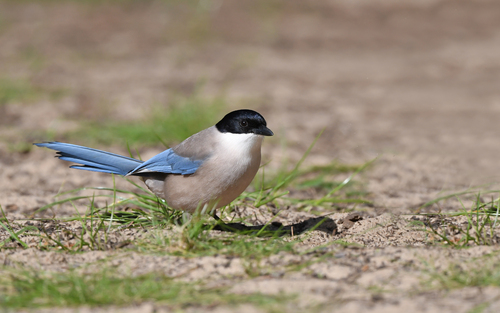 Pie-bleue ibérique
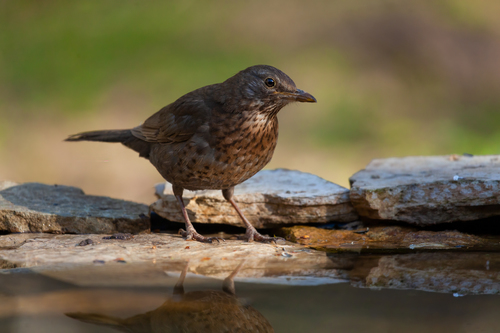 Merle noir
En bref
The most reliable way to separate Iberian Magpie from Eurasian Blackbird is by overall coloration and structure: Iberian Magpie is a slender, long-tailed corvid with striking azure-blue wings and tail, a black cap, and pale grey-fawn body, while Eurasian Blackbird is a more compact thrush with a plain dark (male) or brown (female/juvenile) plumage and no blue tones. In flight or perched, the magpie’s long blue tail and black cap stand out, whereas the blackbird shows a rounded head, shorter tail, and (in males) all-black plumage with a yellow-orange bill. Juvenile and female blackbirds are brownish and lack any blue or black cap, which can cause confusion at a distance, but the magpie’s blue wings and tail are unique. Structure, tail length, and the presence or absence of blue are key, especially in mixed flocks or suburban parks.
Conseils d’identification
- Blue wings and tail (all ages, all seasons): Only Iberian Magpie shows bright azure-blue wings and a long blue tail; blackbird never shows any blue.
- Glossy black cap (all ages): Iberian Magpie has a sharply defined black cap on the head; blackbird (all ages/sexes) never has a cap, instead showing a plain dark or brown head.
- Plumage contrast: Magpie is pale grey-fawn below and on the back, with blue and black highlights; blackbird is uniform black (male) or sooty brown (female/juvenile) with no strong color contrasts.
- Bill color: Adult male blackbird has a bright yellow-orange bill; female and juvenile have duller, brownish bills. Iberian Magpie’s bill is black and slender, never yellow or orange.
- Tail length and shape: Iberian Magpie’s tail is extremely long and straight, often half its total length, and obvious in flight. Blackbird’s tail is shorter, rounded, and never blue.
- Size and structure: Magpie is longer, slimmer, and more elongated; blackbird is compact, round-headed, and upright.
- Juvenile confusion: Juvenile blackbirds are brown with pale spots and a speckled breast, lacking any blue or cap; juvenile magpies are similar to adults in pattern, so blue and cap are always present.
- Flock behavior: Large, noisy flocks (10+ birds) in Iberia are likely magpies; blackbirds rarely form such groups, especially in breeding season.
- Habitat context: In deep woodland or northern Europe, blackbird is likely; in Iberian pine woods or large winter flocks, magpie is likely.
- Perched posture: Magpie often perches upright with tail drooping or cocked, showing off its length; blackbird perches more horizontally with a shorter tail.
- Flight style: Magpie’s flight is direct and agile, with long tail trailing; blackbird’s flight is more bounding/undulating, with a shorter tail and less obvious color.
- Eye ring: Adult male blackbird has a yellow eye ring, visible at close range; magpie does not.
- No blue in blackbird: If you see any blue on wings or tail, rule out blackbird immediately.
- No all-black magpie: If the bird is entirely black (male) or brown (female/juvenile) with no blue or cap, it is a blackbird, not a magpie.
- Bill size: Magpie’s bill is slender and small for its head; blackbird’s bill is thicker and more thrush-like, especially in males.
Taille
Iberian Magpie is larger and more elongated: 31–35 cm long with a very long tail (16–20 cm), and a slender build with smaller legs and bill compared to Eurasian Magpie. Eurasian Blackbird is noticeably smaller and more compact, at 23.5–29 cm long, with a proportionally shorter tail and heavier body. The magpie’s long tail and slim jizz are obvious in flight or when perched. Blackbird is chunkier, with a rounded head and a more upright posture. Weight also differs: blackbird is 80–125 g, while Iberian Magpie is not given here but is typically lighter for its length due to its slender build. Use tail length and overall shape for a quick size/structure check.
Plumage
- Juveniles/first-winter: Juvenile Eurasian Blackbird is brown with pale spots above and a speckled breast, lacking any blue or black cap; young males darken but retain a brownish wing and dark bill for their first year. Iberian Magpie of all ages shows a glossy black cap, pale grey-fawn underparts and back, and striking azure-blue wings and tail, with no brown or speckling. No age of blackbird ever shows blue or a black cap; no age of magpie is plain brown or blackish all over.
- Adult males: Blackbird is glossy black overall with a yellow-orange bill and eye ring. Magpie is never all-black: always blue-winged, black-capped, and pale below.
- Adult females: Blackbird female is sooty-brown with a dull yellowish bill and brownish-white throat, sometimes with faint mottling; again, never blue or capped. Magpie female is similar to male magpie.
- In flight: Magpie’s blue wings and long blue tail are diagnostic at all ages; blackbird shows plain dark wings and tail, with no blue or contrasting cap.
Comportement
Iberian Magpies are highly social, often seen in family groups or large flocks, especially outside the breeding season. They feed together, sometimes in groups up to 70 birds, and nest in loose colonies. Their flight is agile and direct, with long tails trailing. Eurasian Blackbirds are more solitary or seen in pairs, especially in the breeding season; outside of breeding, they may form small loose flocks but not the large, coordinated groups of magpies. Blackbirds forage mostly on the ground, hopping and running, and their flight is more undulating with bursts of rapid wingbeats. Territorial aggression is common in both, but magpie flocks are much more conspicuous.
Habitat
Both species can be found in parks, gardens, and woodland edges, but Iberian Magpie is restricted to the Iberian Peninsula (Spain, Portugal, and rarely SW France/Italy), favoring pine and broadleaf forests, including urban parks. Eurasian Blackbird is much more widespread across Europe, western Asia, and North Africa, and is common in a wider range of habitats, including deep woodland, hedgerows, and urban areas. If you are outside Iberia, the magpie is very unlikely; blackbird is ubiquitous in much of Europe.