

Coucou de Horsfield vs Coucou éclatant
Chalcites basalis contre Chalcites lucidus
Faire un quiz avec Coucou de Horsfield et Coucou éclatant
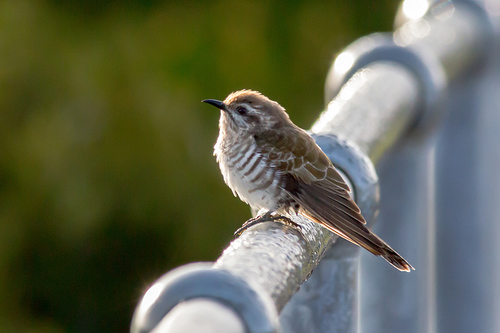 Coucou de Horsfield
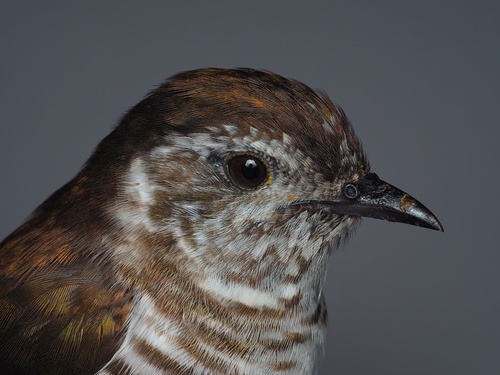 Coucou éclatant
En bref
The most reliable field mark to separate Horsfield's Bronze-Cuckoo from Shining Bronze-Cuckoo is the facial pattern: Horsfield's shows a bold white eyebrow and a dark brown eye-stripe, while Shining lacks this strong contrast and instead has white cheeks with no distinct eyebrow. Both are small, iridescent green cuckoos with barred underparts, but Shining Bronze-Cuckoo is slightly larger and has dark green barring on the underparts, while Horsfield's has incomplete brown barring. Juvenile and immature plumages are not described in detail for either species, so adults and older immatures are most safely separated by face pattern and underpart barring color. In perched or flight views, look for the facial contrast and the color of the barring below.
Conseils d’identification
- Facial pattern is key: Horsfield's Bronze-Cuckoo has a strong white eyebrow and a dark brown eye-stripe, creating a bold facial contrast. Shining Bronze-Cuckoo lacks the eyebrow and instead has plain white cheeks with no strong eye-stripe. This is the most consistent field mark for adults and older immatures.
- Underpart barring color: Horsfield's shows incomplete brown barring from neck to tail; Shining has more complete, dark green barring on white underparts. The greenish tone of the barring is distinctive for Shining.
- Upperparts iridescence: Both are iridescent, but Shining Bronze-Cuckoo is described as more golden or coppery, while Horsfield's is green and bronze. This difference is subtle and can be affected by lighting.
- Cheek color: Shining Bronze-Cuckoo has white cheeks, but they do not form a distinct eyebrow; Horsfield's has a white eyebrow but not a large white cheek patch.
- Crown and nape in females: Female Shining Bronze-Cuckoo may show a purplish sheen to the crown and nape, and bronzer-tinged barring on the belly, but this is subtle and not always visible.
- Size: Shining Bronze-Cuckoo is slightly larger and heavier, but this is rarely diagnostic unless both species are seen together.
- Host context: If observed near fairy-wrens, Horsfield's is more likely; if near Gerygone or other dome-nesting warblers, Shining is more likely. However, both can use a range of hosts, so this is only a supporting clue.
- Egg color (not a field mark, but context): Shining lays dark, matte eggs (olive brown to dark brown), while Horsfield's lays pinkish-white eggs with red-brown speckling. This is only useful if observing parasitized nests.
- Habitat and range: In New Zealand or Pacific islands, only Shining Bronze-Cuckoo is present. In Australia, both occur, but Shining is more widespread in wetter forests and woodlands.
- Behavior: Both species are secretive and more often heard than seen. Foraging and flight behavior are similar and not reliably separable in the field.
- Perched vs. in flight: No distinctive flight or upperwing pattern is described for either species, so separation in flight relies on overall coloration and facial pattern if seen well.
- Juvenile/immature plumage: No detailed information is available for age-specific flight or wing pattern differences; use adult marks for all ages unless new information becomes available.
- Vocalization: No comparative information is provided in the sources; do not use voice for separation based on current notes.
- Lighting pitfalls: Iridescence can appear different in varying light; always confirm with facial and underpart pattern.
- Sex differences: Female Shining may show purplish crown/nape and bronzer barring, but this is subtle and not always visible; sex is not a reliable field mark for separation.
Taille
Shining Bronze-Cuckoo is marginally larger, measuring 13–18 cm in length and weighing about 25 g, compared to Horsfield's Bronze-Cuckoo at 22 g. The difference is subtle and may not be obvious in the field unless both species are seen together. Both are among the smallest cuckoos, but Shining Bronze-Cuckoo is consistently described as the slightly larger of the two. Wingspan for Shining is 25–32 cm, but no direct comparison for Horsfield's is available; expect a slightly shorter wingspan for Horsfield's.
Plumage
No detailed age-specific wing or flight pattern differences are described for juveniles or immatures in the sources. For adults and older immatures, Horsfield's Bronze-Cuckoo shows green and bronze iridescent upperparts, a bold white eyebrow, and a dark brown eye-stripe, with incomplete brown barring on the underparts. Shining Bronze-Cuckoo has metallic golden or coppery green upperparts, white cheeks (not a strong eyebrow), and underparts with dark green barring. The female Shining Bronze-Cuckoo may show a purplish sheen on the crown and nape and bronzer-tinged barring on the belly. In summary, focus on the facial pattern and the color/intensity of the underpart barring for separation.
Comportement
Both species are brood parasites, laying eggs in the nests of small passerines. Horsfield's Bronze-Cuckoo primarily targets fairy-wrens (Malurus), while Shining Bronze-Cuckoo focuses on Gerygone species and other dome-nesting hosts. Both remove a host egg when laying and their chicks eject host young after hatching. Foraging behavior is similar: both take insects from foliage or on the wing, and both can be nomadic during the breeding season. In courtship, Horsfield's Bronze-Cuckoo is noted to feed its mate, but this is not described for Shining.
Habitat
Both species occur in Australia and overlap in range, but Shining Bronze-Cuckoo is more widespread, also found in New Zealand, New Caledonia, and other Pacific islands. Horsfield's is more strictly Australian. Both prefer areas with high densities of their preferred hosts: Horsfield's in areas with many fairy-wrens, Shining in areas with abundant Gerygone or similar dome-nesters. Both may be found in open woodland, forest edge, and shrubland, but Shining is more likely in wetter forests and also migrates to New Zealand.
Coucou de Horsfield · Coucou éclatant · Mes oiseaux difficiles