

Paon spicifère vs Mésangeai du Canada
Pavo muticus contre Perisoreus canadensis
Faire un quiz avec Paon spicifère et Mésangeai du Canada
 Paon spicifère
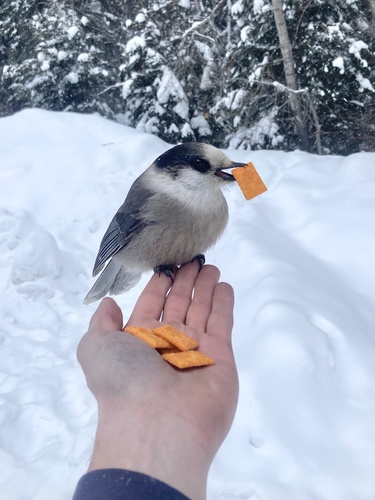 Mésangeai du Canada
En bref
The most reliable way to separate Green Peafowl from Canada Jay in the field is by overall structure and size: Green Peafowl is a massive, long-legged ground-dwelling bird with iridescent green plumage and (in males) an extremely long train, while Canada Jay is a medium-sized, thick-plumaged songbird with a short bill and a fluffy, grey-and-white appearance. In flight, Green Peafowl shows long, heavy wings and a strikingly long tail or train (in males), while Canada Jay has a short, rounded tail and broad wings. Juvenile Canada Jays are all-dark grey, unlike any age of Green Peafowl. Habitat is also a strong clue: Green Peafowl is found in tropical Asian forests, Canada Jay in cold North American boreal woods. Even at great distance, the size, structure, and habitat context should prevent confusion.
Conseils d’identification
- Size and structure: Green Peafowl is vastly larger than Canada Jay, with long legs, a heavy body, and (in males) a train that can be several meters long. Canada Jay is a compact, thick-plumaged songbird with a short bill and rounded tail.
- Flight silhouette: In flight, Green Peafowl shows long, broad wings and a trailing tail or train (in males), with a heavy, direct flapping style. Canada Jay has broad, rounded wings and a short, rounded tail; flight is buoyant and gliding.
- Juvenile plumage: Juvenile Canada Jays are all-dark grey, lacking any white on the face or underparts; Green Peafowl juveniles are never all-dark and always show some greenish or barred patterning.
- Iridescence: Green Peafowl (both sexes) shows strong green iridescence on neck and breast, with blue scapulars in males. Canada Jay is never iridescent—plumage is matte grey and white.
- Train and tail: Male Green Peafowl in breeding plumage has a spectacular train with eyespots; even outside breeding, the tail is long. Canada Jay never shows a train or any tail ornamentation—tail is medium-length, rounded, and plain grey with pale tips.
- Wing coverts: Male Green Peafowl has blue scapulars and coverts, green lesser coverts forming a scaly triangle on the shoulder; female has blue lesser coverts and copper-fringed neck scales. Canada Jay's wing coverts are uniform grey, never blue or green.
- Facial pattern: Green Peafowl has a double-striped facial skin with whitish-blue and yellow-orange crescents, and a dark triangle below the eye (bluish-green in male, brown in female). Canada Jay has a white face with a dark grey or black nape and hood, lacking any bare skin or bright colors.
- Crest: Both sexes of Green Peafowl have a crest of upright plumes (taller and thinner in males, wider in females); Canada Jay has no crest, just a rounded head.
- Legs: Green Peafowl has long, strong legs for walking; Canada Jay has short legs suited for perching.
- Bill: Green Peafowl has a strong, slightly curved bill; Canada Jay's bill is short, straight, and black, typical of corvids.
- Habitat: Green Peafowl is found in tropical Asian forests and grasslands; Canada Jay is found only in North American boreal or subalpine coniferous forests. If you are in the Americas or in cold, coniferous woods, you are seeing a Canada Jay.
- Vocalizations: Green Peafowl's calls are loud, ringing, and far-carrying; Canada Jay's are soft, varied, and often mimic other birds.
- Behavior: Green Peafowl is usually solitary or in small family groups, often on the ground; Canada Jay is social, arboreal, and often approaches humans.
- Seasonal changes: Male Green Peafowl loses the train outside breeding season, making sexing more difficult, but still retains iridescent green and blue wing coverts. Canada Jay does not have seasonal plumage changes.
- Pitfalls: Distant views of a female or non-breeding male Green Peafowl may appear dark and less ornate, but the size, structure, and habitat should still prevent confusion with Canada Jay. Juvenile Canada Jays are unique in their all-dark plumage and cannot be confused with any peafowl.
Taille
Green Peafowl is one of the largest flying birds: adult males reach 1.8–3 m (5 ft 11 in – 9 ft 10 in) in total length including the train, with females about half that length. Their wingspan can reach up to 1.6 m (5 ft 3 in). In contrast, Canada Jay is a medium-sized songbird, 25–33 cm (9.8–13 in) long with a wingspan around 45 cm (18 in). The peafowl is many times larger and heavier, with a much longer tail and legs. Even a female Green Peafowl dwarfs a Canada Jay.
Plumage
-
Juvenile/immature contrast: Juvenile Canada Jays are uniformly very dark grey, lacking the white head and pale underparts of adults, and never show iridescence or long trains. Juvenile Green Peafowl resemble adults but are generally duller and lack the long train of adult males; both sexes are dark, scaly green with pale faces and no all-dark phase.
-
Adult males: Green Peafowl males have bright, iridescent green neck and breast, blue scapular and wing coverts, and a spectacular, long train with eyespots. Canada Jay adults are soft grey above, pale grey below, with a white face and dark nape—no iridescence, no train, and no blue or green tones.
-
Adult females: Female Green Peafowl are also iridescent green but lack the long train, have more barring and copper fringes, and blue lesser wing coverts. Canada Jay females are identical to males in plumage—grey and white, never iridescent.
-
In flight: Green Peafowl shows long, heavy wings, a long tail or train (in males), and pale primaries visible in flight. Canada Jay has broad, rounded wings and a medium-length, rounded grey tail with pale tips, but never any long plumes or iridescence.
Comportement
Green Peafowl spends much time on the ground, walking through tall grasses and forest edges, but is capable of strong, sustained flight—though flight is heavy and direct, lacking gliding. They often roost high in trees. Canada Jay is arboreal, moving nimbly through coniferous trees, often perching conspicuously or gliding between branches. Canada Jays are highly social, often seen in family groups, while Green Peafowl is more solitary or in small family units. Green Peafowl males are territorial and may be seen displaying (if in breeding plumage), while Canada Jays cache food and are known for their bold, inquisitive behavior around humans.
Habitat
Green Peafowl inhabits tropical forests and tall grasslands of Southeast Asia and southern China, often near water and in dense, humid environments. Canada Jay is restricted to boreal forests and subalpine coniferous woods of North America, far north or at high elevation. You will not encounter these species in the same region or habitat: Green Peafowl is strictly Old World and tropical, Canada Jay strictly New World and cold-temperate to subarctic.
Voix
Green Peafowl males give loud, repeated 'ki-wao' calls at dawn and dusk, while females have a loud 'AOw-aa' call. These are harsh, far-carrying, and unlike any jay. Canada Jay gives a variety of soft whistles, clicks, and chuckles, sometimes mimicking other birds or mammals, but never produces the loud, ringing calls of a peafowl. Canada Jay's calls are quieter and more varied, often described as gentle or conversational.
Paon spicifère · Mésangeai du Canada · Mes oiseaux difficiles