

Bécasseau de l'Anadyr vs Bécasseau maubèche
Calidris tenuirostris contre Calidris canutus
Faire un quiz avec Bécasseau de l'Anadyr et Bécasseau maubèche
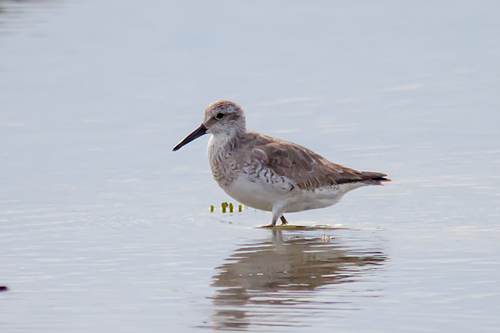 Bécasseau de l'Anadyr
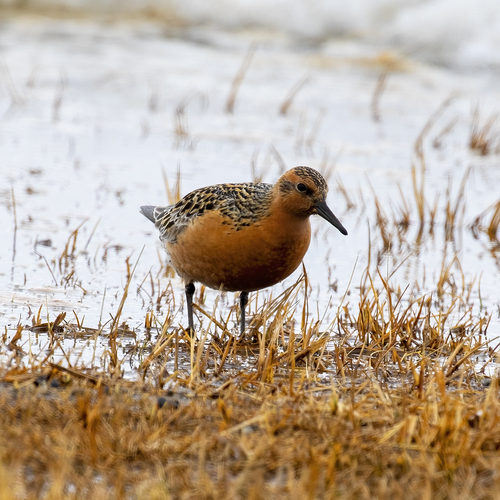 Bécasseau maubèche
En bref
The most reliable field mark between Great Knot and Red Knot is the breeding plumage: Great Knot shows a heavily spotted black breast and a rufous band on the scapulars, while Red Knot in breeding plumage has a rich cinnamon-red face, throat, and breast. In non-breeding (winter) plumage, both are pale grey above and can be very similar, so structural differences become more important: Great Knot is noticeably larger and bulkier, with a longer, slightly downcurved bill and a deeper chest, while Red Knot is smaller, more compact, and has a shorter, straight bill. Juvenile and immature plumages are not detailed in the sources for Great Knot, but Red Knot juveniles have distinctive brown coverts and submarginal lines in their first year. In flight, both show a white wingbar, but Red Knot has a grey rump and tail, which can help in some views. Use a combination of size, structure, and subtle plumage details, especially outside the breeding season.
Conseils d’identification
- Breeding plumage is the most reliable mark: Great Knot has a heavily spotted black breast and a rufous scapular band; Red Knot has a rich cinnamon-red face, throat, and breast. This is the easiest separation in spring/summer.
- Non-breeding plumage is subtle: Both become pale grey above and can be very similar. Look for Great Knot's slightly more streaked upperparts and deeper chest, but these are subtle and unreliable at distance.
- Size and structure: Great Knot is larger and bulkier, with a deeper chest and longer body. Red Knot is smaller, more compact, and appears 'low-slung' when feeding. Use size only when birds are side by side or with known species for scale.
- Bill shape: Great Knot has a longer, slightly downcurved bill; Red Knot's bill is shorter, straight, and about the length of its head. This is best judged at close range or with good optics.
- Flight pattern: Both show a white wingbar, but Red Knot has a grey rump and tail, which can be seen in good light and is a helpful mark in flight.
- Juvenile/first-year birds: Red Knot juveniles have brown coverts and submarginal lines, which can help separate them from Great Knot juveniles (details for Great Knot juveniles not described).
- Chest pattern: Outside breeding, Great Knot may retain a deeper chest and more streaked upperparts, while Red Knot is more evenly pale grey.
- Leg color: Both have short dark legs; leg color is not a separator.
- Feeding posture: Red Knot often looks lower to the ground when feeding due to its body shape; Great Knot stands taller and bulkier.
- Sex differences: Female Red Knots are slightly paler in breeding plumage and have a less distinct eye-line, but this is subtle and not useful for separating from Great Knot.
- Habitat context: In Australia, Great Knot is more likely, but Red Knot can occur. Use local abundance as a supporting clue, not a primary mark.
- Vocalizations: Red Knot may call 'knutt' or 'knuup-knuup' in flight; Great Knot's calls are not described. Do not rely on voice for separation.
- Seasonal context: Breeding plumage is only present in spring/summer and during migration; in winter, rely on structure and subtle plumage differences.
- Flock composition: Both species may mix with other Calidris sandpipers; compare with known species for size and structure.
- When in doubt: If the bird is in non-breeding plumage and size/structure are ambiguous, it may not be possible to separate with confidence without more detailed views.
Taille
Great Knot is the larger of the two, with a body mass averaging 165 g compared to Red Knot's 137 g [wikidata]. Great Knot measures 26–30 cm in length with a wingspan of 56–66 cm, while Red Knot is 23–26 cm long with a 47–53 cm wingspan [wikipedia]. In the field, Great Knot appears bulkier, with a deeper chest and longer body, while Red Knot is more compact and 'low-slung' when feeding. These differences are most apparent when both species are seen side by side, but can be subtle at a distance or in mixed flocks.
Plumage
- Juvenile/First-year: Red Knot juveniles have brown coverts and distinctive submarginal lines in their first year, which can help separate them from Great Knot, though detailed juvenile Great Knot plumage is not described in the sources.
- Breeding adult: Great Knot shows a heavily spotted black face, throat, and breast with a rufous band on the scapulars. Red Knot in breeding plumage is mottled grey above with a rich cinnamon-red face, throat, and breast, and a paler rear belly. Female Red Knots are slightly paler and have a less distinct eye-line than males.
- Non-breeding (winter) adult: Both species become pale grey above and can look very similar. Great Knot may show a slightly more streaked upperpart pattern, while Red Knot is more uniformly pale grey.
- In flight: Both show a white wingbar, but Red Knot has a grey rump and tail, which can be a useful distinction if seen well.
Comportement
Both species forage on mudflats and beaches, probing or picking up food by sight (Great Knot) or tactile probing (Red Knot). Red Knot often appears 'low-slung' when feeding due to its short legs and body shape. There is no mention of significant behavioral differences in the sources that are diagnostic for separation.
Habitat
Both species use similar habitats: coastal mudflats and beaches during migration and winter. Great Knot breeds in eastern Siberia and winters in southern Asia and Australia, while Red Knot breeds in high Arctic tundra across the Northern Hemisphere and winters along coasts worldwide. In Australia, Great Knot is more likely, but Red Knot can occur as well. Habitat alone is not a strong separator unless local abundance is known.
Voix
Red Knot is described as generally quiet when feeding, but gives a low monosyllabic 'knutt' in flight and a disyllabic 'knuup-knuup' on migration. Great Knot's voice is not described in the sources. Vocalizations are not a reliable field separator based on available information.
Bécasseau de l'Anadyr · Bécasseau maubèche · Mes oiseaux difficiles