

Motmot

Dicée de la Sonde vs Dicée à bec épais

Dicaeum annae contre Pachyglossa agilis

Faire un quiz avec Dicée de la Sonde et Dicée à bec épais

Dicée de la Sonde (Dicaeum annae) Dicée de la Sonde
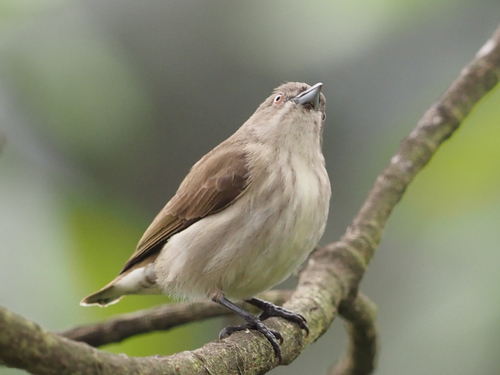
Dicée à bec épais (Pachyglossa agilis) Dicée à bec épais

Médias

Chargement…

En bref

The most reliable field mark to separate Golden-rumped Flowerpecker from Thick-billed Flowerpecker is the presence of a golden or yellow rump patch on the former, which is absent in the latter. Thick-billed Flowerpecker shows a uniform dark grey-brown upperpart with a slightly olive rump (in the nominate race), dull streaked underparts, and a noticeably thick, dark bill. Juvenile Thick-billeds have a paler bill base and less streaking below, but still lack any bright rump. Both species are small, active flowerpeckers, but their ranges overlap only in parts of the Lesser Sundas and adjacent islands, so location can help. In perched or flight views, always look for the golden rump on Dicaeum annae; its absence and the presence of a heavy bill point to Pachyglossa agilis.

Conseils d’identification

  1. Golden/yellow rump patch: Only Golden-rumped Flowerpecker shows a bright golden or yellow rump, visible in both perched and flight views. This is the single most reliable field mark for all ages and sexes.
  2. Absence of golden rump: Thick-billed Flowerpecker never shows a golden rump; its rump is dark grey-brown with a slight olive tinge at best (nominate race), so any hint of yellow rules it out.
  3. Bill structure: Thick-billed has a noticeably thick, heavy, and dark bill, giving it a chunky-headed look. Golden-rumped has a finer, more delicate bill typical of Dicaeum. This is best seen at close range or in good light.
  4. Underpart streaking: Thick-billed shows diffuse greyish streaking on light buffy underparts in adults; juveniles have less streaking. Golden-rumped's underparts are not described as streaked, so a streaked look points to Thick-billed.
  5. Tail pattern: Thick-billed may show whitish spots at the tips of the tail feathers, but these are subtle and not always visible. Golden-rumped does not have this feature.
  6. Juvenile marks: Juvenile Thick-billeds have a paler base to the mandible and less streaking below, but still lack any yellow rump. Immature Golden-rumped likely retain the golden rump patch.
  7. Sex differences: Both species are sexually monomorphic in the field; do not rely on sex for separation.
  8. Behavior – tail movement: Thick-billed often jerks its tail side to side when perched, a subtle behavioral clue if seen well.
  9. Foraging height: Thick-billed tends to forage high in the canopy, especially in Sri Lanka, but this is not diagnostic where ranges overlap.
  10. Vocalizations: If you hear a frequent 'spick' call or a rambling, Ashy Prinia-like song, Thick-billed is likely. Golden-rumped's voice is not described.
  11. Range: Outside the Lesser Sundas, only Thick-billed is expected. Within the Lesser Sundas, both are possible; rely on plumage and structure.
  12. Habitat: Both use forested habitats, but Thick-billed can also be found in more open or cultivated areas (nominate race).
  13. General jizz: Both are small, active flowerpeckers, but Thick-billed may appear chunkier due to its heavy bill and short tail.
  14. Display behavior: Thick-billed males may show an erected crown stripe in display, but this is rarely seen in the field.
  15. Nest association: Not useful for field ID, but Thick-billed sometimes nests near Oecophylla ant nests.

Taille

Thick-billed Flowerpecker is about 10 cm long [wikipedia], which is typical for small flowerpeckers. No direct measurement is available for Golden-rumped Flowerpecker in the provided sources, but both are similarly tiny and size is not a reliable separator in the field. Bill structure is more useful: Thick-billed has a notably stout, heavy bill, while Golden-rumped (like most Dicaeum) has a finer, more delicate bill.

Plumage

For all ages, Golden-rumped Flowerpecker stands out with a conspicuous golden or yellow rump patch, visible both perched and in flight. This mark is present in adults and, based on typical Dicaeum patterns, likely visible in immatures as well. Thick-billed Flowerpecker never shows a golden rump; instead, its upperparts are dark grey-brown with a slightly olive tinge on the rump (nominate race), and the underparts are dull greyish with diffuse streaking. Juvenile Thick-billeds have less streaking and a paler base to the mandible but still lack any bright rump color. Both sexes of Thick-billed look alike and do not show sexual dimorphism in plumage. Whitish tips on the tail feathers of Thick-billed may be visible at close range, but are subtle compared to the golden rump of Dicaeum annae.

Comportement

Both species are active and forage in the canopy, often moving quickly among branches. Thick-billed Flowerpecker is noted for frequently jerking its tail from side to side when perched and foraging higher in the canopy than some congeners. It also wipes mistletoe seeds on branches rather than swallowing them whole. Golden-rumped Flowerpecker's behavior is less well described in the notes, but as a Dicaeum, it is likely similarly active and agile. Neither species is likely to be seen for long in one spot.

Habitat

Golden-rumped Flowerpecker is endemic to the Lesser Sunda Islands, so any sighting outside this region is unlikely to be this species. Thick-billed Flowerpecker is widespread across southern Asia, including parts of Indonesia and Timor, and occurs in a range of habitats from dense lowland forest (most subspecies) to more open or cultivated areas (nominate race). If you are birding in the Lesser Sundas, both are possible, but elsewhere only Thick-billed is likely. Habitat alone is not diagnostic where ranges overlap, but can help elsewhere.

Voix

Thick-billed Flowerpecker gives a frequent 'spick' call while foraging and has a rambling song with notes reminiscent of Ashy Prinia. No vocalization information is provided for Golden-rumped Flowerpecker in the notes, so voice is not a reliable separator unless you know the Thick-billed's distinctive calls.

Envoyer une meilleure description

Utilise les mêmes sections que la comparaison. Ton texte est publié tout de suite.

The most reliable field mark to separate Golden-rumped Flowerpecker from Thick-billed Flowerpecker is the presence of a golden or yellow rump patch on the former, which is absent in the latter. Thick-billed Flowerpecker shows a uniform dark grey-brown upperpart with a slightly olive rump (in the nominate race), dull streaked underparts, and a noticeably thick, dark bill. Juvenile Thick-billeds have a paler bill base and less streaking below, but still lack any bright rump. Both species are small, active flowerpeckers, but their ranges overlap only in parts of the Lesser Sundas and adjacent islands, so location can help. In perched or flight views, always look for the golden rump on Dicaeum annae; its absence and the presence of a heavy bill point to Pachyglossa agilis.

  1. Golden/yellow rump patch: Only Golden-rumped Flowerpecker shows a bright golden or yellow rump, visible in both perched and flight views. This is the single most reliable field mark for all ages and sexes.
  2. Absence of golden rump: Thick-billed Flowerpecker never shows a golden rump; its rump is dark grey-brown with a slight olive tinge at best (nominate race), so any hint of yellow rules it out.
  3. Bill structure: Thick-billed has a noticeably thick, heavy, and dark bill, giving it a chunky-headed look. Golden-rumped has a finer, more delicate bill typical of Dicaeum. This is best seen at close range or in good light.
  4. Underpart streaking: Thick-billed shows diffuse greyish streaking on light buffy underparts in adults; juveniles have less streaking. Golden-rumped's underparts are not described as streaked, so a streaked look points to Thick-billed.
  5. Tail pattern: Thick-billed may show whitish spots at the tips of the tail feathers, but these are subtle and not always visible. Golden-rumped does not have this feature.
  6. Juvenile marks: Juvenile Thick-billeds have a paler base to the mandible and less streaking below, but still lack any yellow rump. Immature Golden-rumped likely retain the golden rump patch.
  7. Sex differences: Both species are sexually monomorphic in the field; do not rely on sex for separation.
  8. Behavior – tail movement: Thick-billed often jerks its tail side to side when perched, a subtle behavioral clue if seen well.
  9. Foraging height: Thick-billed tends to forage high in the canopy, especially in Sri Lanka, but this is not diagnostic where ranges overlap.
  10. Vocalizations: If you hear a frequent 'spick' call or a rambling, Ashy Prinia-like song, Thick-billed is likely. Golden-rumped's voice is not described.
  11. Range: Outside the Lesser Sundas, only Thick-billed is expected. Within the Lesser Sundas, both are possible; rely on plumage and structure.
  12. Habitat: Both use forested habitats, but Thick-billed can also be found in more open or cultivated areas (nominate race).
  13. General jizz: Both are small, active flowerpeckers, but Thick-billed may appear chunkier due to its heavy bill and short tail.
  14. Display behavior: Thick-billed males may show an erected crown stripe in display, but this is rarely seen in the field.
  15. Nest association: Not useful for field ID, but Thick-billed sometimes nests near Oecophylla ant nests.

Thick-billed Flowerpecker is about 10 cm long [wikipedia], which is typical for small flowerpeckers. No direct measurement is available for Golden-rumped Flowerpecker in the provided sources, but both are similarly tiny and size is not a reliable separator in the field. Bill structure is more useful: Thick-billed has a notably stout, heavy bill, while Golden-rumped (like most Dicaeum) has a finer, more delicate bill.

For all ages, Golden-rumped Flowerpecker stands out with a conspicuous golden or yellow rump patch, visible both perched and in flight. This mark is present in adults and, based on typical Dicaeum patterns, likely visible in immatures as well. Thick-billed Flowerpecker never shows a golden rump; instead, its upperparts are dark grey-brown with a slightly olive tinge on the rump (nominate race), and the underparts are dull greyish with diffuse streaking. Juvenile Thick-billeds have less streaking and a paler base to the mandible but still lack any bright rump color. Both sexes of Thick-billed look alike and do not show sexual dimorphism in plumage. Whitish tips on the tail feathers of Thick-billed may be visible at close range, but are subtle compared to the golden rump of Dicaeum annae.

Both species are active and forage in the canopy, often moving quickly among branches. Thick-billed Flowerpecker is noted for frequently jerking its tail from side to side when perched and foraging higher in the canopy than some congeners. It also wipes mistletoe seeds on branches rather than swallowing them whole. Golden-rumped Flowerpecker's behavior is less well described in the notes, but as a Dicaeum, it is likely similarly active and agile. Neither species is likely to be seen for long in one spot.

Golden-rumped Flowerpecker is endemic to the Lesser Sunda Islands, so any sighting outside this region is unlikely to be this species. Thick-billed Flowerpecker is widespread across southern Asia, including parts of Indonesia and Timor, and occurs in a range of habitats from dense lowland forest (most subspecies) to more open or cultivated areas (nominate race). If you are birding in the Lesser Sundas, both are possible, but elsewhere only Thick-billed is likely. Habitat alone is not diagnostic where ranges overlap, but can help elsewhere.

Thick-billed Flowerpecker gives a frequent 'spick' call while foraging and has a rambling song with notes reminiscent of Ashy Prinia. No vocalization information is provided for Golden-rumped Flowerpecker in the notes, so voice is not a reliable separator unless you know the Thick-billed's distinctive calls.

Abandonner tes modifications ?

Tu as des modifications non enregistrées. Si tu pars maintenant, elles seront perdues.

Dicée de la Sonde · Dicée à bec épais · Mes oiseaux difficiles