

Courvite isabelle vs Glaréole à collier
Cursorius cursor contre Glareola pratincola
Faire un quiz avec Courvite isabelle et Glaréole à collier
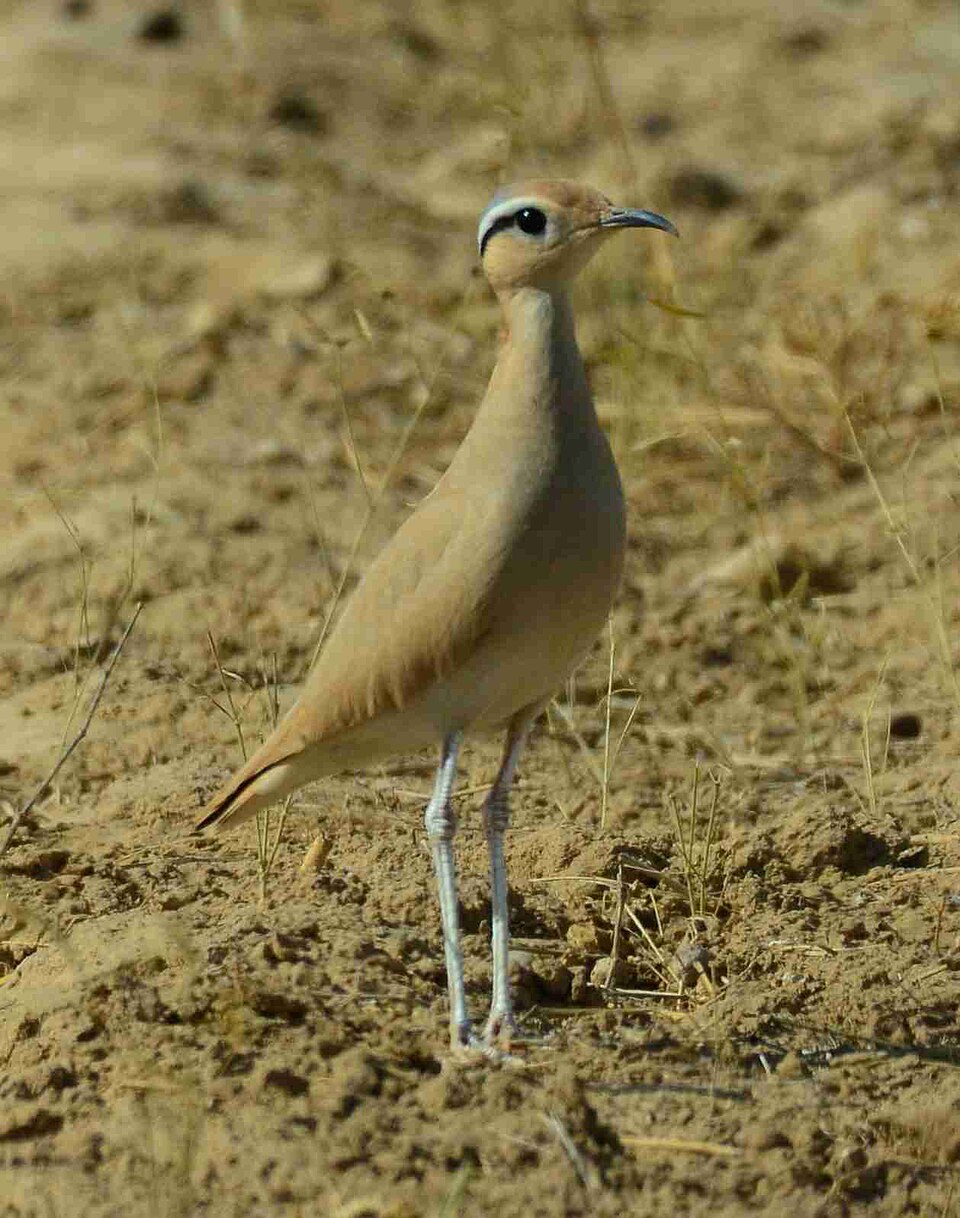 Courvite isabelle
 Glaréole à collier
En bref
The most reliable field mark is the underwing color in flight: Cream-coloured Courser shows striking black underwings (and black outer upperwings), while Collared Pratincole has chestnut underwings that appear dark but not black. Juvenile Cream-coloured Coursers are mottled above and have a duller head pattern, while pratincoles lack this mottling. Structurally, the courser has long legs and a slightly downcurved bill, giving it a very different jizz from the short-legged, fork-tailed pratincole. Both species can be seen running on the ground, but pratincoles are more aerial. Size and shape differences are subtle at a distance, but the courser is heavier and more upright.
Conseils d’identification
- Underwing color in flight: Cream-coloured Courser shows black underwings and black outer upperwings, visible in all ages; Collared Pratincole has chestnut underwings that look dark but not black. This is the single most reliable mark in flight.
- Juvenile upperparts: Juvenile coursers are mottled dark above and have a duller, less distinct head pattern; pratincole juveniles are brown above but lack strong mottling. If you see a mottled back, it's a young courser.
- Head pattern: Courser adults have a bold black eyestripe and a conspicuous white supercilium, with a grey crown and blue-grey nape. Pratincole's head is plain brown without strong facial markings. This is best seen on perched birds at close range.
- Leg length: Courser has very long, pale grey legs (7–8 cm), giving it a tall, upright stance. Pratincole has short legs and sits low to the ground. This is a strong structural clue when birds are standing.
- Bill shape: Courser's bill is slightly downcurved and longer; pratincole's bill is short and straight, adapted for aerial feeding. This is subtle but visible at close range.
- Tail shape: Pratincole has a long, deeply forked tail, especially obvious in flight or when fanned. Courser's tail is shorter and less forked.
- Overall color above: Courser is sandy above, fading to whitish below; pratincole is brown above with a white belly. In bright light, the courser looks paler and more uniform.
- Flight style: Courser's flight is relaxed with pointed wings, but it is less aerial and more likely to land quickly. Pratincole is agile, buoyant, and spends more time on the wing, often catching insects in flight.
- Perched posture: Courser stands tall and upright; pratincole sits low and horizontal.
- Habitat context: In dry, open semi-desert, courser is more likely. In wetlands, grasslands, or near water, pratincole is favored.
- Relative size: Courser is heavier and bulkier (129 g vs 77 g), but pratincole is longer and has a longer wingspan and tail. Size alone is not diagnostic but can support other marks.
- Supercilium: The courser's white supercilium is strong and contrasts with its head pattern; pratincole lacks a supercilium.
- Crown and nape color: Courser has a grey to blue-grey crown and nape, while pratincole's crown is plain brown.
- Behavior on the ground: Both species can run, but the courser is more terrestrial and less likely to take to the air for long periods.
- Plumage pitfalls: In poor light, the pratincole's chestnut underwing may look very dark, but never as black as the courser's. Always try for a good view of the underwing in flight for confirmation.
Taille
Cream-coloured Courser is significantly heavier (129 g vs 77 g) and appears stockier, with long (7–8 cm) legs and a more upright stance. It is slightly shorter in length (19–27 cm) compared to the Collared Pratincole (24–28 cm), but the pratincole has a longer wingspan (60–70 cm vs 51–57 cm) and a notably long, deeply forked tail. The courser's legs are much longer relative to its body, while the pratincole's legs are short and its body more streamlined for aerial feeding.
Plumage
- Juvenile/immature birds: Juvenile Cream-coloured Coursers are mottled dark above and have a duller, less distinct head pattern than adults. Collared Pratincole juveniles are not described as mottled above; their upperparts are brown but lack strong mottling, so a mottled back and subdued head pattern point to young coursers.
- Adults in flight: The courser shows black outer upperwings and black underwings, which are diagnostic when seen well. The pratincole has chestnut underwings that look dark but not truly black; its upperwings are brown with darker flight feathers, lacking the stark black of the courser. Both have white bellies, but the courser is sandy above and fades to whitish below, while the pratincole is brown above.
- Head pattern: The courser has a grey crown, blue-grey nape, a bold black eyestripe, and a strong white supercilium; the pratincole's head is brown and lacks these contrasting marks.
- Tail: Pratincole has a long, deeply forked tail; the courser’s tail is shorter and less forked.
Comportement
Cream-coloured Courser typically runs on the ground in open, dry habitats, using its long legs to chase insects. Its flight is described as relaxed with pointed wings, somewhat pratincole-like, but it is less aerial overall. Collared Pratincole, while also capable of running on the ground, is much more aerial: it often hawks insects on the wing like a swallow, using its long wings and forked tail for agile flight. Perched, the courser stands upright on long legs, while the pratincole sits low with short legs.
Habitat
Cream-coloured Courser favors dry, open semi-desert regions and is most often seen in arid landscapes with sparse vegetation. Collared Pratincole prefers more varied open habitats, including wetlands, grasslands, and riverbanks, and is less strictly tied to arid environments. If you find the bird in a true semi-desert, courser is more likely; in lush grassland or near water, pratincole is favored.
Courvite isabelle · Glaréole à collier · Mes oiseaux difficiles