

Dormilon à ventre roux vs Moucherolle à croupion roux
Muscisaxicola capistratus contre Cnemarchus erythropygius
Faire un quiz avec Dormilon à ventre roux et Moucherolle à croupion roux
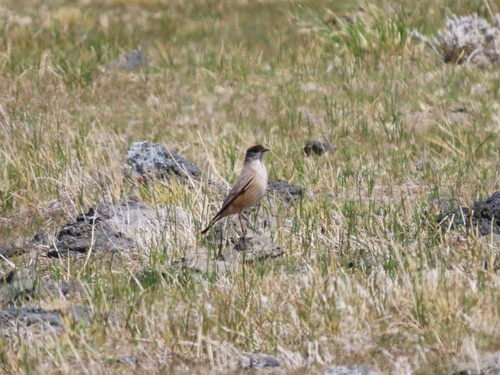 Dormilon à ventre roux
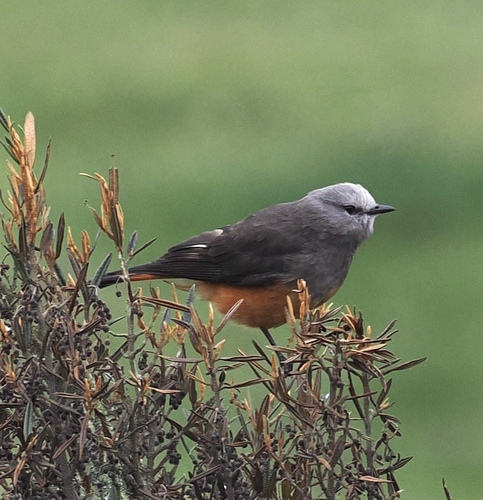 Moucherolle à croupion roux
En bref
The most reliable field mark between Cinnamon-bellied Ground-Tyrant and Red-rumped Bush-Tyrant is the presence of a bright rufous rump and a bold white tertial patch in flight on the Red-rumped Bush-Tyrant, versus the Cinnamon-bellied's more uniform dusky upperparts and lack of a rufous rump. Juvenile Cinnamon-bellied Ground-Tyrants show paler crowns and bellies with faint mottling, while Red-rumped Bush-Tyrants of all ages have a striking rufous rump and more contrasting tail pattern. The Bush-Tyrant is also noticeably larger and bulkier, with a longer tail and heavier jizz. Both species share some gray and rufous tones below, but the distribution and intensity differ. In perched views, focus on the head pattern and rump color; in flight, the Bush-Tyrant's white tertials and rufous rump are decisive.
Conseils d’identification
- Rufous rump (all ages): Red-rumped Bush-Tyrant always shows a bright rufous rump, especially obvious in flight or when the tail is spread. Cinnamon-bellied Ground-Tyrant lacks a rufous rump, having dusky gray or brownish gray upperparts instead.
- White tertial patch in flight: Red-rumped Bush-Tyrant has a bold white patch on the tertials, visible as a conspicuous flash in flight. Cinnamon-bellied Ground-Tyrant has pale white edges on the flight feathers but never forms a bold patch.
- Tail pattern: Red-rumped Bush-Tyrant's tail is blackish in the center with rufous outer feathers tipped blackish, creating a two-toned effect. Cinnamon-bellied Ground-Tyrant has a black tail with whitish edges only on the outermost feathers, lacking the rufous.
- Crown and head pattern: Cinnamon-bellied Ground-Tyrant has a black forecrown and bright rufous-chestnut mid- and hindcrown, while Red-rumped Bush-Tyrant has a white forecrown grading to hoary gray, lacking any rufous on the crown.
- Underparts color: Cinnamon-bellied Ground-Tyrant has a whitish throat, grayish buff breast, and a rich cinnamon-rufous belly, often darker on the flanks and vent. Red-rumped Bush-Tyrant has a white, thinly streaked throat, gray breast, and a rufous belly and undertail, but the rufous is more confined to the lower belly and undertail.
- Juvenile marks: Juvenile Cinnamon-bellied Ground-Tyrant shows a paler crown and belly with faint mottling and buff-edged wings, while juvenile Bush-Tyrants should still show the rufous rump and tertial patch, lacking the mottled look.
- Size and structure: Red-rumped Bush-Tyrant is much larger and heavier, with a longer tail and bulkier build. Cinnamon-bellied Ground-Tyrant is smaller, more compact, and slender.
- Perched jizz: Bush-Tyrant often sits upright on high perches (bushes, posts), while Ground-Tyrant is more likely to be seen on the ground or low rocks, with a more horizontal stance.
- Bill and legs: Both species have black bills and legs, so this is not useful for separation.
- Flight display: Cinnamon-bellied Ground-Tyrant males may hover with dangling legs and spread tail during display flights, a behavior not noted for Bush-Tyrant.
- Vocalization: If heard, Red-rumped Bush-Tyrant gives mellow whistles and rich churrs, plus loud, piercing calls. Cinnamon-bellied Ground-Tyrant's voice is not described, so silence does not help.
- Range and context: In Argentina and Chile, only Cinnamon-bellied Ground-Tyrant is expected. In Colombia and Ecuador, only Red-rumped Bush-Tyrant is present. In Bolivia and Peru, check all field marks carefully.
- Habitat: If the bird is perched high on a bush or fence post, consider Bush-Tyrant; if foraging on the ground or among rocks, Ground-Tyrant is more likely.
- Sex and season: Both species are sexually monomorphic (sexes look alike) and do not show strong seasonal plumage changes, so age and structural marks are more important.
- Common pitfalls: The cinnamon belly of Ground-Tyrant can be mistaken for the rufous rump of Bush-Tyrant if seen poorly; always confirm the location of rufous (belly vs. rump) and look for the tertial patch in flight.
Taille
Red-rumped Bush-Tyrant is significantly larger, measuring 20–23 cm in length and weighing around 50 g (female), compared to Cinnamon-bellied Ground-Tyrant at 16.5–18 cm. The Bush-Tyrant appears bulkier and longer-tailed, with a heavier build even at a distance. Cinnamon-bellied Ground-Tyrant is more compact and slender, with a shorter tail and lighter overall impression. Size alone can be a strong clue when both species are seen together or with familiar reference birds.
Plumage
- Juveniles: Cinnamon-bellied Ground-Tyrant juveniles have a paler crown and belly than adults, with small blackish tips on the feathers, buff edges on the wings, and faint mottling on the breast. Red-rumped Bush-Tyrant juveniles are not described separately, but the rufous rump and white tertial patch should be present from a young age, as these are structural plumage features.
- Adults: Cinnamon-bellied Ground-Tyrant adults have a black forecrown, bright rufous-chestnut mid- and hindcrown, dusky gray or brownish gray upperparts, dusky wings with pale white edges, and a black tail with whitish edges on the outermost feathers. The underparts show a whitish throat, grayish buff breast, and a cinnamon-rufous belly, darker on the flanks and vent. Red-rumped Bush-Tyrant adults have a white forecrown grading to hoary gray, dark gray-brown back, and a conspicuous rufous rump. The wings are dark gray-brown with a bold white patch on the tertials (especially obvious in flight). The tail is blackish centrally, with the rest of the feathers rufous with blackish tips. Underparts are white with thin dusky streaks on the throat, gray breast, and rufous belly and undertail. Subspecies differences are minor but can affect rump and belly tone.
- Flight: In flight, Red-rumped Bush-Tyrant shows a striking white tertial patch and rufous rump, while Cinnamon-bellied Ground-Tyrant lacks both, showing more uniform upperparts and less contrast in the wings.
Comportement
Red-rumped Bush-Tyrant typically perches atop bushes, trees, or fence posts, using a sallying technique to drop to the ground or occasionally hawk insects in mid-air. It is often solitary or in pairs and does not join mixed-species flocks. Cinnamon-bellied Ground-Tyrant's behavior is less detailed in the notes, but ground-tyrants generally forage on the ground or low perches and may be seen walking or running between foraging bouts. Display flights (hovering with dangling legs and spread tail) are described for Cinnamon-bellied males during breeding, which is not mentioned for the Bush-Tyrant.
Habitat
Both species occur in the Andes, but their ranges only overlap in Bolivia and Peru. Cinnamon-bellied Ground-Tyrant is also found in Argentina and Chile (and as a vagrant to Brazil), while Red-rumped Bush-Tyrant is found north to Colombia and Ecuador. Habitat specifics are not detailed here, but ground-tyrants typically favor open, rocky, or grassy areas, while bush-tyrants may be more associated with shrubby or bushy habitats, perching higher than ground-tyrants.
Voix
Red-rumped Bush-Tyrant is not highly vocal, but its song is described as a series of mellow mewed whistles and rich churring notes, with various calls including loud, piercing whistles and shrill, plaintive notes. No vocalization details are provided for Cinnamon-bellied Ground-Tyrant, so voice is not a reliable separator unless the Bush-Tyrant is heard giving its distinctive calls.
Dormilon à ventre roux · Moucherolle à croupion roux · Mes oiseaux difficiles