

Pinson du Nord vs Bouvreuil pivoine
Fringilla montifringilla contre Pyrrhula pyrrhula
Faire un quiz avec Pinson du Nord et Bouvreuil pivoine
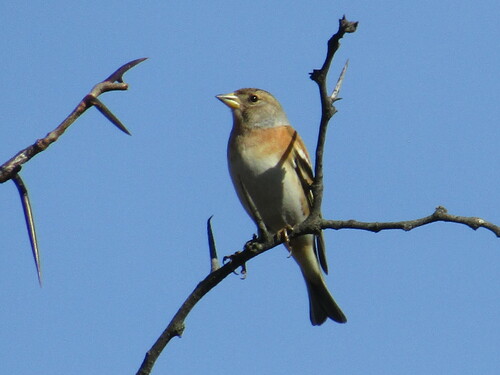 Pinson du Nord
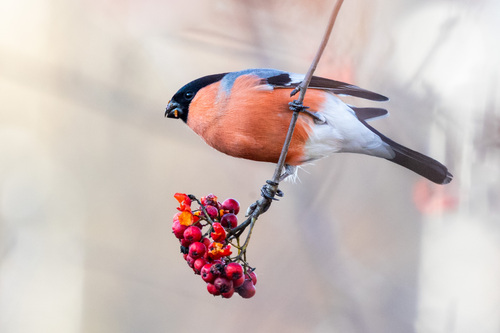 Bouvreuil pivoine
En bref
The most reliable field mark for separating Brambling from Eurasian Bullfinch is the overall body shape and bill: Brambling is a slimmer, more sparrow-like finch with a pointed bill, while Bullfinch is noticeably bulkier and bull-headed with a thick, stubby bill. In flight or perched, Brambling always shows a white rump and orange scapulars, while Bullfinch has a white rump but no orange in the upperparts. Bramblings have an orange breast with a white belly and dark-spotted flanks, contrasting with the Bullfinch's uniform rich red (male) or grey-buff (female/juvenile) underparts. Bill color is also helpful: Bramblings (except breeding males) have yellow bills, while Bullfinches always have black bills. Juvenile and female plumages can cause confusion, but the combination of body shape, bill, and underpart pattern is reliable.
Conseils d’identification
- Body shape and bill: Bullfinch is noticeably bulkier and bull-headed with a thick, stubby bill; Brambling is slimmer, with a pointed finch bill. This is reliable at all ages and in all plumages.
- Underpart pattern: Brambling of all ages shows an orange breast and white belly, with dark-spotted flanks. Bullfinch males have a uniform rich red chest and underparts; females and juveniles are grey-buff below, always plain (never spotted).
- Scapular color: Brambling has orange scapulars in all plumages; Bullfinch scapulars are grey, matching the upperparts.
- Rump color: Both species have a white rump in flight, but Brambling's is often more obvious due to contrast with darker upperparts. (Note: this is not diagnostic against Bullfinch, but can help eliminate Chaffinch.)
- Wing bars: Both show white wing bars, but Bullfinch's are broader and more striking, especially in flight. Brambling's are narrower and less bold.
- Head pattern: Breeding male Brambling has a black head; Bullfinch adults have a black cap and face (greyish-brown in juveniles). Females and juveniles of both species lack strong head patterns, so use other marks.
- Bill color: Brambling has a yellow bill except in breeding males (black bill); Bullfinch always has a black bill. This is subtle but useful at close range.
- Tail pattern: Brambling lacks white outer tail feathers (unlike Chaffinch); Bullfinch's tail is all black. Not a strong separator between these two, but can help in confusion with other finches.
- Behavior: Brambling is often in large, active flocks and feeds openly; Bullfinch is quiet, slow, and usually in pairs or small groups, often in dense cover.
- Flight style: Brambling is more agile and restless in flight, often with flocks swirling; Bullfinch flies with slower, more direct wingbeats and is less likely to flush in large numbers.
- Vocalization: If you hear a soft, mournful, whistled 'peeu' or 'pew', suspect Bullfinch. Brambling calls are not described here, but Bullfinch's song is distinctive for its softness and melancholy tone.
- Sex and age pitfalls: Female and juvenile Bramblings are the most likely to be confused with Bullfinch, especially at a distance. Focus on body shape, bill, and underpart pattern for these birds.
- Seasonal context: Brambling is migratory and often appears in large flocks in winter; Bullfinch is more resident and less gregarious.
- Habitat: If the bird is in dense hedgerow or woodland edge and behaving quietly, Bullfinch is more likely. In open fields or mixed-species flocks, suspect Brambling.
- Direct comparison: If you see both together, Bullfinch will always look heavier, thicker-necked, and shorter-tailed, with a more massive bill and plain underparts.
Taille
Eurasian Bullfinch is significantly heavier and bulkier than Brambling, with an average body mass of 31.0g compared to Brambling's 22.0g [wikidata]. Bullfinch appears thick-necked and broad-chested, with a short, thick bill and a bull-headed profile. Brambling is more slender, with a finer, pointed bill and a more typical finch silhouette. In flocks or side-by-side, Bullfinch stands out as the more robust bird.
Plumage
Juvenile and female Bramblings can be confused with Bullfinches, especially at a distance or in poor light. For all ages, Brambling shows a white rump in flight (contrasting with grey-green in Chaffinch, but Bullfinch also has a white rump), but the orange scapulars and orange breast with a white belly are unique to Brambling. Flanks are dark-spotted in Brambling of all ages, while Bullfinch flanks are plain. Bullfinch males have a rich red chest and underparts, while females and juveniles are grey-buff below. Both species show white wing bars in flight, but Bullfinch's are more striking and the bird looks overall greyer above. Bill color is a subtle but useful clue: Brambling has a yellow bill (except breeding males, which have black bills), while Bullfinch always has a black bill. The head pattern is also different: Brambling males in breeding plumage have a black head, while Bullfinch adults have a black cap and face (greyish-brown in juveniles). Brambling lacks the white outer tail feathers of Chaffinch, but Bullfinch's tail is all black.
Comportement
Brambling is often seen in large, noisy flocks, especially outside the breeding season, and is quite active and restless. Bullfinch is more often encountered in pairs or small groups, and is generally quiet, unobtrusive, and slow-moving. Bullfinch tends to stay low in dense vegetation or hedgerows, while Brambling is more likely to be seen feeding on the ground or in open areas.
Habitat
Both species can occur in woodland edges, gardens, and hedgerows, but Brambling is more likely to be found in open areas and large flocks, especially in winter. Bullfinch prefers denser cover, such as thick hedgerows and woodland margins, and is less likely to be seen in large groups.
Voix
Bullfinch has a soft, melancholy, whistled call (peeu or pew) and a weak, scratchy warbling song with soft whistles, usually only audible at close range. Brambling's vocalizations are not described in the provided notes, but Bullfinch's song is distinctive for its mournful tone and is quieter than most finches. If you hear a quiet, flute-like whistle, suspect Bullfinch.