

Akalat d'Abbott vs Dicée poignardé
Malacocincla abbotti contre Prionochilus percussus
Faire un quiz avec Akalat d'Abbott et Dicée poignardé
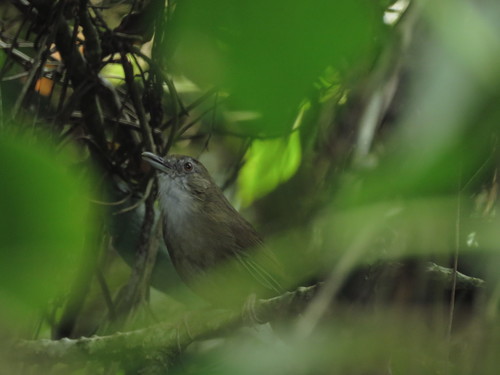 Akalat d'Abbott
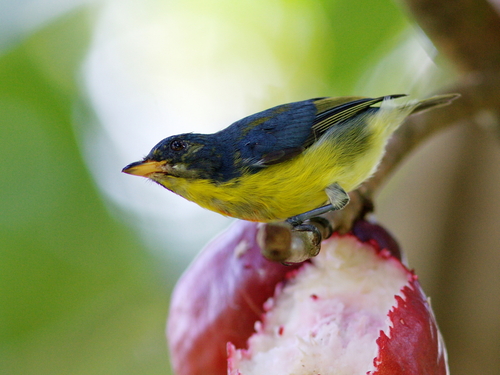 Dicée poignardé
En bref
The most reliable field mark to separate Abbott's Babbler from Crimson-breasted Flowerpecker is overall size and structure: Abbott's Babbler is a much larger, short-tailed, heavy-billed bird that skulks in dense undergrowth, while Crimson-breasted Flowerpecker is a tiny, active canopy species with a short, stubby bill. Abbott's Babbler is drab olive-brown with a pale throat and rusty undertail, whereas Crimson-breasted Flowerpecker (especially males) shows bold, contrasting plumage with a distinctive crimson breast patch. Juvenile babblers are darker and rufous above, but still lack the flowerpecker's compact, colorful look. If you see a small, bright bird in the treetops, it's almost certainly the flowerpecker; a larger, plain bird low in tangled vegetation is the babbler.
Conseils d’identification
- Size and structure: Abbott's Babbler is much larger and bulkier than Crimson-breasted Flowerpecker. If the bird looks sparrow-sized or bigger, it's the babbler; if it's tiny and compact, it's the flowerpecker. This is true for all ages and sexes.
- Bill shape: Babbler has a heavy, strong bill suited for probing and foraging in leaf litter; flowerpecker has a short, stubby bill for feeding on nectar and small fruits. Bill shape is visible even at a distance.
- Tail length and shape: Abbott's Babbler has a short, broad tail, often held low or flicked. Flowerpecker's tail is very short and square, accentuating its compact shape.
- Plumage color (adults): Babbler is drab olive-brown with a pale gray-white throat and rusty undertail coverts. No bright or sharply contrasting colors. Flowerpecker (especially males) shows a bold crimson breast patch and more contrasting plumage overall.
- Juvenile/immature plumage: Young babblers are darker rufous-brown above but still lack any bright or sharply defined markings. Flowerpecker juveniles may be duller than adults but retain a compact, neat look and are never as plain as babbler juveniles.
- Undertail coverts: Abbott's Babbler has bright rusty undertail coverts, visible when the bird flicks its tail. Flowerpecker's undertail is not described here but is not rusty.
- Supercilium and lores: Babbler may show a variable pale gray supercilium and lores, but this is subtle and not a strong field mark compared to the flowerpecker's bold face pattern (if present).
- Foraging height and behavior: Babbler is almost always low, in dense cover, rarely above eye level. Flowerpecker is usually high in the canopy, rarely seen near the ground.
- Habitat context: If you are birding in thick, tangled undergrowth, expect babbler; if you are scanning flowering treetops or mangroves, expect flowerpecker.
- Vocalizations: Listen for the babbler's rich, fluty, slurred notes and duets from the undergrowth. Flowerpecker calls are likely to be thin, high, and simple.
- Flight style: Babbler flies with labored, heavy wingbeats and rarely for long distances; flowerpecker is quick, direct, and agile in flight.
- Group size: Babbler is usually in pairs, flowerpecker often alone or in loose, mixed flocks.
- Sex differences: Both species have sexes alike in most plumages, but male flowerpecker is more brightly colored than female or babbler of any age.
- Pitfalls: A quick glimpse of a dull, small bird in dense foliage could be a flowerpecker, but check for size, bill, and behavior. Babbler is never truly colorful; flowerpecker is never truly plain.
- Seasonal context: Both are resident in their ranges, so seasonal plumage change is not a major issue for separation.
Taille
Abbott's Babbler is significantly larger, measuring 12–13 cm in length, with a notably heavy bill and a short tail [wikipedia]. Crimson-breasted Flowerpecker is much smaller (not measured here, but all flowerpeckers are tiny, typically 7–10 cm), with a compact, rounded body and a very short, stubby bill. The size difference is obvious in the field: babbler is sparrow-sized, flowerpecker is more like a kinglet or sunbird.
Plumage
- Juvenile/immature Abbott's Babbler: Dark rufescent-brown crown and upperparts, still overall drab, with a pale throat and rusty undertail. No bold patterning or bright colors.
- Adult Abbott's Babbler: Olive-brown above, pale gray-white throat and breast, white belly center, olive flanks, rusty undertail coverts. Short tail, heavy bill. No strong contrast or bright patches. Sexes alike.
- Crimson-breasted Flowerpecker: Males (and sometimes females) have a striking crimson breast patch, often with additional contrasting colors (not detailed here, but typical of the genus). Upperparts are usually dark, with a compact, glossy look. No age-specific upperwing pattern is noted for either species, but flowerpeckers often show a neat, clean-edged appearance. In all ages, flowerpecker is much more colorful and sharply marked than any babbler plumage.
Comportement
Abbott's Babbler is almost always found in pairs, foraging close to the ground in dense, tangled undergrowth, often near streams or in secondary growth. Its movements are slow and deliberate, and it is rarely seen in the open or above eye level. In contrast, Crimson-breasted Flowerpecker is an active, restless canopy feeder, usually alone or in loose mixed flocks, flitting rapidly among flowers and foliage high in trees. Flowerpeckers rarely descend to the ground and are much more likely to be seen in the open or at the forest edge.
Habitat
Abbott's Babbler prefers dense, low vegetation in broadleaved evergreen forest, forest edge, secondary growth, and scrub, often near water or tangled undergrowth. It is a ground- and understory-dweller. Crimson-breasted Flowerpecker inhabits subtropical or tropical moist lowland forest and mangrove forest, but is almost always found in the canopy or upper levels of trees, rarely venturing into dense ground cover. The babbler is more likely in thick, tangled, shaded areas; the flowerpecker in sunlit treetops or forest edge.
Voix
Abbott's Babbler has a distinctive, rich, fluty song of three or four notes, often with a drop in the middle note, and a variety of calls including a soft mewing, purring trill, and a sputtering 'churrr'. Its duet is also distinctive, with a male 'poor'ol bear' and female 'dear dear'. Crimson-breasted Flowerpecker's voice is not described here, but flowerpeckers generally have high-pitched, thin, simple calls, not the rich, varied babbler song. If you hear a complex, liquid, whistled song from the undergrowth, it's likely the babbler.