

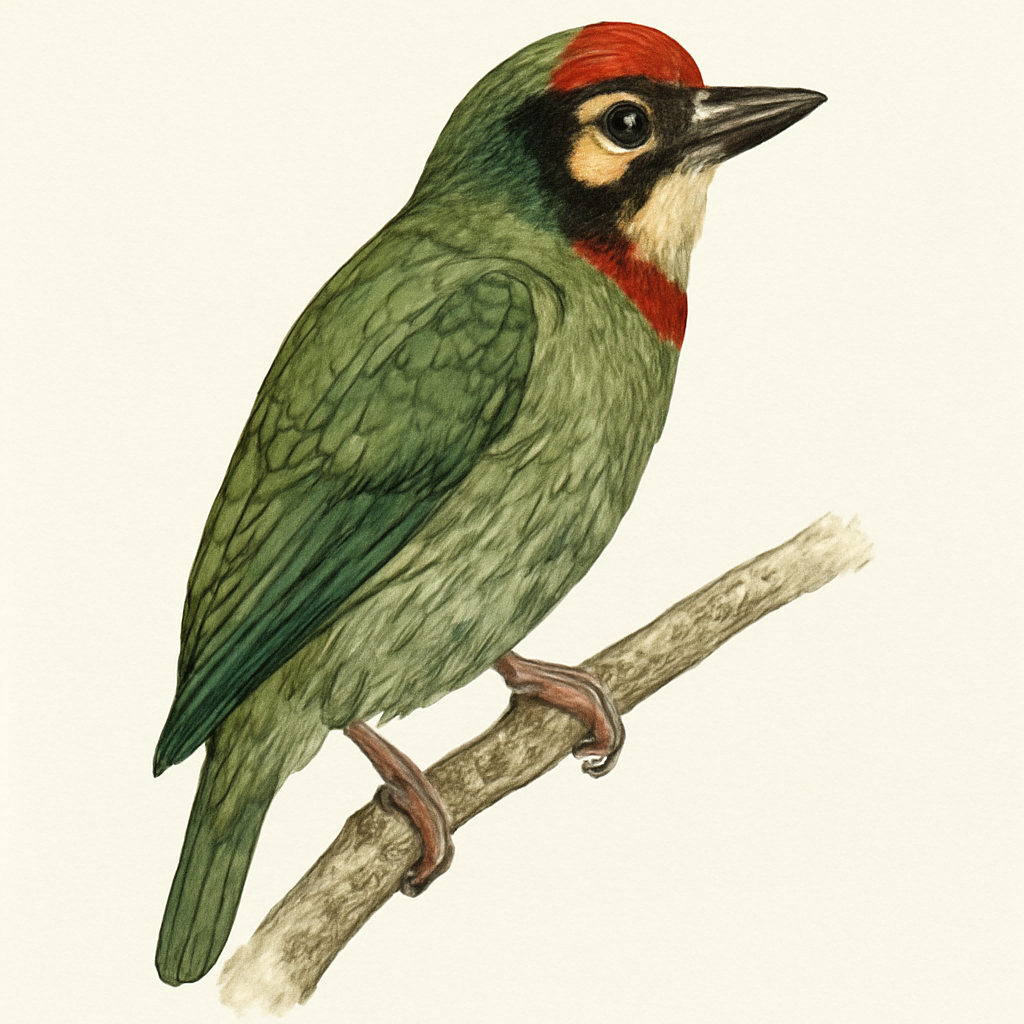
Barbu à plastron rouge
Psilopogon haemacephalus
Asian Barbets (Megalaimidae) · Piciformes · Cabézons et toucans
Faire un quiz avec Barbu à plastron rouge et des espèces similaires
Voir toutes les photos, vidéos et sons
Relecture nécessaire
Motmot est un projet communautaire, et beaucoup de photos attendent encore un œil humain. Si tu connais cet oiseau, tu peux aider en relisant ses images.
O-o, on n’a plus de crédits IA. Je développe Motmot sur mon temps libre, et il n’y a pas de financement pour l’instant. Si tu as envie d’aider à le faire grandir, écris-moi à info@motmot.club.
Comment identifier Barbu à plastron rouge
Rédaction des notes d’identification…
Cela cherche des notes d’identification dans des sources ouvertes, puis demande au modèle de les rédiger. Cela peut prendre une minute.
Connecte-toi pour générer des notes d’identification pour cet oiseau.
Souvent mélangé avec
Dans les quiz, les joueurs confondent le plus souvent Barbu à plastron rouge avec ces oiseaux—soit cette espèce a été choisie par erreur, soit l’inverse.
| Espèces | Confusions |
|---|---|
| Barbu bigarré Psilopogon rafflesii | 3 |
| Perdrix choukar Alectoris chukar | 1 |
| Barbu de Hay Caloramphus hayii | 1 |
| Barbu à oreillons bleus Psilopogon cyanotis | 1 |
| Barbu à oreillons noirs Psilopogon duvaucelii | 1 |
Famille
Megalaimidae, the Asian barbets, are a family of birds, comprising two genera with 35 species native to the forests of the Indomalayan realm from Tibet to Indonesia. They were once clubbed with all barbets in the family Capitonidae but the Old World species have been found to be distinctive and are considered, along with the Lybiidae and Ramphastidae, as sister groups.
Ordre
Nine families of largely arboreal birds make up the order Piciformes (), the best-known of them being the Picidae, which includes the woodpeckers and close relatives. The Piciformes contain about 71 living genera with a little over 450 species, of which the Picidae make up about half. In general, the Piciformes are insectivorous, although the barbets and toucans mostly eat fruit and the honeyguides are unique among birds in being able to digest beeswax (although insects make up the bulk …