

Estornino Carunculado vs Viuda Purpúrea
Creatophora cinerea frente a Vidua purpurascens
Juega un quiz con Estornino Carunculado y Viuda Purpúrea
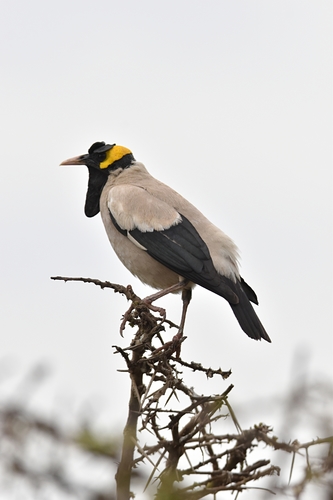 Estornino Carunculado
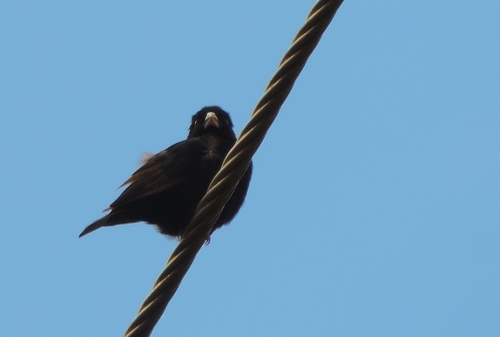 Viuda Purpúrea
En breve
The most reliable field mark to separate Wattled Starling from Purple Indigobird is the starling's distinctive white rump and black flight feathers and tail, which are obvious in flight at all ages. Juvenile and non-breeding Wattled Starlings show these contrasts even when their head pattern is subdued, while Purple Indigobird is a small, uniformly dark finch-like bird lacking any white in the wing or rump. Structure is also a giveaway: Wattled Starling is much larger and longer-winged, with a short tail and pointed wings, versus the compact, small-billed, and short-tailed indigobird. If you see a flock of medium-sized, pale grey birds with white rumps, you have Wattled Starlings; any small, dark, sparrow-sized bird in the same area is far more likely to be an indigobird.
Consejos de identificación
- White rump in flight (all ages, all seasons): Only Wattled Starling shows a bright white rump and black flight feathers/tail in flight. If you see this contrast, you are not looking at an indigobird.
- Uniform dark plumage (indigobird): Purple Indigobird is always dark purplish-black (males) or duller dark brownish (females/immatures), with no white or pale patches anywhere on the body or wings.
- Head pattern (breeding male starling): Wattled Starling breeding males have bare yellow skin and black wattles on the head, plus a white shoulder patch. No indigobird ever shows bare skin or wattles.
- Non-breeding and juvenile starling: Even when the head is feathered and the plumage is duller, Wattled Starling keeps the white rump and black wings/tail; juveniles have brownish flight feathers but still show the rump contrast.
- Bill shape and size: Wattled Starling has a longer, more pointed bill suited to omnivorous feeding; indigobird has a short, conical finch-like bill.
- Body size: The starling is much larger and bulkier—about five times the mass of an indigobird. If the bird looks sparrow-sized, it's not a Wattled Starling.
- Tail shape: Wattled Starling has a short, square tail; indigobird's tail is also short but the overall body is much more compact.
- Wing shape: Wattled Starling has pointed wings, giving a more elongated look in flight; indigobird's wings are shorter and rounder.
- Flocking and behavior: Large, noisy flocks in open country or perched on livestock are Wattled Starlings; indigobirds are solitary or in small groups, never associating with livestock.
- Habitat: Open grassland, farmland, and reedbeds suggest Wattled Starling; bushy grassland near water, especially where firefinches occur, suggests indigobird.
- Voice: Harsh, wheezing, starling-like calls are only given by Wattled Starling; indigobird does not sound like a starling.
- Context with other birds: If you see the bird associating with weavers or other starlings, it's likely a Wattled Starling; indigobird is more often seen near firefinches.
- Seasonal changes: Only breeding male Wattled Starlings show the full bare yellow skin and wattles; non-breeding and young birds are duller but still show the rump/wing contrast.
- Shoulder patch: A white shoulder patch is present on breeding male Wattled Starlings, never on indigobird.
- Plumage pitfalls: Immature and female Wattled Starlings can look dull and lack obvious wattles, but always check for the white rump and black wings/tail in flight—these are never present on indigobird.
Tamaño
Wattled Starling is dramatically larger, weighing about 73 g compared to only 13.4 g for Purple Indigobird [wikidata]. The starling is 21 cm long, with a noticeably longer body and wings, while indigobird is a small, finch-sized bird. Side-by-side, the starling will appear nearly five times heavier and much bulkier, with a longer bill and more elongated shape.
Plumaje
- Juvenile and non-breeding Wattled Starling: Grey overall with a white rump and black flight feathers/tail; head pattern is subdued but the rump and wing/tail contrast are always present. Juveniles have brownish flight feathers and tail but still show the white rump in flight.
- Breeding male Wattled Starling: Striking with bare yellow skin on the head, black wattles, a white shoulder patch, and the same white rump/black wing pattern.
- Purple Indigobird (all ages/sexes): Uniformly dark (purplish-black in males, duller in females/immatures), with no white in the plumage, no contrasting rump, and no pale wing panels or shoulder patches. The indigobird's plumage is smooth and lacks the starling's sharp color contrasts.
- In flight: Only Wattled Starling shows a white rump and black wings/tail; Purple Indigobird is all dark.
Comportamiento
Wattled Starling is highly gregarious, often forming large flocks and mixing with other starlings; it frequently perches on livestock and is conspicuous in open habitats. It is also colonial in breeding and may be seen in noisy groups. Purple Indigobird, by contrast, is usually seen singly or in small groups, often near its firefinch hosts, and does not display the same flocking or perching-on-livestock behavior.
Hábitat
Wattled Starling prefers grassland, open woodland, and cultivated areas, often in open country and sometimes near livestock or reedbeds. Purple Indigobird is more closely tied to areas where its host, Jameson's Firefinch, breeds—typically grassy or bushy habitats, often near water, but not as open or agricultural as the starling's favored sites. The starling is more likely in very open, disturbed, or agricultural settings; indigobird is more restricted to bushy or grassy edges.
Voz
Wattled Starling gives a range of wheezing or grating calls, with the most familiar being a drawn-out 'ssreeeeo', reminiscent of Common Starling. Purple Indigobird's song is not described in the notes, but as a brood parasite it often mimics its host firefinch's calls and is not likely to give the harsh, starling-like sounds of Wattled Starling.