

Alcaraván Común vs Charrán Arábigo
Burhinus oedicnemus frente a Sterna repressa
Juega un quiz con Alcaraván Común y Charrán Arábigo
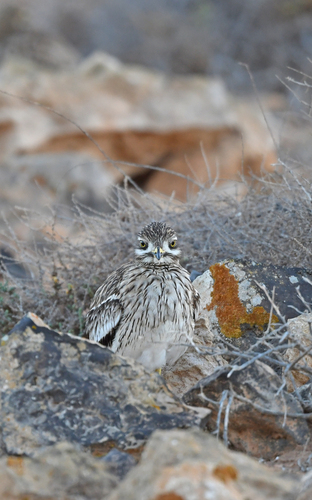 Alcaraván Común
 Charrán Arábigo
En breve
The most reliable field mark to separate Stone-curlew from White-cheeked Tern is overall structure and flight style: Stone-curlew is a large, thickset, ground-dwelling wader with cryptic brown plumage and striking black-and-white wing markings in flight, while White-cheeked Tern is a much lighter, slender seabird with streamlined wings and a pale, tern-like appearance. Stone-curlew shows a strong yellow-and-black bill and large, staring yellow eyes, giving it a 'goggle-eyed' look, unlike the tern's fine, dark bill and small, dark eyes. In flight, Stone-curlew’s bold upperwing pattern and heavy, rounded wings contrast sharply with the tern’s long, narrow wings and buoyant, agile flight. Habitat is also a strong clue: Stone-curlew is found on dry, stony ground, while White-cheeked Tern is strictly coastal.
Consejos de identificación
- Wing pattern in flight: Stone-curlew shows bold black-and-white markings on the upperwing, visible at all ages; White-cheeked Tern’s wings are uniformly pale, with no strong contrast. This is the single best mark in flight.
- Structure and jizz: Stone-curlew is thickset, with a large head, chunky body, and strong, long yellow legs. White-cheeked Tern is slim, with long, pointed wings, a streamlined body, and short legs (barely visible in flight).
- Bill: Stone-curlew has a strong, yellow-and-black bill, thick at the base; White-cheeked Tern has a slender, straight, all-dark bill.
- Eyes: Stone-curlew’s large, staring yellow eyes are unique and give a 'goggle-eyed' or 'reptilian' look, especially at close range. The tern’s eyes are small and dark, not prominent.
- Plumage: Stone-curlew is cryptic, sandy-brown above with streaks, blending into dry ground. White-cheeked Tern is clean, pale grey above, white below, with a neat black cap and white cheeks.
- Legs: Stone-curlew’s legs are long, thick, and yellow, visible when walking or standing. White-cheeked Tern’s legs are short and dark, usually hidden in flight.
- Habitat: Stone-curlew is never found on the coast or over water; White-cheeked Tern is never found far from the sea or large coastal lagoons.
- Behavior: Stone-curlew stands or runs on the ground and freezes when disturbed. White-cheeked Tern is almost always in flight, hovering, dipping, or flying in loose flocks.
- Vocalization: Stone-curlew gives loud, wailing, curlew-like calls at night; White-cheeked Tern gives sharp, high-pitched tern calls.
- Flight style: Stone-curlew’s flight is heavy, direct, and labored, with broad, rounded wings. White-cheeked Tern is buoyant, agile, and graceful, with long, pointed wings.
- Cheek pattern: White-cheeked Tern has a distinct white cheek patch and black cap; Stone-curlew’s face is plain, with no such contrast.
- Size: Stone-curlew is much larger and heavier than White-cheeked Tern; if seen together, the size difference is obvious.
- Context: If the bird is seen at night or dusk, calling from dry ground, it is likely a Stone-curlew. If seen during the day, flying over water or resting with other terns, it is a White-cheeked Tern.
- Sex/age: No strong sexual dimorphism or age-specific confusion is described for either species in these sources, but the Stone-curlew’s wing pattern is diagnostic at all ages.
- Pitfalls: Do not rely on overall color alone—focus on structure, wing pattern, and habitat for a reliable separation.
Tamaño
Stone-curlew is much heavier and bulkier than White-cheeked Tern (Stone-curlew: 290–535 g; White-cheeked Tern: ~123.5 g [wikidata]). Stone-curlew is also longer (38–46 cm vs. the tern’s smaller, more compact body) and has a broader wingspan (76–88 cm). In the field, the Stone-curlew appears robust and thick-legged, while the tern is slim, long-winged, and delicate.
Plumaje
For all ages, Stone-curlew has cryptic, sandy-brown plumage with bold black-and-white wing markings visible in flight. Its strong yellow-and-black bill and large yellow eyes are unique. The White-cheeked Tern, by contrast, is pale overall, with a white cheek patch, a neat black cap, and a slender, dark bill. The tern’s plumage is smooth and clean, with no bold wing markings like the Stone-curlew. In flight, Stone-curlew’s wings show a striking contrast of black and white, while the White-cheeked Tern’s wings are uniformly pale above and below, lacking any strong pattern. Juvenile/immature-specific upperwing patterns are not described for either species in these sources, but the Stone-curlew’s adult wing pattern is diagnostic at all ages.
Comportamiento
Stone-curlew is a terrestrial, ground-dwelling bird, often seen standing motionless or running on open, stony ground. It is mostly nocturnal or crepuscular, with a tendency to freeze when approached. In flight, it is heavy, direct, and shows broad, rounded wings. White-cheeked Tern is highly aerial, rarely perching except on sandbars or rocks, and is constantly in motion, flying with buoyant, agile wingbeats and frequent glides. The tern is gregarious and often seen in flocks, especially near water.
Hábitat
Stone-curlew is found in dry, open habitats such as stony heaths, semi-desert, and fallow fields, well away from water. White-cheeked Tern is strictly coastal, found along seashores, islands, and estuaries, rarely venturing inland. If the bird is seen on a beach, sandbar, or over open water, it is almost certainly a tern; if it is on dry, stony ground, it is a Stone-curlew.
Voz
Stone-curlew is named for its loud, wailing, curlew-like calls, especially at night. White-cheeked Tern gives high-pitched, sharp, tern-like calls, but these are not described in detail in the sources. If you hear a curlew-like, eerie call at dusk or night, suspect Stone-curlew.