

Alondra de Sclater vs Cogujada Picogorda
Spizocorys sclateri frente a Galerida magnirostris
Juega un quiz con Alondra de Sclater y Cogujada Picogorda
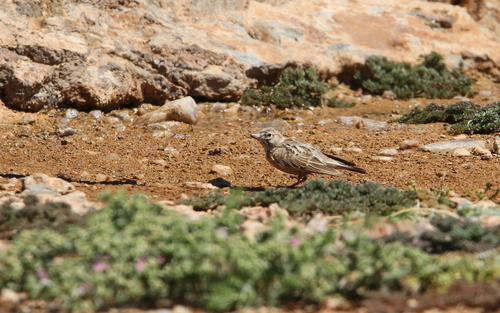 Alondra de Sclater
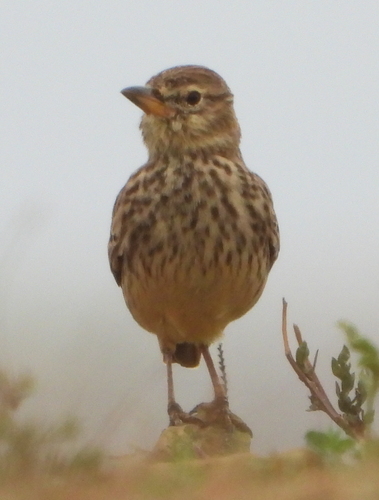 Cogujada Picogorda
En breve
The most reliable way to separate Sclater's Lark from Large-billed Lark is by bill structure and head pattern: Large-billed Lark shows a noticeably thick, two-toned bill with a yellowish base to the lower mandible, a strong white supercilium, and a short, crested look, while Sclater's Lark is plainer-faced with a more modest bill. In the field, Large-billed Lark also appears bulkier and more strongly streaked below. Both species can overlap in southern Africa's dry habitats, but Large-billed Lark is more likely in cultivated or grassy areas, while Sclater's Lark keeps to arid shrubland. Immature and adult birds can be confused, but the combination of bill size, head pattern, and underpart streaking is key.
Consejos de identificación
- Bill shape and color: Large-billed Lark has a thick, heavy bill with a yellowish base to the lower mandible, giving a two-toned look. Sclater's Lark's bill is smaller, more delicate, and lacks strong color contrast. This is a primary field mark at all ages.
- Supercilium and head pattern: Large-billed Lark shows a prominent white supercilium (eyebrow) and a generally bolder facial pattern. Sclater's Lark is much plainer-faced, with little to no supercilium.
- Crest: Large-billed Lark often raises a short crest, especially when displaying or alarmed. Sclater's Lark lacks a noticeable crest and has a smoother head profile.
- Underpart streaking: Large-billed Lark has heavy, dark streaking on the cream-colored breast, visible at all ages. Sclater's Lark is less streaked or more uniform below.
- Upperpart pattern: Large-billed Lark's upperparts are streaked brown-grey, while Sclater's Lark is more uniformly brown or greyish, lacking strong streaking.
- Size and structure: Large-billed Lark is bulkier, with a short tail and a more robust body. Sclater's Lark is lighter (about 19g) and slimmer overall.
- Habitat context: If the bird is in dry shrubland with little grass, Sclater's Lark is more likely. In grassy, agricultural, or fynbos areas, Large-billed Lark is the default.
- Behavior and jizz: Large-billed Lark is more likely to be seen raising its crest and calling, making it conspicuous. Sclater's Lark is quieter and less likely to display.
- Vocalizations: If you hear a soft, creaking 'treeeeleeeeleee', it's Large-billed Lark. Sclater's Lark is not known for a distinctive call in the sources provided.
- Geographic range: Both can occur in Namibia and South Africa, but Large-billed Lark is more widespread and common, especially in cultivated or grassy regions.
- Pitfalls with immatures: No specific juvenile or first-winter wing or flight marks are described for either species, so rely on structural and head pattern differences at all ages.
- Perched vs. in flight: Both species are most easily separated when perched, as bill and head pattern are less obvious in flight. In flight, look for overall bulk and any hint of crest in Large-billed Lark.
- Confusion with other larks: Be aware that the name 'large-billed lark' can also refer to Bradfield's Lark, but the thick, bi-colored bill and strong supercilium are unique to Galerida magnirostris in this comparison.
- Sex and season: No sexual dimorphism or strong seasonal plumage change is noted for either species, so these marks are reliable year-round.
- When in doubt: Focus on the combination of bill size and color, supercilium strength, and underpart streaking. If all three point to one species, it's a safe identification.
Tamaño
Sclater's Lark is lighter, with a body mass of about 19 grams [wikidata], and is generally smaller and more delicate in build. Large-billed Lark is larger overall (length about 18 cm [wikipedia]), appearing more robust and heavy-billed, though exact mass is not provided. In the field, Large-billed Lark's bulk and short tail are noticeable compared to the more slender Sclater's Lark.
Plumaje
No age-specific upperwing or flight pattern marks are described for either species in the sources. For perched birds, Large-billed Lark shows a bold white supercilium, a streaked brown-grey back, and heavy dark streaking on cream underparts. Its thick, bi-colored bill (yellowish at the base) and often-raised crest are distinctive. Sclater's Lark, by contrast, is much plainer: it lacks the strong supercilium, has a less streaked or more uniform face and underparts, and the bill is smaller and less contrasting. Both species are brownish above, but Sclater's Lark is more uniform and less patterned overall.
Comportamiento
Both species are ground-dwelling larks, but Large-billed Lark is described as very vocal and often raises its crest in display or alarm, giving it a distinctive jizz when alert. Sclater's Lark is less conspicuous in behavior and tends to keep to more open, arid shrubland, often blending in with the substrate. Large-billed Lark may be seen in more varied open habitats, including agricultural fields, and is more likely to be noticed due to its vocalizations and head-raising displays.
Hábitat
Sclater's Lark is restricted to subtropical or tropical dry shrubland in Namibia and South Africa [wikipedia], preferring arid, open country. Large-billed Lark has a broader habitat range, found in fynbos, karoo scrub, mountain grassland, and even cultivated or fallow agricultural land across southern South Africa, Lesotho, and southern Namibia [wikipedia]. If seen in grassy or agricultural settings, Large-billed Lark is much more likely; Sclater's Lark is a specialist of dry, shrubby plains.
Voz
Large-billed Lark is notably vocal, with a soft, creaking call described as 'treeeeleeeeleee' [wikipedia]. Sclater's Lark's voice is not described in the sources provided. If you hear the distinctive creaking song, Large-billed Lark is the likely candidate.
Alondra de Sclater · Cogujada Picogorda · Mis aves difíciles