

Chachalaca Norteña vs Tiñosa Menuda
Ortalis vetula frente a Anous minutus
Juega un quiz con Chachalaca Norteña y Tiñosa Menuda
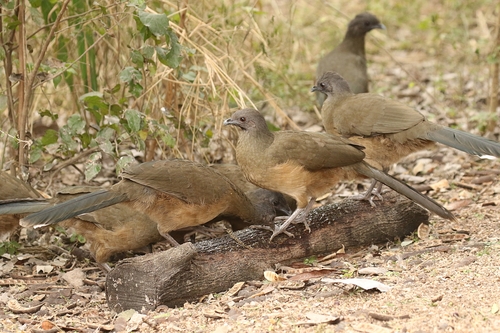 Chachalaca Norteña
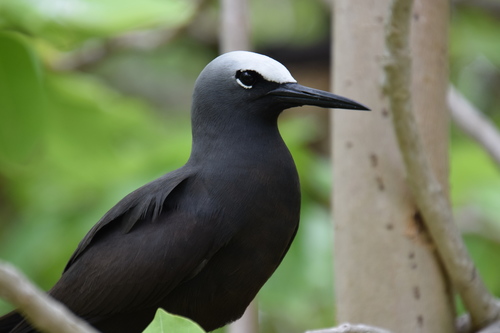 Tiñosa Menuda
En breve
The most reliable field mark separating Plain Chachalaca from Black Noddy is overall structure and habitat: chachalacas are large, long-necked, terrestrial birds with olive-brown plumage and a buff-tipped tail, while black noddies are sleek, medium-sized seabirds with a striking white cap and all-dark, pointed wings. Juvenile or immature-specific upperwing patterns are not described for either species, so focus on silhouette, bill shape, and context. If you see a bird with a white crown and long, pointed wings flying over water, it's a Black Noddy; if it's a chunky, pheasant-like bird in scrub or woodland, it's a Plain Chachalaca. Size, bill, and tail shape are also highly diagnostic.
Consejos de identificación
- White cap on head: Black Noddy always shows a bright white crown, visible at any distance; Plain Chachalaca never has white on the head. This is the single most reliable mark.
- Overall color: Chachalaca is olive-brown to dull brown with pale underparts; Black Noddy is blackish with no brown or olive tones.
- Tail shape: Chachalaca has a long, graduated tail with a buffy-white tip; Black Noddy has a short, squared-off (truncated) tail with no pale tip.
- Bill shape: Chachalaca has a short, thick, slightly curved bill; Black Noddy has a long, thin, sharply pointed bill typical of terns.
- Size and bulk: Chachalaca is much larger and heavier, with a pheasant-like build; Black Noddy is slender and light, with a much smaller body.
- Neck and head: Chachalaca has a long neck and small head, sometimes with a visible bare red throat patch in breeding season; Black Noddy has a compact head and no bare skin.
- Wing shape: In flight, Black Noddy has long, narrow, pointed wings; Chachalaca's wings are broad and rounded, typical of galliforms.
- Legs and feet: Chachalaca has strong, unwebbed legs and feet for walking; Black Noddy has fully webbed feet, sometimes orange (subspecies melanogenys), but usually black.
- Habitat context: Chachalaca is never found at sea or on islands; Black Noddy is never found inland or in terrestrial habitats.
- Behavior: Chachalaca walks or perches in trees, often in groups; Black Noddy is almost always seen flying over water or perched on cliffs/islands.
- Facial markings: Black Noddy shows a small white crescent under each eye and a white spot above; Chachalaca lacks any such facial markings.
- Underparts: Chachalaca's underparts are pale to ochraceous; Black Noddy's underparts are uniformly dark.
- Tail gloss: Chachalaca's tail may show a green gloss in good light; Black Noddy's tail is matte black.
- Seasonal marks: Chachalaca's bare throat patch turns deep red in breeding season (both sexes); Black Noddy's facial pattern is stable year-round.
- Voice (contextual): If you hear loud, repeated, raucous calls in woodland, suspect chachalaca; if you hear soft, tern-like calls over water, suspect noddy.
If you are unsure, always check for the white crown and habitat: these two marks alone will separate every individual in the field.
Tamaño
Plain Chachalaca is much larger and heavier: 48–58 cm in length and 439–794 g in weight [wikipedia], compared to Black Noddy's 35–37 cm length and 98–144 g weight [wikipedia]. Chachalaca is roughly pheasant-sized, with a bulkier body and longer neck, while Black Noddy is a slender, medium-sized tern with a much lighter build. Wingspan is also much greater in the noddy (66–72 cm) relative to its body, giving it a more elongated, aerodynamic appearance in flight.
Plumaje
- Juvenile/Immature wing pattern: No distinctive upperwing pattern or age-specific flight marks are described for either species; adults and immatures are separated by overall coloration and structure.
- Plain Chachalaca (all ages): Dull olive-brown body and wings, greyish head and neck, pale to ochraceous underparts, and a blackish tail with green gloss and buffy-white tip. No white on the head or wings. Bare throat patch turns deep red in breeding season. Iris brown, bill black, orbital skin and feet dull grey.
- Black Noddy (all ages): Uniformly dark (blackish) body and wings, but with a conspicuous white cap (crown), small white crescent under each eye, and a white spot above the eye. Bill is sharply pointed and black. Feet are black or orange (subspecies-dependent), and tail is truncated, not long or graduated. No buff or olive tones anywhere. The white cap is always present and diagnostic.
- In summary: Chachalaca is brownish with no white on the head; Black Noddy is blackish with a bright white cap and facial markings.
Comportamiento
Plain Chachalaca is terrestrial and arboreal, often seen walking or hopping through scrub, woodland, or perched in trees, sometimes in family groups. It is diurnal, most active in the morning and evening, and roosts communally on branches. Black Noddy is strictly pelagic or coastal, rarely seen inland, and is almost always observed flying gracefully over water, perched on cliffs or trees near nesting colonies, or resting on floating objects. Its flight is buoyant and tern-like, with long, pointed wings and a direct, gliding style. Chachalaca never behaves like a seabird, and noddy never acts like a terrestrial gamebird.
Hábitat
Habitat is a primary separator: Plain Chachalaca is found in tropical and subtropical forests, thickets, scrubland, and even human-modified habitats like orchards and gardens, from Texas to Costa Rica. It is never found at sea or on open coasts. Black Noddy is a seabird, breeding and foraging over tropical oceans, islands, and coastal cliffs; it is never found inland, in forests, or in scrub. If the bird is seen over water or on a remote island, it is a noddy; if in woodland or brush, it is a chachalaca.
Voz
No direct comparison is available in the notes. Both species are vocal, but their calls are completely different in context and quality: chachalacas are known for loud, raucous, repeated calls (often described as 'cha-cha-lac'), while noddies have softer, tern-like calls. However, unless you are familiar with both, voice is less reliable than structure and plumage.