

Trepatroncos Ocelado vs Trepatroncos Cacao
Xiphorhynchus ocellatus frente a Xiphorhynchus susurrans
Juega un quiz con Trepatroncos Ocelado y Trepatroncos Cacao
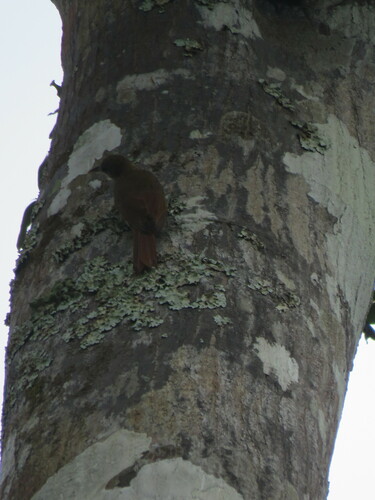 Trepatroncos Ocelado
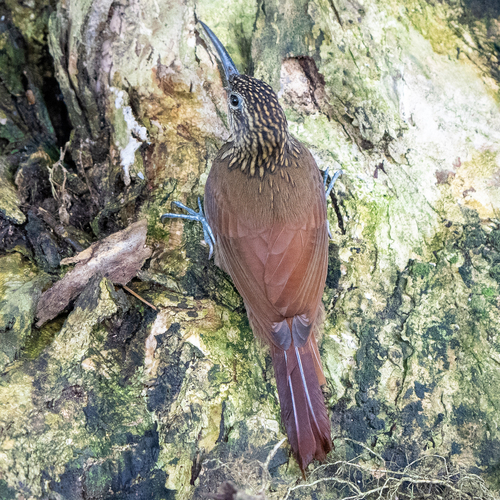 Trepatroncos Cacao
En breve
The most reliable field mark to separate Ocellated and Cocoa Woodcreepers is the pattern and shape of the breast markings: Ocellated Woodcreeper shows large, buff 'teardrop' spots on the upper breast, while Cocoa Woodcreeper has smaller, buffy white spots or streaks, sometimes with dusky edges, that become finer and fade on the lower breast and belly. Juvenile Cocoa Woodcreepers are overall darker with less bold crown spots and wider underpart streaks, but never show the bold teardrop pattern of Ocellated. Structure also helps: Cocoa is heavier-bodied with a stouter, more decurved bill, while Ocellated is slimmer and has a straighter bill. Both species can look similar at a glance, especially in overlapping range, but careful attention to breast pattern, bill shape, and overall jizz will usually clinch the ID.
Consejos de identificación
- Breast Markings (All Ages): Ocellated Woodcreeper shows large, bold buff 'teardrop' spots on the upper breast, sometimes with weak dark borders, while Cocoa Woodcreeper has smaller, buffy white spots or streaks that become finer and fade on the belly. This is the most consistent field mark.
- Juvenile Plumage: Juvenile Cocoa Woodcreeper is overall darker, with a shorter, blacker bill and broader underpart streaks, but never shows the bold teardrop pattern of Ocellated juveniles or adults.
- Bill Shape: Cocoa Woodcreeper has a heavier, more decurved bill; Ocellated's bill is slimmer, longer relative to head, and almost straight. This difference is visible in profile, especially at rest.
- Face Pattern: Cocoa Woodcreeper has a dusky face with buff streaks and a pale supercilium, giving a slightly masked look. Ocellated's face is plainer, lacking a strong supercilium or facial contrast.
- Crown and Nape: Ocellated has fine buff streaks on a dark brown crown; Cocoa shows longish buff spots on a darker crown, which can look streakier on the nape and neck.
- Back and Rump: Ocellated's back is plain reddish-brown to olive-brown, with cinnamon-rufous rump and wings. Cocoa has olive-brown to brown upperparts with blackish-edged buff streaks on the back, and a rufous-chestnut rump and tail.
- Throat Pattern: Ocellated's throat is deep buff with darker feather edges; Cocoa's is paler (whitish to pale buff) with thin black scaling. Some subspecies of Cocoa may show a more buffy or spotted throat, but the scaling is usually visible.
- Underparts: Ocellated's belly is unmarked; Cocoa's underparts are grayish olive to buffy brown with spots or streaks that fade out on the belly. Undertail coverts are mostly unstreaked in Cocoa, more rufescent in Ocellated.
- Leg and Foot Color: Both species have grayish legs and feet, but Cocoa may show more variation (dark blue-gray, greenish gray, or yellowish gray). Not a strong field mark.
- Size and Structure: Cocoa is heavier and bulkier, Ocellated slimmer and lighter. In direct comparison or with experience, this can help, but beware overlap.
- Habitat Context: In Colombia and Venezuela, Ocellated is more likely in interior humid forest, Cocoa in edge, secondary, or drier habitats. Use with caution, as both can occur in similar areas.
- Subspecies Variation: Some subspecies of both species show variation in back color, throat pattern, and streaking. Always prioritize breast pattern and bill shape over subtle color differences.
- Flight Views: No distinctive upperwing or flight pattern differences are noted in the sources. Focus on structure and underpart pattern if seen in flight.
- Sexes: Both species are sexually monomorphic; sex is not a useful field mark.
- Pitfalls: Beware confusing heavily streaked or spotted subspecies of Cocoa with Ocellated, especially in poor light. Always check for the shape and size of breast markings and bill structure.
Tamaño
Ocellated Woodcreeper is lighter and slightly smaller overall (body mass ~33g, length 20–24.5 cm) compared to the Cocoa Woodcreeper, which is heavier (43–58g) and slightly longer (21–25.5 cm). In the field, Cocoa often appears bulkier and more robust, while Ocellated is slimmer and more delicate. This difference is subtle but can be helpful when birds are seen side by side or with experience.
Plumaje
-
Juveniles: Ocellated Woodcreeper juveniles resemble adults but have heavier underpart markings; the bold teardrop spots remain diagnostic. Cocoa Woodcreeper juveniles are overall darker, with a shorter, blacker bill, less bold crown spots, and broader underpart streaks, but lack the large teardrop spots of Ocellated.
-
Adults: Ocellated Woodcreeper adults have a plain reddish-brown to olive-brown back, cinnamon-rufous wings and tail, and a distinctive pattern of large buff teardrop spots on the upper breast, with weak streaks below and an unmarked belly. Cocoa Woodcreeper adults have a dusky face with buff streaks, a whitish supercilium, a crown with longish buff spots, and a back with blackish-edged buff streaks that fade on the lower back. Their underparts are reddish brown with buffy white spots (upper breast) that become streaks and then fade out on the belly, and the undertail coverts are mostly unstreaked. The throat of Cocoa is usually paler (whitish to pale buff) with thin black scaling, while Ocellated's is deep buff with darker feather edges.
Comportamiento
Both species behave similarly, moving methodically up tree trunks and branches in typical woodcreeper fashion. No strong behavioral differences are noted in the sources for field separation. Both may join mixed-species flocks and forage in similar ways.
Hábitat
Ocellated Woodcreeper is found in humid forests of the Amazon basin (Bolivia, Brazil, Colombia, Ecuador, Peru, Venezuela), while Cocoa Woodcreeper occurs further north (Colombia, Central America, Trinidad and Tobago, Venezuela) and is more often found in forest edges, gallery forests, mature secondary growth, mangroves, and even arid scrub on islands. In areas of overlap (Colombia, Venezuela), Ocellated is more likely in interior humid forest, while Cocoa is more adaptable to edge and secondary habitats. Habitat alone is not diagnostic but can support an ID in context.
Trepatroncos Ocelado · Trepatroncos Cacao · Mis aves difíciles