

Tordina Bigotuda vs Tordina Colicorta
Malacopteron magnirostre frente a Pellorneum malaccense
Juega un quiz con Tordina Bigotuda y Tordina Colicorta
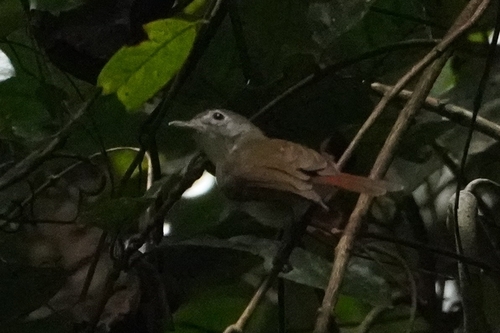 Tordina Bigotuda
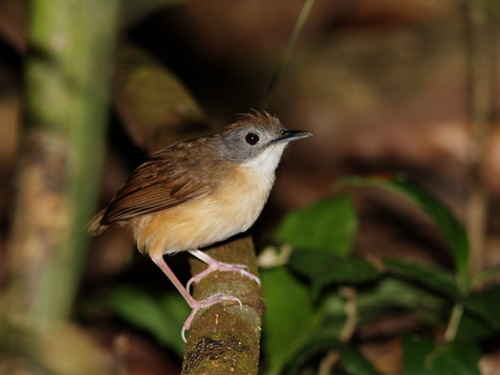 Tordina Colicorta
En breve
The most reliable field mark to separate Moustached Babbler from Short-tailed Babbler is the combination of head pattern and overall structure: Moustached Babbler shows a distinct grey loral and moustachial stripe on a dull brown, olive-tinged crown, while Short-tailed Babbler lacks these facial stripes and appears more uniform. In the field, Moustached Babbler is longer and slimmer, with a proportionally longer tail, whereas Short-tailed Babbler is notably short-tailed and compact. Both species are brownish above and pale below, but the facial pattern and tail structure are key. Immature or in-flight birds may be challenging, but the head pattern and tail length remain the most useful clues.
Consejos de identificación
- Facial stripes (all ages): Moustached Babbler shows a distinct grey loral stripe and a grey moustachial stripe on an olive-brown crown; Short-tailed Babbler lacks any strong facial stripes and appears plain-faced. Always check for these lines in good light.
- Tail length and structure: Moustached Babbler has a noticeably longer tail, giving it a more elongated, balanced profile. Short-tailed Babbler is compact with a very short tail, often appearing stubby and round-bodied. This is often the easiest structural clue, especially in quick or poor views.
- Overall jizz: Moustached Babbler looks longer and slimmer, while Short-tailed Babbler is squat and short-tailed. If you see a babbler that looks almost wren-like in its proportions, suspect Short-tailed.
- Crown color: Moustached Babbler's crown is olive-brown, which can contrast subtly with the rest of the upperparts, especially in the nominate race. Short-tailed Babbler's crown is not described as contrasting and blends with the rest of the upperparts.
- Underparts: Both species are whitish or pale below, so this is not a useful separation.
- Upperparts: Both are dull brown above, so not diagnostic.
- Bill size: Moustached Babbler's scientific name ('magnirostre') suggests a relatively large bill, but no direct comparison is given; do not rely on bill size alone.
- Behavior: If the bird is seen foraging alone or in pairs on the ground, especially using its foot to grasp food, Short-tailed Babbler is more likely. Moustached Babbler's feeding behavior is not specified, so this is only a supporting clue.
- Flocking: Short-tailed Babbler is solitary or in pairs and does not join mixed flocks; if you see a babbler in a larger group, lean toward Moustached (though this is not definitive).
- Habitat: Both occur in lowland forest, so do not use habitat alone for separation.
- Juvenile/immature plumage: No distinctive juvenile or immature upperwing or flight marks are described for either species, so rely on head pattern and structure for all ages.
- Flight views: In brief flight or poor views, focus on tail length and facial pattern; Short-tailed Babbler's short tail is often obvious even when flushed.
- Vocalization: No vocal differences are provided in the notes; do not use song or call for separation unless you have local knowledge.
- Sex and season: No sexual or seasonal plumage differences are described for either species; all tips apply year-round and to both sexes.
- Pitfalls: Both species are brownish and can look similar at a glance, especially in poor light or if the head is obscured. Always try to confirm the presence or absence of facial stripes and note the tail length before making an identification.
Tamaño
Moustached Babbler is slightly longer (about 18 cm) and can weigh between 16–25 g, while Short-tailed Babbler averages around 21 g [wikidata]. However, the most striking difference is in structure: Moustached Babbler has a noticeably longer tail, contributing to a more elongated look. Short-tailed Babbler is compact and stubby, with a much shorter tail relative to body length. This difference is often obvious even at a distance or in brief views.
Plumaje
No age-specific upperwing or flight marks are described for either species, so focus is on head and body plumage. Adult Moustached Babbler (all subspecies) is dull brown above with a whitish belly, but the key feature is the olive-brown crown offset by a grey loral stripe and a distinct grey moustachial stripe. This facial pattern is present in adults and, by implication, likely visible in immatures as well. Short-tailed Babbler is more uniform overall, lacking any strong facial stripes or contrasting head pattern; its plumage is generally brown above and pale below, with no mention of distinctive head markings. Both species are plain brownish birds, but only Moustached Babbler shows the clear facial contrast.
Comportamiento
Short-tailed Babbler is typically solitary or in pairs, foraging on the ground in the understory and rarely joining mixed flocks. It is known for using its foot to grasp food, an unusual behavior for passerines. Moustached Babbler's foraging and flocking behavior is not detailed in the notes, but it is not described as solitary or as having this specialized feeding behavior. Behavioral differences may help in context, but are less reliable than plumage and structure.
Hábitat
Both species occur in lowland forests in overlapping regions (Malay Peninsula, Sumatra, Anambas Islands, etc.). Short-tailed Babbler is specifically noted as a ground forager in tropical moist lowland forests and is locally common but threatened by habitat loss. Moustached Babbler's habitat is not detailed here, but both are ground babblers of similar forest types, so habitat alone is not diagnostic.