
Zorzal Charlo vs Zorzal Real
Turdus viscivorus frente a Turdus pilaris
Juega un quiz con Zorzal Charlo y Zorzal Real
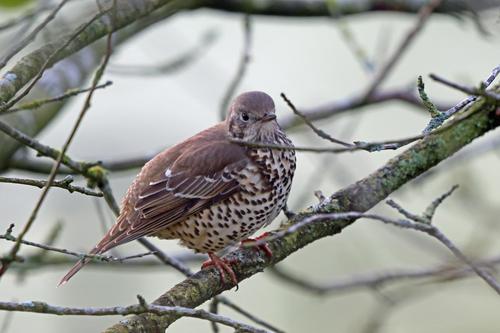 Zorzal Charlo
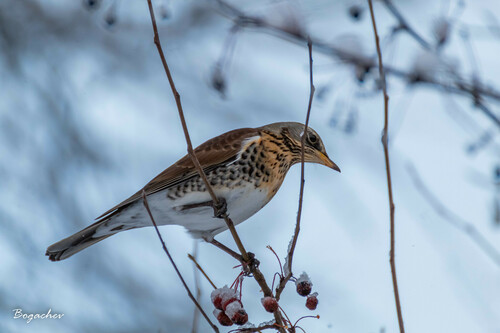 Zorzal Real
En breve
The most reliable field mark between Mistle Thrush and Fieldfare is the head and rump color: Fieldfare shows a distinctive slate-grey head and rump, while Mistle Thrush is overall grey-brown above without this contrast. In flight, both species show white underwing coverts, but Fieldfare’s are especially bold and the bird often flashes its grey rump. Mistle Thrush is larger, longer-tailed, and stands more upright on the ground. For perched birds, Mistle Thrush has round, irregular black spots on a buffy or yellowish background, while Fieldfare’s breast is creamy-buff with bold streaks and a whiter belly. Juveniles of both species are duller, but Fieldfare young still show the grey head and rump contrast after their first autumn moult. Use structure and head pattern first, then check underpart color and spotting.
Consejos de identificación
- Head and Rump Color: Fieldfare always shows a clear slate-grey head and rump, contrasting with a dark brown back. Mistle Thrush is more uniform grey-brown above with no strong head-rump contrast. This is the best single mark for perched or flying birds of any age.
- Underwing Coverts in Flight: Both species show white underwing coverts, but Fieldfare’s are especially bold and obvious in flight. Use this in combination with other marks, as Mistle Thrush also shows white underwings.
- Underpart Color and Spotting: Mistle Thrush has round, irregular black spots on a yellowish-buff or off-white background; Fieldfare has a creamy-buff, boldly streaked breast with a much whiter, less spotted belly. On Fieldfare, the spotting is more streak-like and concentrated on the upper breast.
- Tail Shape and Pattern: Mistle Thrush has a long tail with white tips on the outer feathers; Fieldfare’s tail is shorter, rounded, dark, and has subtle grey fringes and a narrow white border on the outermost feathers.
- Size and Structure: Mistle Thrush is noticeably larger, bulkier, and longer-tailed, with a more upright stance. Fieldfare is more compact and less upright when perched.
- Posture and Jizz: Mistle Thrush stands tall and erect, especially on open ground, often flicking its wings and tail. Fieldfare is more horizontal and less upright.
- Juvenile Plumage: Juvenile Mistle Thrush is paler above with creamy teardrop centers and smaller spots below; juvenile Fieldfare is duller but still shows the grey head and rump after its first autumn moult. Use head pattern for young birds.
- Flock Size and Behavior: Fieldfare is much more likely to be seen in large, noisy flocks in winter, especially in open fields. Mistle Thrush is usually alone or in small groups, even in winter.
- Bill Color: Both have yellowish bills with darker tips, but this is not a strong separator in the field.
- Sex Differences: Both species show little sexual dimorphism in the field; female Fieldfares are slightly browner above and paler below, but this is subtle and not reliable for separation.
- Voice: Fieldfare’s harsh "tsak tsak" flight call is distinctive and not matched by Mistle Thrush, whose calls are more rattling or churring.
- Habitat Context: In winter, Fieldfare prefers open fields and is often in large flocks; Mistle Thrush is more often in woodland edges, parks, or singly in open country.
- Seasonal Movement: Fieldfare is strongly migratory and more likely to appear in large numbers in winter; Mistle Thrush is resident in much of its range but also migrates from the north and east.
- Spot Pattern Regularity: Mistle Thrush’s spots are rounder and more randomly placed; Fieldfare’s breast streaks are bolder and more linear, especially on the upper breast.
- Pitfalls: Beware of dull juvenile Fieldfares, which may look less striking but still show the grey head and rump. Mistle Thrushes never show the strong head-rump contrast of Fieldfare at any age.
Tamaño
Mistle Thrush is the largest native European thrush, noticeably bigger and bulkier than Fieldfare. Mistle Thrush averages 27–28 cm in length with a wingspan around 45 cm and a typical weight near 130 g, while Fieldfare averages 25 cm in length, 39–42 cm wingspan, and about 105 g. Mistle Thrush looks longer-tailed and more upright when perched, while Fieldfare is more compact. These differences are most obvious when both species are seen together, but Mistle Thrush’s larger, stockier build is often apparent even singly.
Plumaje
- Juvenile/First-winter: Juvenile Mistle Thrushes are paler above with creamy teardrop centers to the feathers and smaller, rounder spots on yellowish underparts; by first winter, they resemble adults but are more buff below. Juvenile Fieldfares are duller than adults but still show pale streaks on the feathers and retain the grey head and rump contrast after their first autumn moult.
- Adult: Mistle Thrush is pale grey-brown above with a greyish-white chin and throat, yellowish-buff breast, and off-white belly marked with round, irregular black spots. Fieldfare adults have a striking slate-grey head, nape, and rump, dark brown back, blackish tail, and a creamy-buff, boldly streaked breast with a much whiter belly. Both species have white underwing coverts visible in flight, but Fieldfare’s are especially conspicuous. Mistle Thrush’s tail is long with white tips on the outer feathers; Fieldfare’s tail is rounded and dark with subtle grey fringes and a narrow white border on the outermost feathers.
Comportamiento
Mistle Thrush is often seen alone or in pairs, standing upright and moving with a distinctive, erect posture, especially on open ground. It hops with its head held high and flicks wings and tail when excited. In late summer and autumn, family groups may join to form larger flocks. Fieldfare is more gregarious, especially in winter, often forming large, noisy flocks that feed together in open fields or roost communally. In flight, Mistle Thrush has an undulating, bounding flight with glides, while Fieldfare’s flight is direct and strong, often accompanied by its harsh call.
Hábitat
Both species breed in woodland and open country across Europe and the Palearctic, but Fieldfare is more strongly migratory, breeding further north and east and moving south in winter. Mistle Thrush is a year-round resident in much of its range but also migrates from the north and east in winter, sometimes in small flocks. In winter, Fieldfares are more likely to be seen in large flocks in open fields, while Mistle Thrushes are often in smaller groups or alone in parks, woodland edges, and open countryside.
Voz
Fieldfare’s flight call is a harsh, repeated "tsak tsak" or "tsuk", often heard as flocks fly overhead or gather in trees. Mistle Thrush has a different, rattling or churring call and a fluty, far-carrying song, but these are less likely to be confused with Fieldfare’s calls. When alarmed, Fieldfare can give warning sounds reminiscent of Mistle Thrush, but the typical flight calls are distinct.