

Filentoma Pechipardo vs Drongo Bronceado
Philentoma velata frente a Dicrurus aeneus
Juega un quiz con Filentoma Pechipardo y Drongo Bronceado
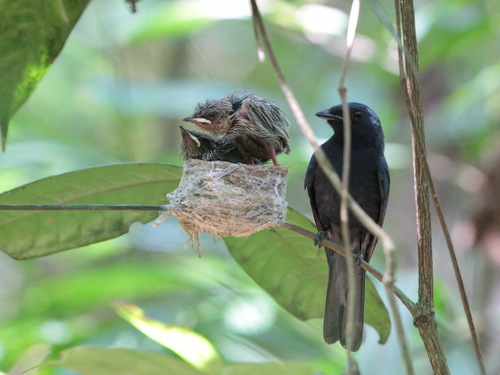 Filentoma Pechipardo
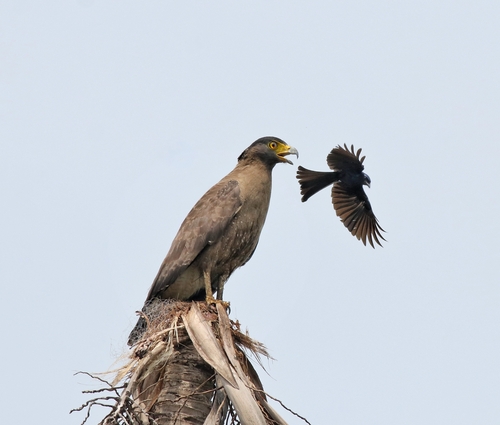 Drongo Bronceado
En breve
The most reliable field mark to separate Maroon-breasted Philentoma from Bronzed Drongo is tail shape: Bronzed Drongo always shows a distinctly forked tail with outward-flaring outer feathers, while Maroon-breasted Philentoma has a straight or only slightly notched tail. If you see a metallic gloss or spangled appearance on the head and breast, especially in adults, you are looking at a Bronzed Drongo. Juvenile Bronzed Drongos may show white-tipped axillaries and a duller, brownish tone, while Philentoma lacks these features. Both species can be found in Southeast Asian forests, but their structure and behavior are quite different: Philentoma is a vangid with a more compact, non-drongo shape, while Bronzed Drongo is a classic, agile drongo with aerial sallies and a slender, forked tail.
Consejos de identificación
- Tail shape is key: Bronzed Drongo always has a distinctly forked tail with outward-flaring outer feathers, visible both perched and in flight. Maroon-breasted Philentoma's tail is straight or only slightly notched—never deeply forked. This is the fastest separator at any age.
- Metallic gloss and spangling: Adult Bronzed Drongo shows strong metallic gloss and a spangled appearance on the head, neck, and breast. Philentoma lacks any metallic or spangled effect, appearing matte and more subdued.
- Juvenile Bronzed Drongo: Look for white-tipped axillaries (underwing coverts) in flight or when preening, and a duller, brownish overall tone with less gloss. Philentoma juveniles do not show white-tipped axillaries or a brownish phase.
- Bill structure: Bronzed Drongo has a classic drongo bill—slender, slightly decurved, and suited for aerial insect hunting. Philentoma's bill is more vangid-like, shorter and broader, not as pointed or decurved.
- Body structure: Bronzed Drongo is compact but with a longer, more graduated tail and a more streamlined, agile appearance. Philentoma is more compact overall, with a shorter, squarer tail and a less agile jizz.
- Perched posture: Bronzed Drongo often perches upright with the tail held out and visible fork. Philentoma perches more horizontally, and the tail appears straight or only slightly notched.
- Aerial behavior: Bronzed Drongo is highly active, making frequent aerial sallies to catch insects. Philentoma is more sedentary, less likely to sally or chase insects in the air.
- Head and face: Bronzed Drongo has velvety lores and duller ear coverts, which may be visible at close range. Philentoma lacks these contrasting facial textures.
- Breast color: Philentoma has a maroon-toned breast, which is never metallic or spangled. Bronzed Drongo's breast is glossy and spangled in adults, duller in juveniles.
- Habitat overlap caution: Both species can occur in the same forest types in the Malay Peninsula and Borneo, so do not rely on habitat alone.
- Size is not reliable: Both are small forest birds; size differences are subtle and not useful in the field.
- No strong seasonal or sexual dimorphism: Both species show similar plumage year-round and between sexes, so focus on structural and plumage marks.
- Flight view: In flight, the forked tail of Bronzed Drongo is obvious, while Philentoma shows a straight or only slightly notched tail.
- Immature confusion: If you see a brownish bird with a forked tail and white-tipped axillaries, it's a juvenile Bronzed Drongo. If the bird is plain, lacks gloss, and has a straight tail, it's Philentoma.
- Drongo vs vangid jizz: Bronzed Drongo looks and acts like a classic drongo—sleek, forked tail, agile. Philentoma is chunkier, less streamlined, and never as aerial.
Tamaño
Bronzed Drongo is a small, compact drongo, smaller than the Black Drongo and generally similar in size to Maroon-breasted Philentoma. Both are small forest birds and size alone is not a reliable separator in the field, as their body lengths overlap and both are lightweight. Focus on structure and tail shape rather than overall size.
Plumaje
- Juvenile/Immature Bronzed Drongo: Look for white-tipped axillaries (underwing coverts) and a generally duller, brownish plumage with less metallic gloss and spangling. The tail is still distinctly forked, even in young birds.
- Adult Bronzed Drongo: Shows strong metallic gloss, especially on the head, neck, and breast, with a spangled effect. The lores are velvety, ear coverts duller, and the tail is always well forked with outer feathers flared outward.
- Maroon-breasted Philentoma (all ages): Lacks any metallic gloss or spangling. The plumage is more subdued, with a maroon-toned breast (not metallic or spangled), and the tail is straight or only slightly notched. No white-tipped axillaries or brownish juvenile phase is described. Overall, Philentoma appears plainer and less glossy than Bronzed Drongo at all ages.
Comportamiento
Bronzed Drongo is an active, agile aerial insectivore, often seen making quick sallies from perches to catch insects in the forest canopy shade. It frequently returns to the same perch and is noticeably restless and acrobatic. Maroon-breasted Philentoma, by contrast, is less aerial and does not show the same sallying behavior typical of drongos. Its movements are more vangid-like, often perching quietly and not engaging in repeated aerial chases.
Hábitat
Both species occur in Southeast Asian forests, including Malaysia, Indonesia, Thailand, and Myanmar. Bronzed Drongo is also found in the Indian subcontinent and is a resident of forested areas, especially in the canopy and edges. Maroon-breasted Philentoma is more restricted to the Sundaic region and is not found as far west as India. Habitat overlap is significant in the Malay Peninsula and Borneo, so context alone is not diagnostic.
Filentoma Pechipardo · Drongo Bronceado · Mis aves difíciles