

Espolonero Chinquis vs Espolonero de Rothschild
Polyplectron bicalcaratum frente a Polyplectron inopinatum
Juega un quiz con Espolonero Chinquis y Espolonero de Rothschild
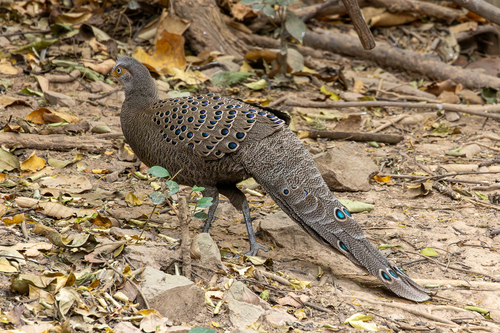 Espolonero Chinquis
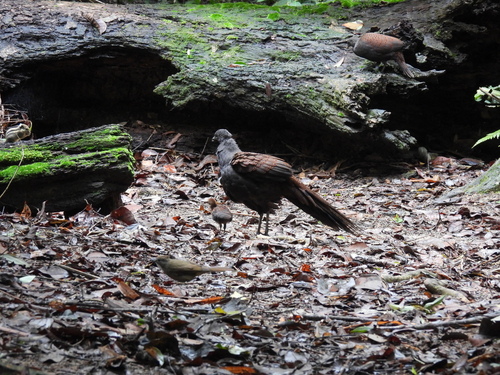 Espolonero de Rothschild
En breve
The most reliable field mark between Grey Peacock-Pheasant and Mountain Peacock-Pheasant is the color and size of the ocelli (eyespots) on the upperparts and tail, especially in adult males. Grey Peacock-Pheasant shows larger, green eyespots scattered across a greyish-brown body, while Mountain Peacock-Pheasant has smaller, metallic blue ocelli on the upperparts and green ocelli on the tail, set against a darker, blackish-brown background. Females of both are less ornamented, but Mountain Peacock-Pheasant females have black ocelli and a shorter tail. Size is also a clue: Grey Peacock-Pheasant is distinctly larger. Both sexes can be confusing at a distance or in poor light, but careful attention to eyespot color, tail length, and overall size will usually resolve the ID.
Consejos de identificación
- Ocelli color and size (adults): Grey Peacock-Pheasant shows larger, green eyespots on a greyish-brown background; Mountain Peacock-Pheasant has smaller, metallic blue ocelli on the upperparts and green ocelli on the tail, set against a blackish-brown background. This is most reliable in adult males.
- Tail feather count and shape: Mountain Peacock-Pheasant males have twenty tail feathers, females eighteen; Grey Peacock-Pheasant's tail is long but feather count is less emphasized in field notes. Mountain Peacock-Pheasant's tail is long and graduated, but overall shorter than Grey Peacock-Pheasant's.
- Facial skin color: Grey Peacock-Pheasant has bare pink or yellow facial skin and a white throat, which can be visible at close range. Mountain Peacock-Pheasant lacks mention of colorful facial skin.
- Body color: Grey Peacock-Pheasant is overall greyish-brown; Mountain Peacock-Pheasant is distinctly darker, blackish-brown.
- Female plumage: Female Grey Peacock-Pheasant is smaller, darker, and less ornamented than the male but still shows some greenish ocelli. Female Mountain Peacock-Pheasant is duller, with black ocelli and a shorter tail (eighteen feathers), and lacks leg spurs.
- Leg spurs: Male Mountain Peacock-Pheasant has two spurs per leg; female lacks spurs. Grey Peacock-Pheasant's spur count is not specified, but both sexes have grey legs.
- Size: Grey Peacock-Pheasant is larger (up to 76 cm) than Mountain Peacock-Pheasant (up to 65 cm). Use this when birds are seen at similar distance or with a reference for scale.
- Crest: Grey Peacock-Pheasant has an elongated, bushy crest, which may be visible when perched or displaying. Mountain Peacock-Pheasant does not have a prominent crest.
- Iris and bill color: Grey Peacock-Pheasant has a grey iris and bill; Mountain Peacock-Pheasant's iris and bill color are not specified, so this is only a supporting mark.
- Juvenile/immature separation: Both species' juveniles resemble the adult female, but Grey Peacock-Pheasant juveniles will be paler and show some greenish ocelli, while Mountain Peacock-Pheasant juveniles will be darker with black ocelli.
- Habitat context: If observed in montane forest in the central Malay Peninsula, Mountain Peacock-Pheasant is expected; in lowland or hill forest in mainland Southeast Asia, Grey Peacock-Pheasant is more likely.
- Behavior: Both are shy and ground-dwelling; behavior is not a reliable separator.
- Flight views: Both species have long, graduated tails in flight, but Grey Peacock-Pheasant will look bulkier and longer-tailed.
- Bare facial skin: Only Grey Peacock-Pheasant is noted for bare pink or yellow facial skin; look for this in close views.
- Spur presence (females): Female Mountain Peacock-Pheasant lacks leg spurs, which may be visible if the bird is walking or displaying.
Tamaño
Grey Peacock-Pheasant is the larger of the two, reaching up to 76 cm in length, while Mountain Peacock-Pheasant is smaller, up to 65 cm. This difference is most apparent when seen side by side or with a good sense of scale. Both species are long-tailed, but Grey Peacock-Pheasant's overall bulk and tail length are greater. Females of both species are smaller than males, but the size gap between species remains consistent.
Plumaje
Adult male Grey Peacock-Pheasant is greyish-brown with prominent, fairly large green eyespots (ocelli) scattered on the upperparts and tail, and an elongated bushy crest. The bare facial skin is pink or yellow, and the throat is white. Females are smaller, darker, and less ornamented, but still have some greenish ocelli. Juveniles resemble females, lacking strong ornamentation. In contrast, adult male Mountain Peacock-Pheasant is blackish-brown with small, metallic blue ocelli on the upperparts and green ocelli on the tail, which has twenty feathers. The tail is long and graduated. Females are duller, with black ocelli on the upperparts, unspurred legs, and a tail of eighteen feathers. Both sexes of Mountain Peacock-Pheasant are darker overall and have smaller, more subdued ocelli compared to Grey Peacock-Pheasant. No distinctive age-specific upperwing pattern is described for either species, so separation relies on body and tail plumage.
Comportamiento
Both species are shy and elusive, tending to skulk in dense forest undergrowth. There is no diagnostic behavioral difference noted in the sources; both are ground-dwelling and secretive. In flight, both are likely to show long, graduated tails, but Grey Peacock-Pheasant may appear bulkier and heavier due to its larger size.
Hábitat
Grey Peacock-Pheasant is widespread in mainland Southeast Asia, inhabiting lowland and hill forests. Mountain Peacock-Pheasant is a much more localized species, restricted to montane forests of the central Malay Peninsula. If seen in true montane forest in the Malay Peninsula, Mountain Peacock-Pheasant is far more likely; in lowland or more northern forests, expect Grey Peacock-Pheasant.
Espolonero Chinquis · Espolonero de Rothschild · Mis aves difíciles