

Serín Forestal vs Serín Gorjinegro
Crithagra scotops frente a Crithagra atrogularis
Juega un quiz con Serín Forestal y Serín Gorjinegro
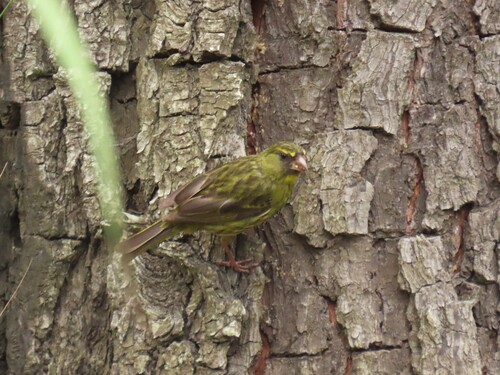 Serín Forestal
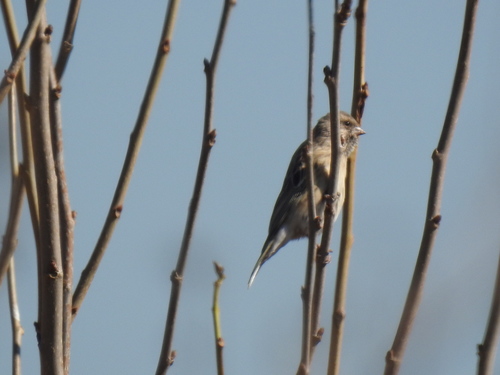 Serín Gorjinegro
En breve
The most reliable field mark between Forest Canary and Black-throated Canary is plumage: Forest Canary males are distinctly yellowish with a greenish tinge and a black facial mask, while Black-throated Canary lacks this bright yellow and instead shows a more subdued, streaky appearance with a black throat patch. Females and juveniles of Forest Canary are duller but still show yellow underparts and a greenish-olive cast, whereas Black-throated Canary remains plainer and more uniformly streaked. Forest Canary is noticeably heavier and often appears chunkier. Habitat can also help: Forest Canary is tied to moist forests, while Black-throated Canary prefers more open or drier habitats.
Consejos de identificación
- Male Forest Canary is bright yellow below and yellow-green above, with a black mask from forehead through the eyes. This is the single most obvious field mark for adult males and is not matched by Black-throated Canary at any age or sex.
- Female and juvenile Forest Canary are duller but still show yellowish underparts and a greenish-olive cast. Juveniles are especially olive, but always lack the black throat patch of Black-throated Canary.
- Black-throated Canary of all ages and sexes shows a black throat patch, not a mask. The black is confined to the throat and does not extend as a mask across the face. This is diagnostic when seen well.
- Forest Canary has a black facial mask, not a throat patch. If the black is around the eyes and forehead, it's Forest Canary; if it's on the throat, it's Black-throated Canary.
- Upperpart streaking is present in both, but Forest Canary's is on a yellow or olive background, while Black-throated Canary's is on a paler, less colorful base. This can help in poor light or with immature birds.
- Size and build: Forest Canary is heavier and chunkier (15.4g vs 11.4g). If the bird appears noticeably stocky for a small finch, Forest Canary is more likely.
- Bill structure is not detailed as different in the sources, but Forest Canary is described as having a short, thick beak. Use with caution unless seen side by side.
- Habitat: Dense, moist forest strongly favors Forest Canary; open or dry country points to Black-throated Canary. Always consider habitat, especially if plumage is ambiguous.
- Juvenile Forest Canary can be confused with Black-throated Canary due to dull coloration, but lacks the black throat patch and retains a dull olive tone.
- No unique wing or flight pattern marks are described for either species, so rely on perched views for ID.
- Both species have streaked upperparts, but the context (background color and intensity) is key.
- If you see a bird with a black mask and yellow tones, it's Forest Canary, regardless of age or sex.
- If you see a bird with a black throat patch and otherwise plain or streaky gray-brown plumage, it's Black-throated Canary.
- If the bird is in a mixed flock, check for the presence of both facial and throat black to avoid confusion.
- No vocal differences are provided in the sources, so do not rely on calls or song for separation in this context.
Tamaño
Forest Canary is larger and heavier, averaging about 15.4g compared to Black-throated Canary's 11.4g [wikidata]. In the field, Forest Canary often looks stockier and more robust, while Black-throated Canary appears slimmer and lighter. Both are small finches, but this size difference can be apparent when seen side by side or with experience.
Plumaje
Adult male Forest Canary stands out with bright yellow underparts and a yellow-green back, plus a black mask running from forehead through the eyes. Females and juveniles are duller, showing a greenish-gray back and yellowish underparts, but still with some olive tones and faint streaking. Juvenile Forest Canary resembles the female but is even duller, with a more olive hue. In contrast, Black-throated Canary (all ages and sexes) lacks the strong yellow tones and instead is generally grayish or brownish with fine streaking and a distinctive black throat patch (not a mask). The black throat is diagnostic for Black-throated Canary, while the black facial mask (not throat) is key for Forest Canary. Both species have streaked upperparts, but the pattern and intensity differ: Forest Canary's streaks are more pronounced on a yellow or olive background, while Black-throated Canary's are finer and on a paler, less colorful base.
Comportamiento
No direct behavioral differences are noted in the sources. Both are typical finches in their habits, but Forest Canary may appear more at home in dense foliage, while Black-throated Canary is more often seen in open or edge habitats. No unique flight or feeding behaviors are described that would reliably separate them in the field.
Hábitat
Forest Canary is strongly associated with subtropical or tropical moist lowland and montane forests in South Africa and Eswatini [wikipedia]. It prefers dense, humid forest environments. Black-throated Canary, while not detailed here, is known to favor more open country, woodland edges, and drier habitats. Thus, finding a canary in deep, moist forest strongly favors Forest Canary, while birds in open or drier areas are more likely Black-throated Canary.