

Leñatero vs Canastero Coludo
Anumbius annumbi frente a Asthenes pyrrholeuca
Juega un quiz con Leñatero y Canastero Coludo
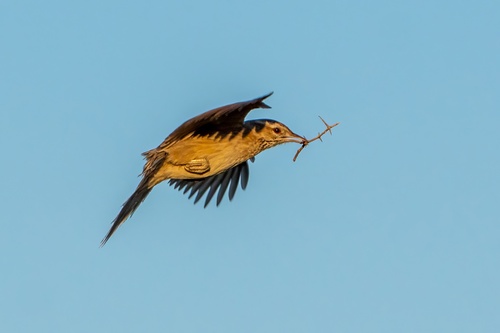 Leñatero
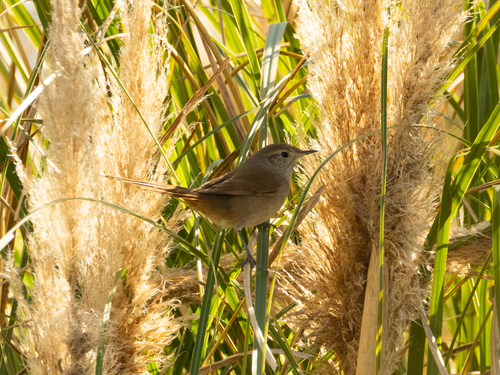 Canastero Coludo
En breve
The most reliable field mark for separating Firewood-gatherer from Sharp-billed Canastero is overall size and structure: Firewood-gatherer is notably larger and bulkier, with a heavier, less pointed bill, while Sharp-billed Canastero is smaller, slimmer, and has a distinctly thin, sharp-tipped bill. Juvenile plumages can be confusing, but the Firewood-gatherer juvenile lacks rufous on the forehead and has a more ochraceous throat, while juvenile Sharp-billed Canastero is mottled below and lacks the adult’s throat patch. In flight or perched, check the tail: Firewood-gatherer’s tail is longer and more graduated, with white at the tips of the outer feathers, while Sharp-billed Canastero’s tail is shorter, with more rufous and less white. Both species share a similar brownish ground color, but facial and throat patterns differ subtly. Habitat overlap is broad, but Firewood-gatherer is more likely in open, brushy areas with scattered trees, while Sharp-billed Canastero favors drier, shrubbier, or grassier landscapes.
Consejos de identificación
- Size and Structure: Firewood-gatherer is much larger and heavier-bodied than Sharp-billed Canastero. If the bird looks chunky and robust, think Firewood-gatherer; if it is slim and delicate, think Sharp-billed Canastero. This is reliable at all ages and seasons.
- Bill Shape: Firewood-gatherer has a straight, sturdy bill, not especially thin or pointed. Sharp-billed Canastero has a distinctly thin, sharply pointed bill, which gives the face a more delicate look. This is especially useful on close views or photos.
- Tail Shape and Pattern: Firewood-gatherer’s tail is long and graduated, with the central feathers pointed and dark, and the outer feathers less pointed and blackish brown with variable white at the tips. Sharp-billed Canastero’s tail is shorter, with central feathers pointed and dark, but the outer feathers are mostly dull rufous (entirely rufous in some subspecies) with dark inner webs and little or no white. In flight or when fanned, look for white tips (Firewood-gatherer) vs. rufous (Sharp-billed Canastero).
- Supercilium (Eyebrow): Firewood-gatherer shows a broad, whitish supercilium, often obvious in the field. Sharp-billed Canastero’s supercilium is paler but narrower and less striking.
- Forehead and Crown: Firewood-gatherer adults have a dull rufous forehead and a brown crown with narrow blackish streaks (more obvious on lower back). Sharp-billed Canastero lacks rufous on the forehead and has a plain dull brown crown.
- Facial Pattern: Firewood-gatherer has a medium brownish stripe behind the eye and a light brownish to grayish brown face. Sharp-billed Canastero’s face is gray-brown with less contrast and a paler, less distinct supercilium.
- Throat and Breast: Firewood-gatherer has a white throat bordered by a line of black speckles and a slightly reddish, streaked upper breast. Sharp-billed Canastero has a rufous to tawny chin and upper throat with dark-tipped pale streaks, and a paler, faintly streaked lower throat and breast. Juvenile Firewood-gatherer has an ochraceous throat, while juvenile Sharp-billed Canastero lacks the throat patch and has a mottled breast.
- Underparts: Firewood-gatherer’s underparts are pale buffy with streaks fading toward the belly; flanks are darker sandy brown. Sharp-billed Canastero’s belly is pale buff-brown, with flanks and undertail coverts darker buff-brown and more rufescent.
- Upperparts: Both are brown above, but Firewood-gatherer’s back is dull brown with streaks on the lower back, while Sharp-billed Canastero’s back and rump are slightly paler brown and less streaked.
- Wing Color: Firewood-gatherer’s wings are dull brown with darker centers and tips; Sharp-billed Canastero’s wings are more rufescent brown. This is subtle and best seen in good light.
- Leg Color: Firewood-gatherer has gray to greenish or creamy gray legs; Sharp-billed Canastero’s legs are slate-gray.
- Juvenile Pitfalls: Immature Firewood-gatherer lacks rufous on the forehead and has less distinct streaking above; juvenile Sharp-billed Canastero lacks throat patch and has a mottled breast. If you see a streaky, brownish juvenile with an ochraceous throat, lean Firewood-gatherer; if the breast is mottled and the throat plain, lean Sharp-billed Canastero.
- Habitat Context: If the bird is in open country with scattered trees or near human habitation, Firewood-gatherer is more likely. If in dry, shrubby, or grassy steppe, especially away from trees, Sharp-billed Canastero is favored.
- Behavior: Firewood-gatherer often perches upright and conspicuously, sometimes on fences or exposed branches, and may be seen carrying sticks. Sharp-billed Canastero is more likely to skulk in low vegetation and is less often seen in the open.
- Subspecies Note: In southern Chile and west-central Argentina, Sharp-billed Canastero (A. p. sordida) has entirely rufous outer tail feathers, which can be a strong mark against Firewood-gatherer in that region.
Tamaño
Firewood-gatherer is substantially larger (18–20 cm, 27–45 g) than Sharp-billed Canastero (14–15 cm, 12–14 g) [wikipedia]. This difference is obvious in the field: Firewood-gatherer appears robust and heavy-bodied, with a strong, straight bill, while Sharp-billed Canastero is noticeably smaller, slimmer, and has a thin, sharply pointed bill. The difference in mass is nearly double, and the Firewood-gatherer’s longer tail and overall bulk are apparent even at a distance.
Plumaje
-
Juveniles: Firewood-gatherer juveniles lack rufous on the forehead, have an ochraceous (yellowish-brown) throat, and less distinct upperpart streaking compared to adults, with darker underparts. Sharp-billed Canastero juveniles lack the adult’s throat patch and have a mottled breast, but otherwise resemble adults. These differences are subtle but can be useful if seen well.
-
Adults: Firewood-gatherer adults show a broad whitish supercilium, a dull rufous forehead, and a streaked brown crown, with a white throat bordered by a line of black speckles, and a slightly reddish, streaked upper breast fading to a pale buff belly. The tail is long, with the central feathers pointed and dark, and the outer feathers less pointed and blackish brown with variable white at the tips. Sharp-billed Canastero adults have a paler, narrower supercilium, a dull brown crown, and a gray-brown face. The chin and upper throat are rufous to tawny with dark-tipped pale streaks, and the lower throat and breast are pale grayish brown with faint streaks. The tail is shorter, with the central feathers pointed and dark, and the outer feathers mostly dull rufous (entirely rufous in some subspecies) with dark inner webs, and less white at the tips compared to Firewood-gatherer.
-
Wings: Both species have dull brownish wings, but Firewood-gatherer’s are more uniformly dull brown with darker centers and tips, while Sharp-billed Canastero’s are dull rufescent brown. No distinctive age-specific upperwing pattern is described for either species.
Comportamiento
Both species are terrestrial and often forage on or near the ground, but Firewood-gatherer tends to be more conspicuous, often perching upright on exposed branches or fence posts, and may appear more pipit-like in its stance. Sharp-billed Canastero is more likely to be seen moving quickly through low shrubs or grass, often less conspicuous and more secretive. Firewood-gatherer may be seen gathering sticks for its large, visible nest, while Sharp-billed Canastero’s nest is smaller and more hidden in shrubs.
Hábitat
There is broad overlap in range (Argentina, Paraguay, Uruguay, southern Brazil), but habitat preferences differ subtly. Firewood-gatherer favors open country with scattered trees, brushy pastures, and edges of woodland, often near human habitation or agricultural areas. Sharp-billed Canastero prefers drier, semi-arid or arid shrub-steppe, grasslands, and scrubby hillsides, sometimes at higher elevations or in more open, rocky terrain. In the non-breeding season, Sharp-billed Canastero may also be found in tall grass or marshy areas, but is generally less associated with trees than Firewood-gatherer.