

Spatelraubmöwe vs Schreiadler
Stercorarius pomarinus gegen Clanga pomarina
Ein Quiz mit Spatelraubmöwe und Schreiadler spielen
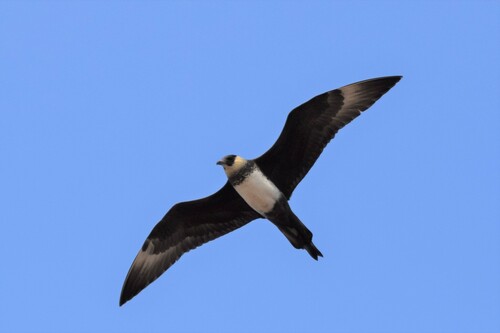 Spatelraubmöwe
 Schreiadler
Kurz gesagt
The most reliable field mark to separate Pomarine Skua from Lesser Spotted Eagle is the wing and tail pattern in flight, especially in juveniles and immatures. Juvenile Pomarine Skuas show a strong white double flash on the underwing and, in adults, distinctive spoon-shaped central tail feathers, while Lesser Spotted Eagles of all ages show a pale head, a white 'V' on the rump, and prominent white spots on the remiges (flight feathers) in juveniles. Structurally, Pomarine Skua is a bulky, broad-winged seabird with a shorter, stouter bill, while Lesser Spotted Eagle is a much larger, long-winged raptor with a small head and bill for an eagle. These species are unlikely to overlap in habitat, but confusion may arise with distant or soaring birds. Focus on wing pattern, tail shape, and overall jizz for confident separation.
Bestimmungstipps
- Underwing pattern in flight (all ages): Pomarine Skua shows a diagnostic white double flash on the underwing, visible in all morphs and ages. Lesser Spotted Eagle never shows this pattern; instead, look for white spots on the remiges in juveniles and a less contrasting underwing in adults.
- Tail shape (breeding adults): Adult Pomarine Skuas have two long, spoon-shaped, twisted central tail feathers. Lesser Spotted Eagles always have a broad, straight-cut tail with no streamers or projections.
- Rump pattern (all ages): Lesser Spotted Eagle shows a clear white 'V' on the rump, visible from above and behind in flight. Pomarine Skua never shows a white rump.
- Head and neck color: Adult Pomarine Skua (light morph) has a yellowish-white head and neck with a black cap. Lesser Spotted Eagle has a pale brown head and neck, contrasting with its darker body, but never shows a black cap.
- Juvenile marks: Juvenile Lesser Spotted Eagles have a cream-colored neck patch and prominent white spots on the flight feathers but lack covert spotting. Juvenile Pomarine Skuas are variable brown but always show the underwing double flash.
- Size and structure: Lesser Spotted Eagle is much larger, longer-winged, and more imposing. Pomarine Skua is bulky but still much smaller and more compact, with a shorter, stouter bill.
- Flight style: Pomarine Skua has a measured, direct flight, often low over water, sometimes harassing other seabirds. Lesser Spotted Eagle soars on thermals with slow, deep wingbeats, rarely flapping for long.
- Bill and head: Pomarine Skua has a short, thick bill and a robust head. Lesser Spotted Eagle has a small bill and a relatively small head for an eagle, giving it a distinctive profile.
- Habitat context: Pomarine Skua is found at sea or along coasts; Lesser Spotted Eagle is strictly terrestrial, never found at sea.
- Perched posture: Pomarine Skua is rarely seen perched except on the ground or floating; Lesser Spotted Eagle perches upright in trees, typical of large raptors.
- Wing coverts: Lesser Spotted Eagle adults have pale brown wing coverts contrasting with the dark flight feathers; Pomarine Skua does not show this contrast.
- Voice: If heard, Pomarine Skua gives harsh chatters; Lesser Spotted Eagle gives a dog-like yip. Voice is rarely diagnostic in the field.
- Plumage morphs: Pomarine Skua comes in light, dark, and intermediate morphs, but all show the underwing double flash. Lesser Spotted Eagle does not show such morphs.
- Season and location: If the bird is seen far inland in Europe, especially soaring over fields or woods, it is likely a Lesser Spotted Eagle. If seen over open ocean, it is almost certainly a Pomarine Skua.
- Common pitfalls: Distant, soaring Pomarine Skuas may look eagle-like due to size and broad wings, but always check for the underwing flash and tail shape. Conversely, eagles never show the skua's wing or tail pattern, and their flight style is more soaring and less direct.
Größe
Lesser Spotted Eagle is substantially larger and heavier than Pomarine Skua: average body mass is about 1475.5 g for the eagle versus 694.0 g for the skua [wikidata]. The eagle reaches about 60 cm in length with a 150 cm wingspan, while the skua is 46–67 cm (including tail streamers) with a 110–138 cm wingspan [wikipedia]. In the field, the eagle will appear much larger, longer-winged, and more imposing, while Pomarine Skua is bulkier than gulls but still much smaller and more compact than any eagle.
Gefieder
- Juvenile/immature birds in flight:
- Pomarine Skua juveniles are highly variable but always show a strong white double flash on the underwing, which is diagnostic for the species. The rest of the plumage is variable brown, and at a distance, they can be very hard to separate from similar jaegers, but not from eagles.
- Lesser Spotted Eagle juveniles lack covert spotting but show prominent white spots on the remiges (flight feathers) and a cream-colored neck patch. The white 'V' on the rump is present in all ages but is especially clear in adults. Juveniles have less contrast in the wings than adults.
- Adults:
- Adult Pomarine Skuas (light morph) have a brown back, white underparts, dark primaries with a white double flash, and a yellowish-white head with a black cap. In breeding plumage, the two central tail feathers are elongated, spoon-shaped, and twisted. Dark and intermediate morphs exist, but all have the white underwing flash.
- Adult Lesser Spotted Eagles are generally dark brown with a pale brown head and wing coverts, a small bill, and a distinct white 'V' on the rump. The upperwings often show a white patch. The white 'V' is always present and is a key field mark.
- Key contrast: The skua's white underwing double flash and (in adults) spoon-shaped tail feathers are never shown by the eagle. The eagle's white rump 'V' and pale head are never shown by the skua.
Verhalten
Pomarine Skua is a seabird, typically seen flying with a more measured, less falcon-like flight than smaller jaegers, often chasing gulls or terns for food (kleptoparasitism). In flight, it appears broad-winged and heavy-bodied. Lesser Spotted Eagle soars with long, broad wings and a small head, often using thermals over open or lightly wooded country. It hunts by soaring and scanning for terrestrial prey, rarely seen over open water. Perched, the eagle is upright and powerful, while the skua is rarely seen perched except on the ground or floating at sea.
Lebensraum
Pomarine Skua is strictly pelagic outside of breeding, seen over open ocean or coastal waters, rarely inland except during storms or migration. Lesser Spotted Eagle is a raptor of open or lightly wooded terrestrial habitats, breeding in Central and Eastern Europe and wintering in Africa. It is never found at sea. If seen over water, the bird is almost certainly a skua; if soaring over fields or woods, it is almost certainly an eagle.
Stimme
Pomarine Skua gives harsh chattering calls and a 'which-yew' sound, mostly heard at breeding grounds or during aggressive interactions. Lesser Spotted Eagle's call is a dog-like yip, rarely heard except near the nest. In most field situations, voice is not a useful separation mark.