

Paradiesgans vs Saumschnabelente
Tadorna variegata gegen Hymenolaimus malacorhynchos
Ein Quiz mit Paradiesgans und Saumschnabelente spielen
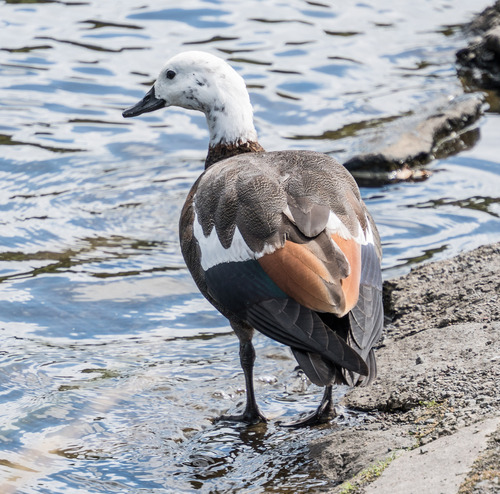 Paradiesgans
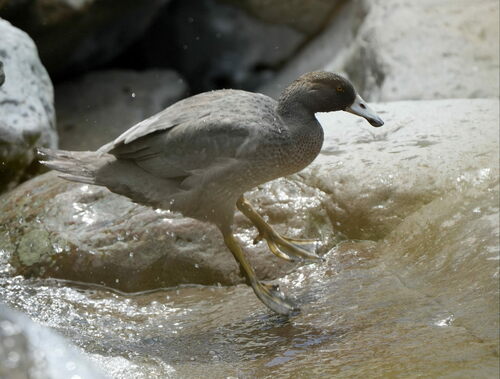 Saumschnabelente
Kurz gesagt
The most reliable field mark for separating Paradise Shelduck from Blue Duck is overall plumage: Paradise Shelduck shows strong sexual dimorphism with either a white-headed chestnut female or a dark-headed, barred male, while Blue Duck is uniformly slate-grey with subtle chestnut flecking and no bold white or chestnut patches. In flight, Paradise Shelduck of all ages shows prominent white upperwing coverts and a metallic green speculum, while Blue Duck lacks white wing panels and instead has only small white tips to the outer secondaries. Juvenile and immature plumages are less contrasting but still differ in wing pattern and head color. Paradise Shelduck is much larger and bulkier, with a more upright posture, while Blue Duck is smaller, sleeker, and typically found on fast-flowing rivers. Context and habitat are often decisive, as Blue Duck is restricted to wild rivers, while Paradise Shelduck is widespread in open country.
Bestimmungstipps
- White upperwing panel (all ages): In flight, Paradise Shelduck always shows a broad white panel across the upperwing coverts; Blue Duck never shows this, instead having a uniformly dark upperwing with only small white tips to some secondaries.
- Speculum color: Paradise Shelduck has a metallic green speculum, visible in flight; Blue Duck's speculum is not metallic and blends with the rest of the dark wing.
- Head pattern (adult/older juvenile): Female Paradise Shelduck has a pure white head and neck—unique among New Zealand ducks. Blue Duck's head is always dark slate-grey with a greenish sheen, never white.
- Body color: Paradise Shelduck females are rich chestnut below; males are barred black and grey. Blue Duck is uniformly slate-grey with subtle chestnut flecking on the breast, never showing bold chestnut or barring.
- Sexual dimorphism: Paradise Shelduck sexes are strikingly different; Blue Duck sexes are nearly identical, with only minor chestnut differences.
- Size and structure: Paradise Shelduck is much larger and bulkier, with a more upright, goose-like stance. Blue Duck is smaller, sleeker, and more streamlined, especially on water.
- Bill color and shape: Blue Duck has a pale grey bill with a soft, semicircular flap at the tip (sometimes pink when agitated); Paradise Shelduck has a plain black bill with no flap.
- Iris color: Adult Blue Duck has a yellow iris (grey in juveniles); Paradise Shelduck has a black iris at all ages.
- Juvenile confusion: Juvenile Paradise Shelduck males resemble adults; juvenile females may show a white patch at the bill base but quickly develop the white head. Blue Duck juveniles are similar to adults but have oversized feet and legs for river life.
- Habitat: Paradise Shelduck is found in open country, farmland, and lakes; Blue Duck is restricted to fast-flowing rivers in forested or mountainous areas. Context is often decisive.
- Behavior: Paradise Shelduck is often seen grazing or loafing in open, sometimes in flocks. Blue Duck is solitary or in pairs, swimming or diving in rapids, perching on rocks, and rarely seen far from running water.
- Vocalizations: Paradise Shelduck is much more vocal and obvious, with loud honks and 'zeek' calls. Blue Duck is quieter, with the male's whistling 'whio' call heard mainly at dawn.
- Flock size: Paradise Shelduck may gather in large flocks, especially outside breeding season. Blue Duck is almost always in pairs or singly due to territoriality.
- On land: Paradise Shelduck walks upright and grazes; Blue Duck is rarely seen far from water, and when on land, moves quickly and low to the ground.
- Common pitfalls: At a distance, a dark-headed Paradise Shelduck male may look uniformly dark, but the white wing panel in flight and larger size are giveaways. Blue Duck never shows white on the head or a bold white wing patch, regardless of age.
Größe
Paradise Shelduck is nearly twice the mass of Blue Duck (average 1549.5g vs 832.5g) and is also longer (63–71 cm vs 50–55 cm). In the field, Paradise Shelduck appears large, heavy-bodied, and goose-like, especially when compared to the more compact, streamlined Blue Duck. This size difference is usually obvious when both species are seen in similar contexts, but can be misleading at a distance or with lone birds.
Gefieder
-
Juvenile/immature in flight: Paradise Shelduck of all ages shows a bold white upperwing panel (upperwing coverts) and a metallic green speculum, with chestnut underwing and undertail. Juvenile males resemble adults; juvenile females are smaller and may show a white patch at the bill base, but quickly develop the white head. Blue Duck juveniles and adults lack any large white wing panel; their upperwing is uniformly dark slate-grey with only subtle white tips to the outer secondaries and black margins to inner secondaries. No metallic green speculum is present in Blue Duck.
-
Adult plumage: Paradise Shelduck males have a blue-black head and neck, barred black body, and contrasting white upperwing coverts; females have a striking white head and chestnut body. Blue Duck adults are overall dark slate-grey with a greenish sheen on the head and chestnut-flecked breast, but never show a white head or large white wing patches. Both sexes of Blue Duck are similar, with only minor differences in chestnut extent.
-
Head pattern: Paradise Shelduck females are unique in having an entirely white head and neck, while males have a dark head. Blue Duck always has a uniformly dark head with a greenish sheen, never white.
-
Bill and iris: Blue Duck has a unique pale grey bill with a soft semicircular flap at the tip (sometimes turning pink when agitated), and a yellow iris in adults (grey in juveniles). Paradise Shelduck has a black bill and iris in both sexes and ages.
Verhalten
Paradise Shelduck is often seen in pairs or small flocks in open fields, lakes, or wetlands, walking upright on land or grazing. They may display territorial or threat postures, especially during breeding. Blue Duck is highly territorial along fast-flowing rivers, usually seen in pairs or singly, rarely in flocks. Their behavior is adapted to riverine life: swimming and diving in strong currents, perching on rocks, and using their unique bill to feed on aquatic invertebrates. Blue Duck is much less approachable and more secretive, often remaining close to cover or swiftly moving water.
Lebensraum
Paradise Shelduck is widespread across New Zealand in open country, farmland, wetlands, and lakes, often far from fast-flowing rivers. They are adaptable and commonly seen in pastures and open water. Blue Duck, by contrast, is strictly associated with fast-flowing, clear rivers in forested or mountainous areas. They are never found on lakes, ponds, or in open farmland. If you see a duck on a wild river, Blue Duck is likely; if in a field or still water, Paradise Shelduck is almost certain.
Stimme
Paradise Shelduck has loud, distinctive calls, with males giving a deep honk and females a high-pitched, penetrating 'zeek-zeek'. Blue Duck is named for its male's whistling 'whio' call, usually heard in the morning, while females are quieter. In the field, Paradise Shelduck is much more vocal and obvious, while Blue Duck is generally quieter and less likely to call unless disturbed or during territorial disputes.