

Motmot

Nelsonammer vs Fleckengrundammer

Ammospiza nelsoni gegen Pipilo maculatus

Ein Quiz mit Nelsonammer und Fleckengrundammer spielen
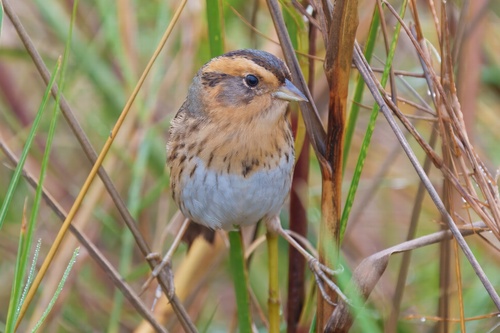
Nelsonammer (Ammospiza nelsoni) Nelsonammer
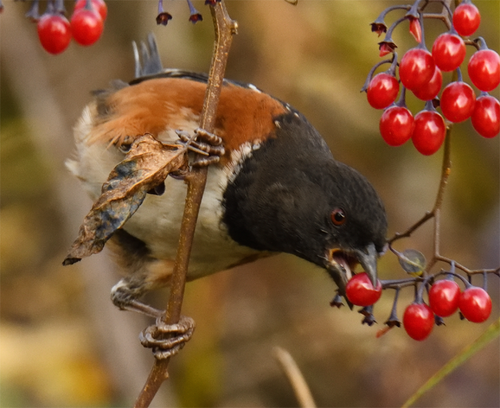
Fleckengrundammer (Pipilo maculatus) Fleckengrundammer

Medien

Laden…

Kurz gesagt

The most reliable field mark to separate Nelson's Sparrow from Spotted Towhee is overall size and structure: Spotted Towhee is much larger, with a long, broad tail and bold white spotting on the wings and tail, while Nelson's Sparrow is a small, compact marsh sparrow with an orange face and subtle streaking. In flight or perched, Spotted Towhee's white wing spots and rufous flanks are obvious, while Nelson's Sparrow shows a short, pointed tail and lacks any white in the wings. Juvenile or immature-specific wing patterns are not described for either species, so focus on adult plumage and structure. Habitat is also a strong clue: Nelson's is restricted to marshes, while Spotted Towhee favors brushy or open woodland edges.

Bestimmungstipps

  1. Size is the quickest separator: Spotted Towhee is more than twice the mass of Nelson's Sparrow and much longer; if the bird looks robin-sized or close, it's not a Nelson's.
  2. Tail shape and length: Spotted Towhee has a long, broad, fan-shaped tail with white corners; Nelson's Sparrow's tail is short and pointed, lacking any white.
  3. Wing and back pattern: Spotted Towhee shows bold white spots on the back and wings (all ages/sexes), while Nelson's Sparrow has plain brownish upperparts with no white spots or wing bars.
  4. Face pattern: Nelson's Sparrow has a striking orange face with gray cheeks; Spotted Towhee lacks orange on the face, showing a dark (black or brown) head with red eyes.
  5. Flank color: Spotted Towhee has rich rufous flanks and a white belly; Nelson's Sparrow has a cream-colored breast with faint streaking and a white belly, but no rufous.
  6. Eye color: Spotted Towhee's eyes are bright red (all adults); Nelson's Sparrow has dark eyes.
  7. Bill structure: Both have sparrow-like bills, but Spotted Towhee's is proportionally heavier for its size; not a primary field mark.
  8. Perched posture: Spotted Towhee often appears upright with a long tail angled down; Nelson's Sparrow is more compact and horizontal, often skulking in grass.
  9. Flight style: Spotted Towhee has strong, bounding flight with long tail trailing; Nelson's Sparrow flies low and weakly over marsh vegetation.
  10. Habitat context: Marshes (especially salt or brackish) strongly favor Nelson's; brushy upland or woodland edge is Spotted Towhee territory.
  11. Vocalization: Listen for the mechanical, insect-like trill of Nelson's Sparrow vs. the loud, buzzy trill or 'chewink' call of Spotted Towhee.
  12. Sex and age differences: Female Spotted Towhee is browner but still has white spots and rufous flanks; Nelson's Sparrow sexes are similar.
  13. Seasonal confusion: Both species are migratory, but their ranges rarely overlap outside migration; check local eBird data for likelihood.
  14. Juvenile/immature confusion: No distinctive juvenile wing patterns are described for either, so rely on adult marks.
  15. Common pitfalls: In poor light, Spotted Towhee's rufous flanks and white spots can be mistaken for streaking or pale panels, but the size and tail length are always reliable.

Größe

Spotted Towhee is dramatically larger: 17–21 cm (6.7–8.3 in) in length and 33–49 g (1.2–1.7 oz) in weight, with a wingspan of 28 cm (11 in) [wikipedia]. Nelson's Sparrow is much smaller: 11–13 cm (4.3–5.1 in) long, 17–21 g (0.6–0.7 oz), and a wingspan of 16.5–20 cm (6.5–7.9 in) [wikipedia]. This size difference is obvious in the field, especially when seen side-by-side or with familiar species for scale.

Gefieder

No age-specific upperwing or flight marks are described for either species, so focus on adult plumage. Spotted Towhee stands out with its black (male) or dark brown (female) upperparts, bold white spots on the wings and back, rufous sides, white belly, and long dark tail with white corners. Its eyes are bright red. Nelson's Sparrow, by contrast, has brownish upperparts with gray on the crown and nape, a distinctive orange face with gray cheeks, cream-colored breast with faint streaking, and a white throat and belly. Its tail is short and pointed, and there are no white spots or wing bars. Juvenile or immature-specific patterns are not noted for either species in the sources.

Verhalten

Nelson's Sparrow forages low in marsh vegetation or on the ground, often probing in mud, and is generally secretive. Spotted Towhee is more conspicuous, often scratching in leaf litter or hopping in brushy areas, and frequently perches in the open to sing. In flight, Spotted Towhee's long tail and strong, bounding flight are distinctive, while Nelson's Sparrow appears more compact and tends to stay low in dense marsh grass.

Lebensraum

Nelson's Sparrow is strictly a marsh bird, breeding in coastal and inland marshes in Canada and the northern US, and wintering in southeastern coastal marshes. Spotted Towhee is found in brushy habitats, forest edges, thickets, and sometimes open woodlands, mainly in western North America. If you are in a saltmarsh or freshwater marsh, Nelson's is far more likely; in brushy upland or woodland edge, Spotted Towhee is expected.

Stimme

Nelson's Sparrow gives a raspy, mechanical trill, often compared to a drop of water hitting a hot pan—thin, insect-like, and not musical. Spotted Towhee's song is a buzzy trill, but its call is a sharp, cat-like 'mew' or 'chewink.' The towhee's vocalizations are generally louder and more varied, while Nelson's is quieter and more mechanical.

Eine bessere Beschreibung senden

Nutze dieselben Abschnitte wie der Vergleich. Dein Text ist sofort veröffentlicht.

The most reliable field mark to separate Nelson's Sparrow from Spotted Towhee is overall size and structure: Spotted Towhee is much larger, with a long, broad tail and bold white spotting on the wings and tail, while Nelson's Sparrow is a small, compact marsh sparrow with an orange face and subtle streaking. In flight or perched, Spotted Towhee's white wing spots and rufous flanks are obvious, while Nelson's Sparrow shows a short, pointed tail and lacks any white in the wings. Juvenile or immature-specific wing patterns are not described for either species, so focus on adult plumage and structure. Habitat is also a strong clue: Nelson's is restricted to marshes, while Spotted Towhee favors brushy or open woodland edges.

  1. Size is the quickest separator: Spotted Towhee is more than twice the mass of Nelson's Sparrow and much longer; if the bird looks robin-sized or close, it's not a Nelson's.
  2. Tail shape and length: Spotted Towhee has a long, broad, fan-shaped tail with white corners; Nelson's Sparrow's tail is short and pointed, lacking any white.
  3. Wing and back pattern: Spotted Towhee shows bold white spots on the back and wings (all ages/sexes), while Nelson's Sparrow has plain brownish upperparts with no white spots or wing bars.
  4. Face pattern: Nelson's Sparrow has a striking orange face with gray cheeks; Spotted Towhee lacks orange on the face, showing a dark (black or brown) head with red eyes.
  5. Flank color: Spotted Towhee has rich rufous flanks and a white belly; Nelson's Sparrow has a cream-colored breast with faint streaking and a white belly, but no rufous.
  6. Eye color: Spotted Towhee's eyes are bright red (all adults); Nelson's Sparrow has dark eyes.
  7. Bill structure: Both have sparrow-like bills, but Spotted Towhee's is proportionally heavier for its size; not a primary field mark.
  8. Perched posture: Spotted Towhee often appears upright with a long tail angled down; Nelson's Sparrow is more compact and horizontal, often skulking in grass.
  9. Flight style: Spotted Towhee has strong, bounding flight with long tail trailing; Nelson's Sparrow flies low and weakly over marsh vegetation.
  10. Habitat context: Marshes (especially salt or brackish) strongly favor Nelson's; brushy upland or woodland edge is Spotted Towhee territory.
  11. Vocalization: Listen for the mechanical, insect-like trill of Nelson's Sparrow vs. the loud, buzzy trill or 'chewink' call of Spotted Towhee.
  12. Sex and age differences: Female Spotted Towhee is browner but still has white spots and rufous flanks; Nelson's Sparrow sexes are similar.
  13. Seasonal confusion: Both species are migratory, but their ranges rarely overlap outside migration; check local eBird data for likelihood.
  14. Juvenile/immature confusion: No distinctive juvenile wing patterns are described for either, so rely on adult marks.
  15. Common pitfalls: In poor light, Spotted Towhee's rufous flanks and white spots can be mistaken for streaking or pale panels, but the size and tail length are always reliable.

Spotted Towhee is dramatically larger: 17–21 cm (6.7–8.3 in) in length and 33–49 g (1.2–1.7 oz) in weight, with a wingspan of 28 cm (11 in) [wikipedia]. Nelson's Sparrow is much smaller: 11–13 cm (4.3–5.1 in) long, 17–21 g (0.6–0.7 oz), and a wingspan of 16.5–20 cm (6.5–7.9 in) [wikipedia]. This size difference is obvious in the field, especially when seen side-by-side or with familiar species for scale.

No age-specific upperwing or flight marks are described for either species, so focus on adult plumage. Spotted Towhee stands out with its black (male) or dark brown (female) upperparts, bold white spots on the wings and back, rufous sides, white belly, and long dark tail with white corners. Its eyes are bright red. Nelson's Sparrow, by contrast, has brownish upperparts with gray on the crown and nape, a distinctive orange face with gray cheeks, cream-colored breast with faint streaking, and a white throat and belly. Its tail is short and pointed, and there are no white spots or wing bars. Juvenile or immature-specific patterns are not noted for either species in the sources.

Nelson's Sparrow forages low in marsh vegetation or on the ground, often probing in mud, and is generally secretive. Spotted Towhee is more conspicuous, often scratching in leaf litter or hopping in brushy areas, and frequently perches in the open to sing. In flight, Spotted Towhee's long tail and strong, bounding flight are distinctive, while Nelson's Sparrow appears more compact and tends to stay low in dense marsh grass.

Nelson's Sparrow is strictly a marsh bird, breeding in coastal and inland marshes in Canada and the northern US, and wintering in southeastern coastal marshes. Spotted Towhee is found in brushy habitats, forest edges, thickets, and sometimes open woodlands, mainly in western North America. If you are in a saltmarsh or freshwater marsh, Nelson's is far more likely; in brushy upland or woodland edge, Spotted Towhee is expected.

Nelson's Sparrow gives a raspy, mechanical trill, often compared to a drop of water hitting a hot pan—thin, insect-like, and not musical. Spotted Towhee's song is a buzzy trill, but its call is a sharp, cat-like 'mew' or 'chewink.' The towhee's vocalizations are generally louder and more varied, while Nelson's is quieter and more mechanical.

Änderungen verwerfen?

Du hast ungespeicherte Änderungen. Wenn du jetzt gehst, gehen sie verloren.

Nelsonammer · Fleckengrundammer · Meine schwierigen Vögel