

Moschuslori vs Regenbogenlori
Trichoglossus concinnus gegen Trichoglossus moluccanus
Ein Quiz mit Moschuslori und Regenbogenlori spielen
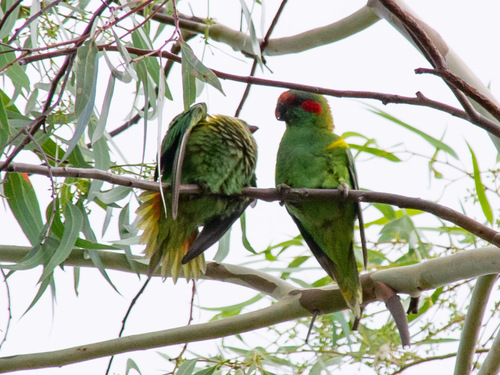 Moschuslori
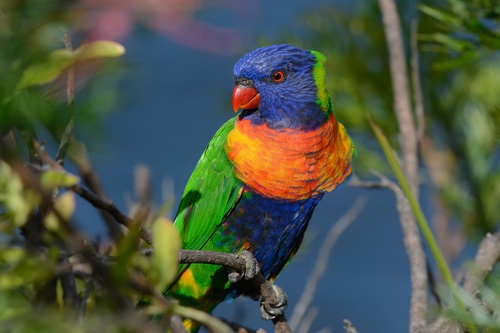 Regenbogenlori
Kurz gesagt
The most reliable field mark between Musk Lorikeet and Rainbow Lorikeet is the head and face pattern: Musk Lorikeet shows a red forehead, blue crown, and a yellow wing band, while Rainbow Lorikeet has a deep blue head, green nape, and a bright orange/yellow breast. In flight, Rainbow Lorikeet displays a yellow wing-bar and red underwing coverts, whereas Musk Lorikeet's wing pattern is less contrasting. Rainbow Lorikeet is noticeably larger and bulkier, with a longer tail and heavier build. Both species are mainly green overall, but the face and underpart colors are key for separation. Juvenile Rainbow Lorikeets have a dark beak, which can help in age-specific identification.
Bestimmungstipps
- Head and face pattern: Musk Lorikeet shows a red forehead and blue crown, with a mostly green face; Rainbow Lorikeet has a deep blue head and green nape. This is the most reliable field mark at close range.
- Breast and underparts: Rainbow Lorikeet has a bright orange/yellow breast and deep blue belly, while Musk Lorikeet is mainly green below. If you see orange or blue on the underparts, it's Rainbow Lorikeet.
- Wing pattern in flight: Rainbow Lorikeet shows a strong yellow wing-bar and red underwing coverts, creating a bold contrast; Musk Lorikeet has a yellow band on the wing but lacks the deep red underwing. Use this mark for adults and older immatures.
- Bill color (juveniles): Juvenile Rainbow Lorikeets have a black beak, turning orange as they age. Musk Lorikeet juveniles are not described as having a black bill, so a dark-billed young bird is likely Rainbow Lorikeet.
- Size and structure: Rainbow Lorikeet is larger, bulkier, and longer-tailed; Musk Lorikeet is smaller, slimmer, and more compact. This is most useful when both species are present.
- Yellow on wing: Musk Lorikeet's yellow wing band is distinctive but less broad and contrasting than Rainbow Lorikeet's yellow wing-bar in flight.
- Face and nape: Rainbow Lorikeet has a greenish-yellow nuchal collar (back of neck), which Musk Lorikeet lacks.
- Bill color (adults): Both species have reddish bills as adults, but Musk Lorikeet's is red at the tip and darker at the base.
- Plumage brightness: Rainbow Lorikeet is overall more colorful and contrasting, especially with blue, orange, and yellow; Musk Lorikeet is more uniform green with limited red and blue on the head.
- Habitat context: In dense urban areas, Rainbow Lorikeet is more common and likely to dominate feeders and flowering trees. Musk Lorikeet prefers outer suburbs and eucalypt-rich areas, but both can occur together.
- Group behavior: Rainbow Lorikeets are often in larger, noisier flocks and can be aggressive at food sources. Musk Lorikeets are less aggressive and usually in smaller groups.
- Sexual dimorphism: Both species are similar between sexes, so do not rely on sex-based marks.
- Confusion risk: At a distance or in poor light, both appear green and similar in size, but look for the head pattern and underpart color for separation.
- Flight jizz: Rainbow Lorikeet appears heavier and more robust in flight; Musk Lorikeet is more streamlined and agile.
- Urban adaptation: Both species use urban nectar sources, but Rainbow Lorikeet is more likely to be seen in inner city areas.
Größe
Rainbow Lorikeet is significantly larger, measuring 25–30 cm in length and weighing 75–157 g, compared to Musk Lorikeet's 22 cm length [wikipedia]. The Rainbow Lorikeet also appears bulkier and longer-tailed in the field, while Musk Lorikeet is more compact and slimmer. This size difference is often apparent when both species are seen together, but can be misleading at a distance or when seen singly.
Gefieder
- Juvenile/immature birds: Juvenile Rainbow Lorikeets have a black beak, which gradually turns orange as they mature. This is not mentioned for Musk Lorikeet, so a dark-billed young bird is likely a Rainbow Lorikeet.
- Adults: Musk Lorikeet is mainly green with a red forehead, blue crown, and a distinctive yellow band on the wing. The bill is red-tipped with a darker base. Rainbow Lorikeet has a deep blue head, greenish-yellow nuchal collar, green upperparts, orange/yellow breast, deep blue belly, and green thighs/rump. In flight, Rainbow Lorikeet shows a yellow wing-bar and red underwing coverts, which contrast strongly with the rest of the wing. Musk Lorikeet's wing pattern is less contrasting, with the yellow band being the main feature. Both species have little sexual dimorphism, so these marks apply to both sexes.
Verhalten
Both species are active, noisy, and often seen feeding in flowering trees. Rainbow Lorikeets are more likely to be seen in larger, raucous flocks and can dominate feeding sites, sometimes excluding Musk Lorikeets. Musk Lorikeets are adaptable and thrive in urban areas, but tend to be less aggressive and less numerous than Rainbow Lorikeets in direct competition. Both species are highly mobile and can be seen flying rapidly between feeding sites.
Lebensraum
Both species overlap in much of eastern and southeastern Australia, especially in urban and suburban areas with nectar-rich plantings. Rainbow Lorikeet is more widespread along the eastern seaboard and is common in rainforests, coastal bush, and woodlands. Musk Lorikeet is more restricted to south-central and eastern Australia, with a preference for outer urban areas and eucalypt forests. In cities, Musk Lorikeet tends to be less abundant than Rainbow Lorikeet, which can be dominant and even considered a pest.