

Schopfadler vs Amethystglanzköpfchen
Lophaetus occipitalis gegen Chalcomitra amethystina
Ein Quiz mit Schopfadler und Amethystglanzköpfchen spielen
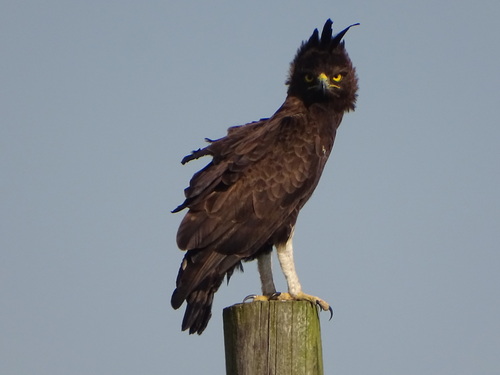 Schopfadler
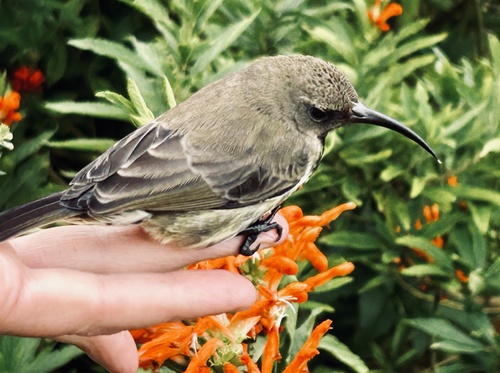 Amethystglanzköpfchen
Kurz gesagt
The most reliable way to separate Long-crested Eagle from Amethyst Sunbird is by overall structure and size: the eagle is a massive raptor with a long, shaggy crest and broad wings, while the sunbird is a tiny, slender songbird with a thin, decurved bill. In flight, the eagle shows a striking white patch on the wings and a barred tail, whereas the sunbird is uniformly dark or iridescent and much more fluttery. Juvenile eagles lack the developed crest but remain much larger and bulkier than any sunbird. Even at a distance, the eagle’s silhouette and slow, soaring flight contrast sharply with the sunbird’s rapid, darting movements and small size.
Bestimmungstipps
- Size is the fastest check: Long-crested Eagle is enormous compared to any sunbird. If the bird looks raptor-sized or is seen soaring, it cannot be a sunbird.
- Crested head: Only the eagle has a long, shaggy crest (adults and older immatures). Juvenile eagles may lack a full crest but are still much larger and bulkier than sunbirds.
- Wing pattern in flight: Long-crested Eagle (all ages) shows a bold white patch on both upper and lower wing surfaces and a barred tail. Amethyst Sunbird never shows white in the wings or tail.
- Bill shape: The eagle has a heavy, hooked raptor bill; the sunbird has a thin, decurved nectar-feeding bill. This is visible even at a distance with binoculars.
- Tail: Eagle’s tail is broad and barred; sunbird’s tail is long and narrow, sometimes with metallic purple upper tail coverts in males (depending on subspecies), but never barred.
- Plumage gloss: Sunbird males are glossy black with metallic purple in some subspecies; females are dark or pale below, but never solid black-brown or crested. Eagle is always dark brown to blackish, never iridescent.
- Eye color: Adult eagle has bright yellow eyes (duller in females); sunbird’s eye color is not a field mark.
- Feet and cere: Eagle’s feet and cere are yellow (pale in males); sunbird’s legs and feet are dark and delicate.
- Perched posture: Eagles perch upright and prominently; sunbirds perch more horizontally and are often seen feeding among flowers.
- Flight style: Eagles soar or glide with slow, deep wingbeats; sunbirds fly rapidly with fluttery, direct movements and may hover at flowers.
- Habitat context: Eagles are usually seen alone or in pairs near forest edges or tall trees; sunbirds are found at flowering trees, often in gardens or open woodlands, sometimes in small groups.
- Vocalizations: Sunbird’s song is a loud, sustained twitter; eagle’s calls are less musical and more raptorial.
- Juvenile confusion: Young eagles may lack a full crest but retain large size and white wing patches; sunbirds never approach eagle size or structure at any age.
- Sexual dimorphism: Sunbird males and females differ in plumage, but neither sex resembles an eagle in any context.
- Common pitfalls: At a distance, a perched eagle with a less visible crest could be mistaken for a dark bird, but size, structure, and wing pattern in flight always resolve the ID.
Größe
Long-crested Eagle is dramatically larger, with an average body mass around 1291.5 g [wikidata], compared to the Amethyst Sunbird, which is a typical sunbird and weighs only a fraction of that (exact mass not given, but sunbirds are generally under 20 g). The eagle measures 53–58 cm in length, while the sunbird is much smaller (not specified, but typically 12–15 cm for sunbirds). Even juvenile eagles are vastly larger than adult sunbirds. In the field, there is no risk of confusion on size alone if both are seen clearly.
Gefieder
- Juveniles: Juvenile Long-crested Eagles are lighter brown than adults and lack the full shaggy crest, but still have a barred tail and white wing patches in flight. Juvenile Amethyst Sunbirds are not described in detail, but all ages are much smaller, lack any crest, and are generally dark or iridescent with no white wing patches.
- Adults: Adult Long-crested Eagles are blackish-brown overall with a long, shaggy crest, bright yellow eyes (duller in females), and a distinctive white patch on the upper and lower wing in flight, plus a black tail barred with pale grey. Adult Amethyst Sunbirds are sexually dimorphic: males are glossy black with metallic purple on the upper tail coverts (subspecies-dependent), while females are dark or pale below depending on subspecies, but never show a crest or white wing patches. The eagle’s bold crest and wing pattern are unique; the sunbird’s iridescence and lack of crest are equally distinctive.
Verhalten
Long-crested Eagles are typically seen perched upright on exposed branches or soaring with slow, deep wingbeats, often near forest edges or moist areas. They may display with steep dives and rocking flights during courtship. Amethyst Sunbirds are active, agile, and often hover or flit rapidly between flowers, singly or in pairs, sometimes gathering in numbers at flowering trees. They may act aggressively toward other sunbirds at feeding sites. The eagle’s behavior is stately and raptorial, while the sunbird’s is fast, restless, and nectar-focused.
Lebensraum
Both species occur in well-watered habitats, but the eagle prefers forest edges and moist areas with tall trees for nesting, while the sunbird is found in a variety of flowering woodlands and gardens, often following seasonal blooms. Eagles are territorial and need large trees for nesting, whereas sunbirds are more flexible and can be found wherever suitable flowers are present. Overlap is possible at woodland edges, but their ecological niches and perching/foraging sites differ markedly.
Stimme
Long-crested Eagles call frequently during display flights, but no detailed description is provided. Amethyst Sunbirds have a complex, loud, sustained twittering song, especially at flowering trees. If heard, the sunbird’s song is rapid and musical, while the eagle’s calls are likely harsher and less sustained.
Schopfadler · Amethystglanzköpfchen · Meine schwierigen Vögel