

Motmot

Spornammer vs Braunkopf-Kuhstärling

Calcarius lapponicus gegen Molothrus ater

Ein Quiz mit Spornammer und Braunkopf-Kuhstärling spielen
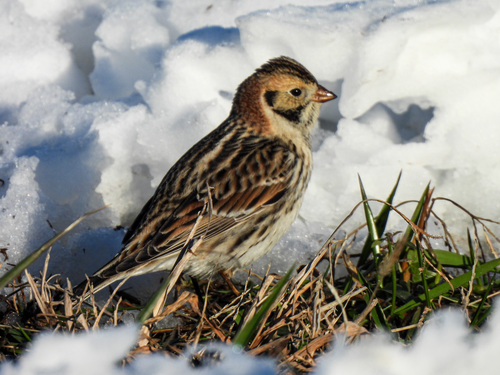
Spornammer (Calcarius lapponicus) Spornammer
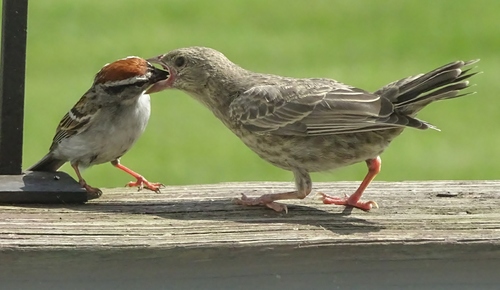
Braunkopf-Kuhstärling (Molothrus ater) Braunkopf-Kuhstärling

Medien

Laden…

Kurz gesagt

The most reliable field mark between Lapland Bunting (Lapland Longspur) and Brown-headed Cowbird is the combination of head and bill structure: Lapland Bunting has a short, thick, yellowish seed-eater's bill and, in breeding males, a striking black face with a white eyestripe and chestnut nape, while Brown-headed Cowbird males show a glossy black body with a chocolate-brown head and a heavier, more conical bill. Females and non-breeding birds are trickier, but Lapland Buntings retain a chestnut nape and more streaked, sparrow-like patterning, while female cowbirds are plainer gray-brown with fine underpart streaking and lack any rufous tones. In flight or at a distance, note the Lapland Bunting's more compact, bunting-like jizz and streaked back versus the cowbird's icterid shape and uniform coloration. Size is not a safe separator due to overlap, but cowbirds average bulkier with a longer wingspan. Context also helps: Lapland Buntings are arctic breeders and rare in most of North America outside migration, while cowbirds are common in open country and often seen in mixed blackbird flocks.

Bestimmungstipps

  1. Bill shape and color: Lapland Bunting has a short, thick, yellowish seed-eater's bill; Brown-headed Cowbird's bill is heavier, more conical, and dark, typical of icterids. This is visible at all ages and sexes.
  2. Head pattern (breeding male): Lapland Bunting males in summer have a black face and throat, bold white eyestripe, and chestnut nape. Cowbird males have a solid brown head and glossy black body, with no white or rufous.
  3. Head and nape (non-breeding and female/immature): Lapland Buntings (all ages except adult males) show a chestnut or rufous nape and a generally orange-brown or buffy head, often with a pale supercilium. Cowbird females and juveniles are plain gray-brown, lacking any rufous or chestnut.
  4. Back and wing pattern: Lapland Buntings are heavily streaked on the back and may show chestnut or rufous wing panels, especially in non-breeding and immature birds. Cowbirds are uniform: males glossy black, females/juveniles plain gray-brown with very fine streaking only on the underparts.
  5. Underparts: Lapland Bunting has white underparts, sometimes with streaking on the flanks. Cowbird females have fine, even streaking on the underparts, but males are solid black below.
  6. Flight appearance: Lapland Bunting appears compact, with a short tail and rounded wings, and may show contrasting wing panels or streaked back in flight. Cowbird is longer-winged, heavier-bodied, and uniform in color (males black, females plain gray-brown) with no rufous or bold pattern.
  7. Tail: Lapland Bunting has a shorter, more rounded tail; cowbird's tail is longer and more squared-off, especially obvious in flight.
  8. Jizz: Lapland Bunting is bunting-like, often perching upright or foraging low in grass. Cowbird is more icterid-like, often seen walking in open areas, sometimes with a hunched posture.
  9. Habitat and context: Lapland Bunting is rare in most of North America, usually found in open, weedy fields during migration or winter. Cowbird is common in open country, pastures, and at feeders, often in mixed blackbird flocks.
  10. Association with livestock: Cowbirds often follow cattle or horses; Lapland Buntings do not.
  11. Group size: Cowbirds are often in large flocks, Lapland Buntings in small groups or singly.
  12. Seasonality: Lapland Buntings are present in North America mainly during migration and winter; cowbirds are resident or migrant depending on latitude, but always more common.
  13. Sexual dimorphism: Cowbirds show strong male/female differences (male black with brown head, female plain gray-brown); Lapland Buntings are less dimorphic, with both sexes showing some rufous/chestnut in nape except adult breeding males.
  14. No rufous or chestnut in cowbird: Any bird with a chestnut nape or rufous in the wing is not a cowbird.
  15. No glossy black in Lapland Bunting: Any bird with a glossy black body and brown head is a male cowbird, not a Lapland Bunting.

Größe

Lapland Bunting is slightly smaller and more compact, measuring 15–16 cm (5.9–6.3 in) in length, with a wingspan of 22–29 cm (8.7–11.4 in) and mass of 22–33 g (0.8–1.2 oz) [wikipedia]. Brown-headed Cowbird is larger and bulkier: 16–22 cm (6.3–8.7 in) in length, wingspan about 36 cm (14 in), and mass 30–60 g (1.1–2.1 oz) [wikipedia]. Female cowbirds average 38.8 g, males 49 g. However, there is overlap in length, so size alone is not diagnostic unless seen side-by-side. Cowbirds look heavier-bodied and longer-winged, especially in flight.

Gefieder

For juveniles and non-breeding birds, Lapland Bunting shows a streaked back and chestnut nape, with a generally orange-brown or buffy head and contrasting wing panels. These features are visible in all plumages except adult breeding males, which are more striking with a black head and throat, white eyestripe, and chestnut nape. Brown-headed Cowbird males are glossy black with a brown head year-round, lacking any streaking or rufous tones. Females are dull grayish-brown, with a pale throat and very fine underpart streaking, but no chestnut or rufous anywhere. In flight, Lapland Bunting may show more contrast in the wing and back pattern, while cowbirds appear uniformly dark (males) or plain brownish-gray (females), with no rufous or strong streaking. Juvenile cowbirds are similar to females but even plainer, with a lack of any warm tones or bold face pattern.

Verhalten

Lapland Buntings forage on the ground, picking seeds in open areas, often singly or in small groups, and are more likely to flush low and drop back into cover. Brown-headed Cowbirds are often seen in larger, mixed flocks with blackbirds or starlings, especially in open fields or near livestock, and may follow grazing animals to catch insects. Cowbirds are more likely to be conspicuous in open country, walking or striding rather than hopping, and may visit feeders. Flight style differs: Lapland Buntings are more bounding and bunting-like, while cowbirds have a more direct, icterid flight.

Lebensraum

Lapland Buntings breed in arctic tundra and are seen in migration or winter in open, weedy fields, often in northern or Eurasian locations. They are rare in most of North America except as migrants or vagrants. Brown-headed Cowbirds are widespread in temperate and subtropical North America, favoring open or semiopen country, pastures, and agricultural areas, often near livestock or human habitation. Cowbirds are common at feeders and in mixed blackbird flocks, while Lapland Buntings are more likely found in remote or less disturbed open habitats.

Eine bessere Beschreibung senden

Nutze dieselben Abschnitte wie der Vergleich. Dein Text ist sofort veröffentlicht.

The most reliable field mark between Lapland Bunting (Lapland Longspur) and Brown-headed Cowbird is the combination of head and bill structure: Lapland Bunting has a short, thick, yellowish seed-eater's bill and, in breeding males, a striking black face with a white eyestripe and chestnut nape, while Brown-headed Cowbird males show a glossy black body with a chocolate-brown head and a heavier, more conical bill. Females and non-breeding birds are trickier, but Lapland Buntings retain a chestnut nape and more streaked, sparrow-like patterning, while female cowbirds are plainer gray-brown with fine underpart streaking and lack any rufous tones. In flight or at a distance, note the Lapland Bunting's more compact, bunting-like jizz and streaked back versus the cowbird's icterid shape and uniform coloration. Size is not a safe separator due to overlap, but cowbirds average bulkier with a longer wingspan. Context also helps: Lapland Buntings are arctic breeders and rare in most of North America outside migration, while cowbirds are common in open country and often seen in mixed blackbird flocks.

  1. Bill shape and color: Lapland Bunting has a short, thick, yellowish seed-eater's bill; Brown-headed Cowbird's bill is heavier, more conical, and dark, typical of icterids. This is visible at all ages and sexes.
  2. Head pattern (breeding male): Lapland Bunting males in summer have a black face and throat, bold white eyestripe, and chestnut nape. Cowbird males have a solid brown head and glossy black body, with no white or rufous.
  3. Head and nape (non-breeding and female/immature): Lapland Buntings (all ages except adult males) show a chestnut or rufous nape and a generally orange-brown or buffy head, often with a pale supercilium. Cowbird females and juveniles are plain gray-brown, lacking any rufous or chestnut.
  4. Back and wing pattern: Lapland Buntings are heavily streaked on the back and may show chestnut or rufous wing panels, especially in non-breeding and immature birds. Cowbirds are uniform: males glossy black, females/juveniles plain gray-brown with very fine streaking only on the underparts.
  5. Underparts: Lapland Bunting has white underparts, sometimes with streaking on the flanks. Cowbird females have fine, even streaking on the underparts, but males are solid black below.
  6. Flight appearance: Lapland Bunting appears compact, with a short tail and rounded wings, and may show contrasting wing panels or streaked back in flight. Cowbird is longer-winged, heavier-bodied, and uniform in color (males black, females plain gray-brown) with no rufous or bold pattern.
  7. Tail: Lapland Bunting has a shorter, more rounded tail; cowbird's tail is longer and more squared-off, especially obvious in flight.
  8. Jizz: Lapland Bunting is bunting-like, often perching upright or foraging low in grass. Cowbird is more icterid-like, often seen walking in open areas, sometimes with a hunched posture.
  9. Habitat and context: Lapland Bunting is rare in most of North America, usually found in open, weedy fields during migration or winter. Cowbird is common in open country, pastures, and at feeders, often in mixed blackbird flocks.
  10. Association with livestock: Cowbirds often follow cattle or horses; Lapland Buntings do not.
  11. Group size: Cowbirds are often in large flocks, Lapland Buntings in small groups or singly.
  12. Seasonality: Lapland Buntings are present in North America mainly during migration and winter; cowbirds are resident or migrant depending on latitude, but always more common.
  13. Sexual dimorphism: Cowbirds show strong male/female differences (male black with brown head, female plain gray-brown); Lapland Buntings are less dimorphic, with both sexes showing some rufous/chestnut in nape except adult breeding males.
  14. No rufous or chestnut in cowbird: Any bird with a chestnut nape or rufous in the wing is not a cowbird.
  15. No glossy black in Lapland Bunting: Any bird with a glossy black body and brown head is a male cowbird, not a Lapland Bunting.

Lapland Bunting is slightly smaller and more compact, measuring 15–16 cm (5.9–6.3 in) in length, with a wingspan of 22–29 cm (8.7–11.4 in) and mass of 22–33 g (0.8–1.2 oz) [wikipedia]. Brown-headed Cowbird is larger and bulkier: 16–22 cm (6.3–8.7 in) in length, wingspan about 36 cm (14 in), and mass 30–60 g (1.1–2.1 oz) [wikipedia]. Female cowbirds average 38.8 g, males 49 g. However, there is overlap in length, so size alone is not diagnostic unless seen side-by-side. Cowbirds look heavier-bodied and longer-winged, especially in flight.

For juveniles and non-breeding birds, Lapland Bunting shows a streaked back and chestnut nape, with a generally orange-brown or buffy head and contrasting wing panels. These features are visible in all plumages except adult breeding males, which are more striking with a black head and throat, white eyestripe, and chestnut nape. Brown-headed Cowbird males are glossy black with a brown head year-round, lacking any streaking or rufous tones. Females are dull grayish-brown, with a pale throat and very fine underpart streaking, but no chestnut or rufous anywhere. In flight, Lapland Bunting may show more contrast in the wing and back pattern, while cowbirds appear uniformly dark (males) or plain brownish-gray (females), with no rufous or strong streaking. Juvenile cowbirds are similar to females but even plainer, with a lack of any warm tones or bold face pattern.

Lapland Buntings forage on the ground, picking seeds in open areas, often singly or in small groups, and are more likely to flush low and drop back into cover. Brown-headed Cowbirds are often seen in larger, mixed flocks with blackbirds or starlings, especially in open fields or near livestock, and may follow grazing animals to catch insects. Cowbirds are more likely to be conspicuous in open country, walking or striding rather than hopping, and may visit feeders. Flight style differs: Lapland Buntings are more bounding and bunting-like, while cowbirds have a more direct, icterid flight.

Lapland Buntings breed in arctic tundra and are seen in migration or winter in open, weedy fields, often in northern or Eurasian locations. They are rare in most of North America except as migrants or vagrants. Brown-headed Cowbirds are widespread in temperate and subtropical North America, favoring open or semiopen country, pastures, and agricultural areas, often near livestock or human habitation. Cowbirds are common at feeders and in mixed blackbird flocks, while Lapland Buntings are more likely found in remote or less disturbed open habitats.

Änderungen verwerfen?

Du hast ungespeicherte Änderungen. Wenn du jetzt gehst, gehen sie verloren.

Spornammer · Braunkopf-Kuhstärling · Meine schwierigen Vögel