

Pfeifkuckuck vs Kurzflügelkuckuck
Hierococcyx nisicolor gegen Cuculus micropterus
Ein Quiz mit Pfeifkuckuck und Kurzflügelkuckuck spielen
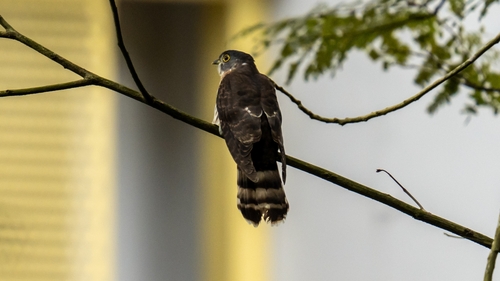 Pfeifkuckuck
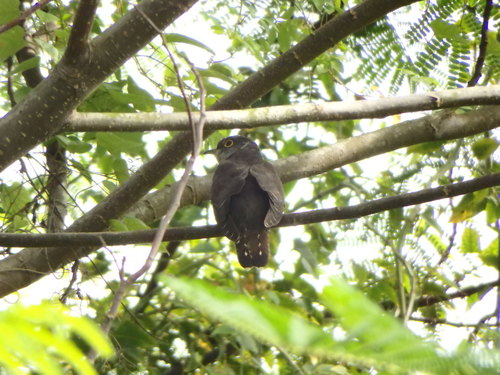 Kurzflügelkuckuck
Kurz gesagt
The most reliable field mark between Hodgson's Hawk-Cuckoo and Indian Cuckoo is the juvenile plumage: young Indian Cuckoos show broad white tips to the head and wing feathers, plus a white chin and throat contrasting with a dark face, while Hodgson's Hawk-Cuckoo lacks these features. For adults, Indian Cuckoo is a medium-sized, grey-backed cuckoo with bold black barring below, a barred tail with a broad dark subterminal band and white tip, and a yellow or gray eye-ring. Hodgson's Hawk-Cuckoo is similar in size and shape but lacks the Indian Cuckoo's distinctive juvenile markings and has unique underwing skin patches (visible only in nestlings). In the field, focus on juvenile upperparts and head pattern, and on the tail and underpart barring in adults. Both occur in overlapping regions, but Indian Cuckoo is more widespread and often solitary.
Bestimmungstipps
- Juvenile Indian Cuckoo shows broad white tips to head and wing feathers—look for these in young birds; Hodgson's Hawk-Cuckoo juveniles lack these marks.
- Indian Cuckoo juveniles have a white chin and throat contrasting with a dark face; this sharp contrast is not present in Hodgson's Hawk-Cuckoo.
- Adult Indian Cuckoo has bold black barring on the underparts; check for this in perched or flying birds. Hodgson's Hawk-Cuckoo is not described as having such strong barring.
- Tail pattern in Indian Cuckoo is diagnostic: look for a broad dark subterminal band and a white tip. Hodgson's Hawk-Cuckoo's tail pattern is not described as such.
- Indian Cuckoo has a yellow or gray eye-ring and a light brown to reddish iris; this is a useful mark at close range. Hodgson's Hawk-Cuckoo's eye color is not specified.
- Female Indian Cuckoo is paler on the throat and browner on the breast and tail than the male, with narrower barring—useful if sex can be determined.
- Indian Cuckoo is generally solitary and shy; both species can be elusive, but Indian Cuckoo's behavior is specifically noted.
- Hodgson's Hawk-Cuckoo nestlings have gape-colored skin patches under the wing (not visible in the field except in hand or at the nest).
- Indian Cuckoo occurs at higher elevations (up to 3,600 m); if at high altitude, Indian Cuckoo is more likely.
- Both species are medium-sized cuckoos and similar in size; do not rely on size for separation.
- Habitat overlap is extensive; do not use habitat except at the highest elevations.
- No distinctive flight or wing pattern is described for Hodgson's Hawk-Cuckoo; rely on Indian Cuckoo's juvenile and tail pattern for in-flight separation.
- No vocalization differences are provided in the sources; do not use voice for separation with current information.
- If you see a juvenile cuckoo with white-tipped wing and head feathers, and a white chin/throat, it's Indian Cuckoo—this is the most reliable field mark in immature birds.
- If the bird lacks strong underpart barring and tail pattern, and shows no white-tipped feathers in juvenile plumage, consider Hodgson's Hawk-Cuckoo.
Größe
Only Hodgson's Hawk-Cuckoo has a reported body mass (81 g [wikidata]), but both are medium-sized cuckoos and likely similar in overall size and bulk. No significant size difference is noted in the available sources; size alone is not a reliable separator in the field.
Gefieder
Juvenile Indian Cuckoo is distinctive: look for broad white tips on the head and wing feathers, a white chin and throat sharply contrasting with a dark face, and generally browner upperparts. These features are absent in Hodgson's Hawk-Cuckoo juveniles, which are not described as having such strong contrasts or white-tipped feathers. Adult Indian Cuckoo shows grey upperparts, bold black barring on the belly, a tail with a broad dark subterminal band and white tip, and a yellow or gray eye-ring. Females are slightly paler on the throat and browner on the breast and tail, with narrower barring on the belly. Hodgson's Hawk-Cuckoo adults are not described in detail here, but lack mention of the Indian Cuckoo's strong underpart barring and tail pattern. Note that Hodgson's Hawk-Cuckoo nestlings show unique gape-colored skin patches under the wing (not visible in field conditions).
Verhalten
Indian Cuckoo is described as solitary and shy, often staying hidden in forests and open woodland. Hodgson's Hawk-Cuckoo is a brood parasite, but no specific field behavior is mentioned to distinguish it from Indian Cuckoo in normal birding situations. Both are likely to be seen singly and can be elusive.
Lebensraum
Both species overlap widely in range across the Indian subcontinent and Southeast Asia, inhabiting forests and woodland. Indian Cuckoo is noted to occur up to 3,600 m elevation and is widespread from India to Russia and Indonesia. Hodgson's Hawk-Cuckoo is found in northeast India, Myanmar, southern China, and Southeast Asia. Habitat is not a strong separator except at the highest elevations, where Indian Cuckoo may be more likely.