

Galápagosspottdrossel vs San-Cristóbal-Spottdrossel
Mimus parvulus gegen Mimus melanotis
Ein Quiz mit Galápagosspottdrossel und San-Cristóbal-Spottdrossel spielen
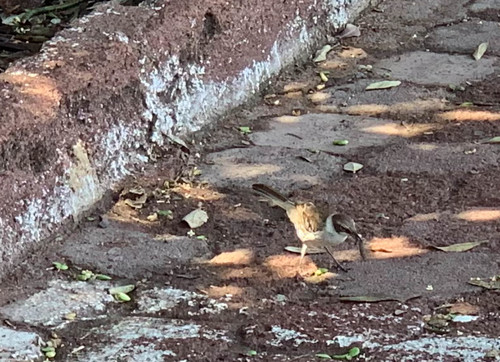 Galápagosspottdrossel
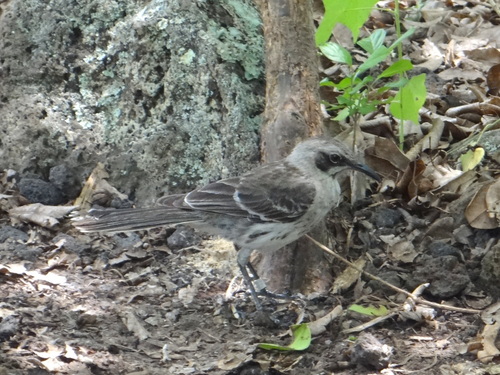 San-Cristóbal-Spottdrossel
Kurz gesagt
The most reliable field mark between Galapagos Mockingbird and San Cristobal Mockingbird is the facial pattern: Galapagos Mockingbird shows a broad white collar and a whitish stripe behind the eye, with a dark ear patch, while San Cristobal Mockingbird has a thinner white supercilium, black lores, and a distinct blackish patch behind the eye. Both species have two whitish wing-bars, but San Cristobal Mockingbird’s outer tail feathers have whitish tips, which Galapagos Mockingbird lacks. Juvenile San Cristobal Mockingbirds show heavier streaking below than adults or Galapagos Mockingbirds. Structure and overall coloration are similar, but subtle differences in head and tail pattern are key. Both are long-tailed, long-legged mimids, so careful study of the head and tail is essential.
Bestimmungstipps
- Facial Pattern: Galapagos Mockingbird shows a broad white collar and a distinct whitish stripe behind the eye, with a dark ear patch and blackish-brown lores. San Cristobal Mockingbird has a thinner white supercilium, black lores, and a blackish patch behind the eye. Focus on the width and placement of the white above and behind the eye, and the darkness of the ear patch.
- Tail Pattern: Only San Cristobal Mockingbird has whitish tips to the outer tail feathers. This can be seen when the tail is spread or in flight. Galapagos Mockingbird lacks this feature.
- Juvenile Underparts: Juvenile San Cristobal Mockingbirds have more extensive streaking on the underparts than either adults or Galapagos Mockingbird juveniles. If you see a heavily streaked young bird, it is likely San Cristobal.
- Underpart Streaking: Adult Galapagos Mockingbird is whitish below with a few brownish streaks on the breast and flanks. San Cristobal Mockingbird adults are also whitish below, but with a buffy tinge on the throat, tiny dark spots on the breast sides, and more pronounced dark streaks on the flanks.
- Wing-bars: Both species show two whitish wing-bars on dark brown wings. This feature is not diagnostic between the two.
- Crown and Upperparts: Both species have grayish-brown crowns and upperparts with darker streaks. This is not a useful separator.
- Bill and Legs: Both have long, slim, decurved black bills and black legs. Structure is very similar and not a reliable separator.
- Iris Color: Galapagos Mockingbird is described as having a yellowish iris. No iris color is given for San Cristobal Mockingbird, so this may be a minor supporting mark if seen well.
- Throat Color: San Cristobal Mockingbird shows a buffy tinge to the throat, while Galapagos Mockingbird is more uniformly whitish below.
- Behavior: San Cristobal Mockingbird performs a 'wing flash' display, opening its wings briefly while foraging. While not unique, this may be more frequently observed in this species.
- Location: If you are on San Cristóbal Island, you are almost certainly seeing San Cristobal Mockingbird, as it is the only mockingbird species there. Elsewhere in the Galápagos, Galapagos Mockingbird is more widespread.
- Size: San Cristobal Mockingbird averages slightly larger, but this is not a reliable field mark unless birds are side by side.
- Voice: Both species have typical Mimus songs; no diagnostic differences are described in the notes.
- Sex and Season: No significant sexual or seasonal plumage differences are described for either species; all field marks above apply year-round and to both sexes.
- Pitfalls: Both species are long-tailed, long-legged, and similar in general jizz. Quick views can be misleading; focus on the head pattern and tail in good light for the best chance at a confident ID.
Größe
San Cristobal Mockingbird is slightly larger on average, measuring 25–26 cm in length, with males averaging 53.2 g and females 48 g. No direct measurements are given for Galapagos Mockingbird, but both are described as long-tailed and long-legged, and the difference is not likely to be obvious in the field. Size is not a reliable separator for most observers.
Gefieder
-
Juveniles: San Cristobal Mockingbird juveniles have more extensive streaking on the underparts than adults or Galapagos Mockingbird of any age. This is most visible on the breast and flanks. Galapagos Mockingbird juveniles are not described in detail, but adults have only a few brownish streaks below.
-
Adults: Both species have two whitish wing-bars on dark brown wings, but San Cristobal Mockingbird has whitish tips to the outer tail feathers, a feature not noted in Galapagos Mockingbird. Galapagos Mockingbird has a broad white collar and a whitish stripe behind the eye, with a dark ear patch and blackish-brown lores. San Cristobal Mockingbird shows a thinner white supercilium, black lores, and a blackish patch behind the eye, with a buffy tinge to the throat and tiny dark spots on the breast sides. The crown and upperparts are similar in both, being grayish-brown with darker streaks. Underparts are mostly whitish in both, but San Cristobal Mockingbird has more pronounced streaking on the flanks and a buffy throat.
Verhalten
Both species are ground-foraging, long-legged mimids. San Cristobal Mockingbird is noted for its 'wing flash' display, even though it lacks the white wing patches typical of some other Mimus species. This involves running a short distance and briefly opening the wings. Both species are active and often conspicuous, but this specific wing-flash behavior may be more noticeable in San Cristobal Mockingbird.
Lebensraum
Galapagos Mockingbird is widespread across the Galápagos Islands, while San Cristobal Mockingbird is restricted to San Cristóbal Island. On San Cristóbal, the latter uses a range of habitats from coastal mangroves to arid scrub and woodland, avoiding dense lowland forest and tall wet woodland. Habitat alone is not diagnostic unless you are certain of your location, but San Cristobal Mockingbird is the only mockingbird on San Cristóbal Island.
Stimme
San Cristobal Mockingbird sings a loud, melodious, and disjointed song typical of the genus. There is no comparative information for Galapagos Mockingbird’s song in the provided notes, so vocalization is not a reliable separator with the information at hand.
Galápagosspottdrossel · San-Cristóbal-Spottdrossel · Meine schwierigen Vögel