

Sperber vs Rotmilan
Accipiter nisus gegen Milvus milvus
Ein Quiz mit Sperber und Rotmilan spielen
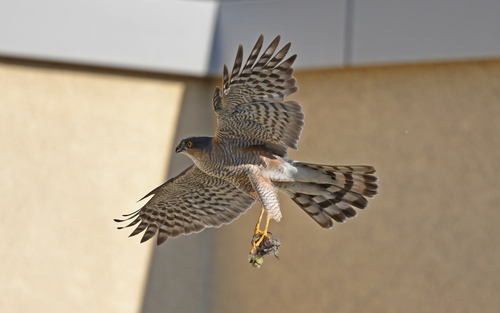 Sperber
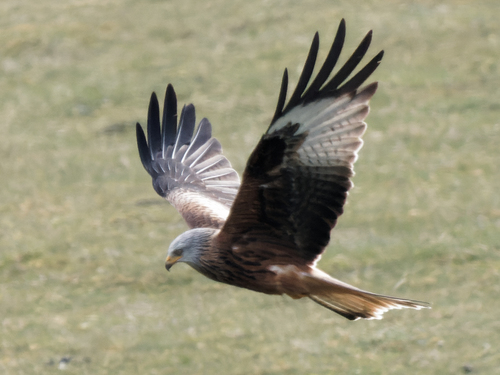 Rotmilan
Kurz gesagt
The most reliable field mark to separate Eurasian Sparrowhawk from Red Kite is the tail: Red Kite of any age shows a very long, deeply forked tail, while Sparrowhawk always has a long, square-tipped or slightly rounded tail. In flight, juvenile Red Kites display a pale line across the upperwing (from pale tips to coverts) and a less forked tail, but still never match the compact, rounded-winged, short-tailed jizz of Sparrowhawk. Sparrowhawk is a small, fast, woodland raptor with short, broad wings and rapid, flap-flap-glide flight, while Red Kite is a much larger, elegant, open-country bird with long, narrow wings, slow buoyant flight, and a strikingly forked tail. Even at a distance, the Red Kite's rufous body and white wing panels contrast with the Sparrowhawk's barred underparts and overall grey or brown tones.
Bestimmungstipps
- Tail shape is the single most reliable mark: Red Kite of all ages has a long, deeply forked tail (less forked in juveniles but still obvious); Sparrowhawk always has a long, square-tipped or slightly rounded tail. Check the tail in both perched and flying birds.
- Flight silhouette: Red Kite shows long, narrow wings held in a shallow 'V', with a languid, buoyant flight and frequent tail twisting. Sparrowhawk is compact, with short, broad wings and rapid, stiff wingbeats interspersed with glides.
- Size: Red Kite is huge compared to Sparrowhawk. If the bird looks as big as a buzzard or crow, it's not a Sparrowhawk. Even the largest female Sparrowhawk is much smaller than the smallest Red Kite.
- Juvenile Red Kite upperwing: Look for a long, narrow pale line across the upperwing (from pale tips to greater coverts) in juveniles and first-years; Sparrowhawk never shows this feature at any age.
- Underparts: Sparrowhawk (all ages) shows fine horizontal barring below (orange in adult males, brown in females/juveniles); Red Kite has a rufous or buff body with streaks, never barred like Sparrowhawk.
- Plumage tones: Red Kite is rufous on body and upper tail, with white panels on the wings and black wingtips; Sparrowhawk is blue-grey (male) or brown (female/juvenile) above, with no rufous or white wing panels.
- Wing pattern: Red Kite always shows white primary panels and black tips; Sparrowhawk's wings are plain, with no white or black panels.
- Perched posture: Red Kite perches upright, often with its long forked tail hanging conspicuously; Sparrowhawk appears more compact, with a proportionally long but square/rounded tail.
- Habitat context: In open country, especially where birds are soaring high, expect Red Kite; in woodland or near hedgerows, especially with rapid, low flight, expect Sparrowhawk.
- Behavior: Red Kite soars and glides for long periods, often in groups; Sparrowhawk is solitary, dashing, and rarely soars except briefly.
- Eye color: Adult Sparrowhawks have orange-yellow or orange-red irides; Red Kite's eye color is not a strong field mark in this context.
- Legs and feet: Sparrowhawk has long, thin legs and toes for catching birds; Red Kite's legs are proportionally shorter and thicker, but this is rarely visible in the field.
- Vocalizations: If heard, Red Kite gives a thin piping call; Sparrowhawk is usually silent except at the nest.
- Pitfalls: Large female Sparrowhawks can appear bigger than expected, but never approach Red Kite size or show a forked tail. Juvenile Red Kites may have a less forked tail, but always longer and more pointed than Sparrowhawk's.
- Season/age: Juvenile Red Kites may be confused with other large raptors, but never with Sparrowhawk due to size and structure differences. Juvenile Sparrowhawks are browner and more streaked, but still compact and short-winged.
Größe
Red Kite is vastly larger than Eurasian Sparrowhawk in every dimension. Red Kite averages over 1100 g in body mass, with a wingspan of 175–195 cm and length of 60–70 cm; Sparrowhawk averages 220 g, with a wingspan of 59–80 cm (females at the upper end) and length of 29–41 cm. Even the largest female Sparrowhawk is dwarfed by the smallest Red Kite. In the field, Red Kite appears as a large, graceful raptor, while Sparrowhawk is compact and much smaller, often only slightly larger than a thrush or pigeon.
Gefieder
-
Juvenile/immature Red Kite: Shows a buff breast and belly, less deeply forked tail with a dark subterminal band, and a long, narrow pale line across the upperwing (from pale tips to all greater coverts above and below). Adults lose the pale line and have pale fringes only to upperwing secondary coverts. Juvenile Sparrowhawks are brown above with rusty fringes, coarsely barred or spotted brown below, and have pale yellow eyes; their throat is streaked but lacks a central stripe. Juvenile Sparrowhawks never show the pale upperwing line or forked tail of Red Kite.
-
Adult Red Kite: Rich rufous body, upper tail, and wing coverts, white primary panels, black wing tips, and a long, deeply forked tail. Sparrowhawk adult males are blue-grey above with orange-barred underparts; females are brown or grey-brown above with brown-barred underparts. Both sexes of Sparrowhawk have a much plainer wing, with no white panels or rufous tones, and always a square or slightly rounded tail.
-
In all ages: Red Kite's white wing panels and forked tail are unique; Sparrowhawk is always more uniformly barred below, lacks any white on the wing, and has a shorter, squarer tail.
Verhalten
Red Kite soars with long, narrow wings held in a shallow 'V' (dihedral), often twisting its long forked tail to steer, and spends much time gliding or circling high over open country. Its flight is buoyant and graceful, with slow, deep wingbeats. Eurasian Sparrowhawk is adapted for woodland hunting: it flies with quick, stiff wingbeats interspersed with short glides, often low to the ground or through trees, and rarely soars for long. Sparrowhawk appears compact and purposeful, with short, broad wings and a long tail used for rapid maneuvering.
Lebensraum
Red Kite is typically found in open country, farmland, and upland areas, often seen soaring over fields, valleys, and hills. It avoids dense woodland. Eurasian Sparrowhawk prefers wooded habitats, forest edges, and parks, where it can hunt small birds by surprise. While both may be seen over mixed landscapes, Red Kite is rarely found deep in woodland, and Sparrowhawk rarely soars high over open fields for extended periods.
Stimme
Red Kite gives a thin, piping call, less mewling than a buzzard but still distinctive when heard. Sparrowhawk is generally silent away from the nest, and its calls are rarely heard in the field except during breeding. Vocalizations are not usually helpful for separation unless the birds are calling.