

Weidengelbkehlchen vs Mönchswaldsänger
Geothlypis trichas gegen Cardellina pusilla
Ein Quiz mit Weidengelbkehlchen und Mönchswaldsänger spielen
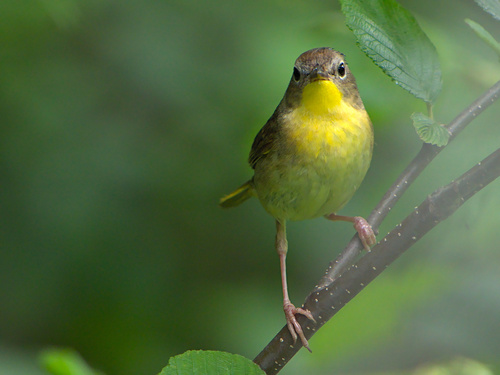 Weidengelbkehlchen
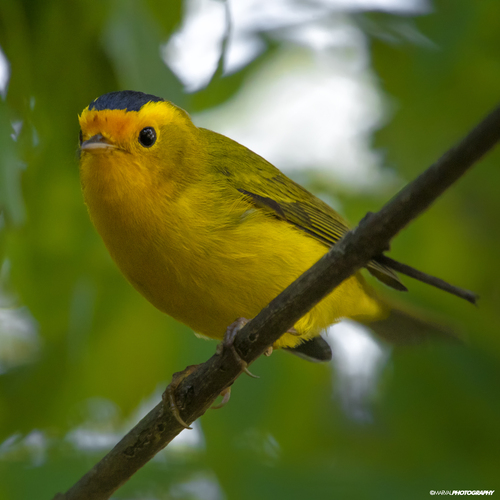 Mönchswaldsänger
Kurz gesagt
The most reliable field mark to separate Common Yellowthroat from Wilson's Warbler is the location and shape of the black on the male's head: Common Yellowthroat males have a broad black mask across the eyes and face, while Wilson's Warbler males show a small, round black cap on the crown. Females and immatures of both species lack strong black markings, but Common Yellowthroat is more olive above with a white belly and yellow throat, while Wilson's Warbler is greenish above and clean yellow below. Structure also helps: Wilson's Warbler is slimmer with a longer, thinner tail, and both species are active, but Wilson's Warbler often flicks its tail and wings. Habitat and context can help, as Common Yellowthroat prefers dense, low vegetation, while Wilson's Warbler is more likely in shrubby or open woodland.
Bestimmungstipps
- Male head pattern: The most decisive mark—male Common Yellowthroat has a broad black mask across the face and forehead, bordered above by white or gray; male Wilson's Warbler shows a small, round black cap on the crown only, with no mask. This is reliable in spring and summer, and for some first-year males in fall (mask may be faint).
- Female and immature head: Female and immature Common Yellowthroat lack the black mask but may show a faint shadow of it (especially first-year males in fall); they are olive above, yellow on throat/chest, and white on the belly. Female and immature Wilson's Warblers are greenish above and yellow below, with no black on the head at all and a more uniform yellow underparts.
- Underparts color: Wilson's Warbler is yellow from throat to belly, with little contrast. Common Yellowthroat shows yellow on the throat and chest, but the belly is whiter, creating a two-toned effect, especially in females and immatures.
- Back color: Both are olive/greenish above, but Wilson's Warbler is usually brighter green, especially in western birds, while Common Yellowthroat is more olive-brown.
- Tail shape and length: Wilson's Warbler has a longer, slimmer tail that is often flicked or wagged; Common Yellowthroat has a shorter, rounder tail and rarely flicks it.
- Wing pattern: Neither species has wing bars or strong upperwing marks at any age, so this is not a useful separator.
- Bill and structure: Wilson's Warbler is slimmer and more delicate overall, with a thinner bill and longer tail. Common Yellowthroat is chunkier, with a heavier, more conical bill and a rounder body.
- Flight style: Wilson's Warbler is more buoyant and active in flight, often moving at various heights; Common Yellowthroat is more direct and usually stays low to the ground or in dense cover.
- Habitat: In marshes, wet thickets, or dense low vegetation, expect Common Yellowthroat; in shrubby woodland, forest edge, or higher in trees, expect Wilson's Warbler—especially during migration.
- Voice: Learn the distinctive "twichety" song of Common Yellowthroat versus the chattering, descending song of Wilson's Warbler. Calls also differ: "jip" (Yellowthroat) vs. "chuff" (Wilson's).
- Behavior: Wilson's Warbler often flicks its tail and wings nervously while foraging; Common Yellowthroat is more secretive and less likely to be seen in the open.
- Sex/age pitfalls: First-year male Common Yellowthroat may show a faint mask, but never a cap; female Wilson's Warbler never shows any black on the head. Immature Wilson's Warbler is always plain-headed.
- Seasonal context: In fall migration, both species can be drab and confusing, but the mask (even faint) on young male Yellowthroats and the uniform yellow below of Wilson's Warbler remain useful.
- Geographic variation: Western Wilson's Warblers are brighter green above and more yellow below, but the head pattern remains the best separator across all subspecies.
- Abundance: Both species can be common in migration, but Common Yellowthroat is more likely to be resident or breeding in marshy areas, while Wilson's Warbler is more migratory and less tied to wetlands.
Größe
Wilson's Warbler is slightly smaller overall, measuring 10–12 cm in length with a 14–17 cm wingspan and 5–10 g in mass [wikipedia]. Common Yellowthroat is similar in size but typically appears chunkier and more compact, with a shorter tail and less elongated shape. In the field, Wilson's Warbler may look more delicate and slim, especially with its longer, thinner tail, while Common Yellowthroat often appears rounder and more robust.
Gefieder
- Males (breeding): Common Yellowthroat males have a bold black mask stretching across the forehead, eyes, and sides of the head, bordered above by white or gray; underparts are bright yellow on throat and chest, fading to white on the belly. Wilson's Warbler males have a small, round black cap on the crown only, with no mask; their underparts are clean, unbroken yellow from throat to belly, and the back is greenish.
- Females and immatures: Both species lack strong black markings. Female and immature Common Yellowthroats are olive above, yellow on throat and chest, and white on the belly; they may show a faint, incomplete mask (especially first-year males in fall). Female and immature Wilson's Warblers are greenish above and yellow below, with no mask and no cap, and appear more uniformly yellow below than Common Yellowthroat.
- Juvenile/first-year birds: First-year male Common Yellowthroats may show a faint, partial black mask that is not as bold as in adults, and immatures resemble adult females. Wilson's Warbler immatures lack any black on the head and are plain greenish above, yellow below.
- Wings and tail: Neither species shows strong wing bars or distinctive upperwing patterns in any age class. Wilson's Warbler has a longer, slimmer tail, while Common Yellowthroat's tail is shorter and rounder.
Verhalten
Both species are active foragers, but Wilson's Warbler is especially restless, often flicking its tail and wings while moving quickly through shrubs and low trees. Common Yellowthroat tends to skulk in dense, low vegetation, often remaining partially hidden and moving with short hops or flights close to the ground. Wilson's Warbler is more likely to be seen in the open, foraging at various heights, and may be observed flycatching. In flight, Wilson's Warbler appears lighter and more buoyant, while Common Yellowthroat looks more compact and direct.
Lebensraum
Common Yellowthroat is strongly associated with dense, low vegetation—especially wetlands, marshes, and thick brush near water. It is rarely seen far from cover and usually stays close to the ground. Wilson's Warbler prefers shrubby or open woodlands, forest edges, riparian thickets, and brushy clearings, often at higher levels than Common Yellowthroat. During migration, Wilson's Warbler can be found in a wider range of habitats, including gardens and parks, but is less tied to wetland edges than Common Yellowthroat.
Stimme
Common Yellowthroat's song is a loud, distinctive "twichety twichety twichety twich," and its call is a soft "jip." Wilson's Warbler sings a chattering series of loud descending notes, and its call is a flat "chuff." While both are distinctive with experience, the Common Yellowthroat's song is more rhythmic and repetitive, while Wilson's Warbler's song is faster and more variable.
Weidengelbkehlchen · Mönchswaldsänger · Meine schwierigen Vögel