

Breitschnabelkolibri vs Schwarzstirn-Saphirkolibri
Cynanthus latirostris gegen Basilinna xantusii
Ein Quiz mit Breitschnabelkolibri und Schwarzstirn-Saphirkolibri spielen
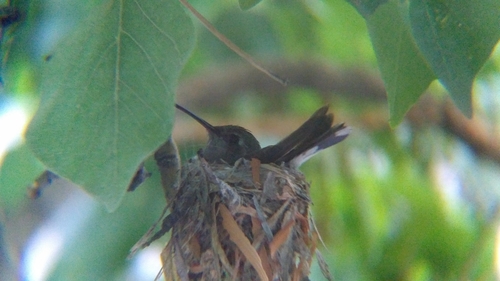 Breitschnabelkolibri
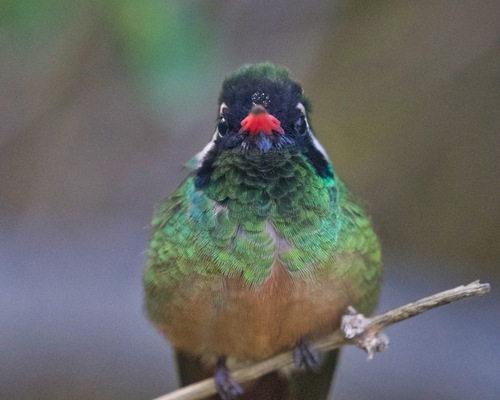 Schwarzstirn-Saphirkolibri
Kurz gesagt
The most reliable field mark to separate Broad-billed Hummingbird from Xantus's Hummingbird is the bill and face pattern: Broad-billed shows a long, bright red bill with a black tip and lacks any black mask or rufous underparts, while Xantus's Hummingbird (especially males) has a striking black face and chin, a white eyestripe, and extensive cinnamon underparts. Juvenile Broad-billeds resemble adult females but lack the strong face pattern and rufous tones of Xantus's. In flight or perched, look for Broad-billed's blue gorget (male), green upperparts, and broad, dark tail versus Xantus's golden-green crown, rufous tail, and cinnamon below. Both are similar in size, but their structure and coloration are distinct if seen well.
Bestimmungstipps
- Bill Color and Shape: Broad-billed Hummingbird of both sexes shows a long, bright red bill with a black tip; males' bills are shorter but more intensely red. Xantus's male has a red bill with a black tip, but the female's bill is darker above with only a pinkish base and pinkish-red lower mandible—less striking overall.
- Face Pattern: Xantus's male has a bold black forehead and chin, a mostly black face, and a wide white eyestripe. Broad-billed lacks any black mask or chin; female Broad-billed has a white eyestripe but no black face.
- Throat/Gorget: Broad-billed male has a blue gorget (throat patch), while Xantus's male has an iridescent emerald green throat. Female Broad-billed has a pale throat; female Xantus's has cinnamon underparts including the throat.
- Underparts Color: Xantus's of both sexes shows extensive cinnamon or pale cinnamon underparts, sometimes with green mottling on the flanks (male). Broad-billed is pale below (female/juvenile) or greenish (male), never cinnamon.
- Tail Pattern: Broad-billed male has a broad, blackish-blue tail; female has white-tipped tail feathers. Xantus's tail is rufous-chestnut (male) or rufous with green central feathers and white tips (female); look for rufous tones in flight.
- Crown and Upperparts: Xantus's male has a golden-green to emerald crown and nape; Broad-billed is metallic green above but lacks the golden tones.
- Juvenile Plumage: Juvenile Broad-billeds resemble adult females but lack the white-tipped tail (in males) and do not show cinnamon below or black face. Juvenile Xantus's are not described, but all ages show some cinnamon below and a strong face pattern.
- Sexual Dimorphism: Both species are sexually dimorphic, but the differences are more pronounced in Xantus's (black face, white eyestripe, cinnamon underparts) than Broad-billed (blue gorget in male, pale below in female).
- Habitat and Range: If seen outside Baja California, Xantus's is extremely unlikely. Broad-billed is regular in the US Southwest and Mexico.
- Perched vs. Flight: In flight, focus on tail color and underpart tone: Broad-billed never shows rufous in the tail or cinnamon below. Perched, the face pattern and bill color are most useful.
- White Eyestripe: Both species' females have a pale eyestripe, but only Xantus's has a strong blackish face to set it off. Broad-billed's eyestripe is on a plain green face.
- Tail Shape: Broad-billed's tail is broad and squared or slightly notched; Xantus's is more rufous and may appear more pointed due to color contrast.
- Bill Length: Both have straight bills of similar length, but Broad-billed's is proportionally longer and more vividly colored in both sexes.
- Cinnamon Flanks/Undertail: Any hint of cinnamon on the flanks or undertail coverts points to Xantus's; Broad-billed is always pale or greenish below.
- Pitfalls: Juvenile Broad-billeds lacking adult male features can be confused with female Xantus's, but look for the absence of cinnamon and the less contrasting face pattern.
Größe
Both species are very close in size: Broad-billed Hummingbird measures 8–10 cm in length with a wingspan of about 13 cm and weighs 3–4 g [wikipedia][avonet]. Xantus's Hummingbird is 8.5–9.5 cm long, with males averaging 3.5 g and females 3.4 g [wikipedia]. In the field, size is not a reliable separator between these two; any perceived difference is subtle and easily masked by posture or feather position.
Gefieder
- Juveniles and Females: Juvenile Broad-billed Hummingbirds look like adult females: metallic green above, pale below, with a white eyestripe and white-tipped tail. They lack the strong black face and cinnamon underparts of Xantus's. Juvenile male Broad-billeds do not show the white tail tips of females, and their bill gradually becomes redder with age.
- Adult Males: Broad-billed male is metallic green above, with a blue gorget and broad, blackish-blue tail. The bill is bright red with a black tip. Xantus's male has a golden-green to emerald crown, black forehead and chin, a bold white eyestripe, and cinnamon underparts with green mottling on the flanks. The tail is rufous-chestnut with green edges.
- Adult Females: Broad-billed female is green above, pale below, with a white eyestripe and white-tipped tail. Xantus's female has a dull brownish forehead, golden-green upperparts, blackish-brown face with a pale buffy eyestripe, and pale to medium cinnamon underparts. Her tail is rufous with green central feathers and white tips.
- Tail Pattern: Broad-billed has a broad, dark tail (male: blackish-blue; female: white-tipped). Xantus's has a rufous or rufous-edged tail with green in the center and white tips on the outer feathers (female).
Verhalten
Both species are active, diurnal hummingbirds. Broad-billed is noted for being especially active during the day. There are no strong behavioral distinctions in the notes for field separation, but Xantus's may move locally in response to flowering plants, especially after breeding. Both species feed at a variety of flowers, often hovering and darting between blooms.
Lebensraum
Broad-billed Hummingbird occurs in Mexico and the southwestern United States, often in canyons, riparian areas, and gardens. Xantus's Hummingbird is endemic to the Baja California Peninsula, typically found in montane forests but descending to lower elevations after breeding. If observed outside Baja California, Xantus's is highly unlikely. Habitat overlap is minimal except in captivity or rare vagrancy.
Breitschnabelkolibri · Schwarzstirn-Saphirkolibri · Meine schwierigen Vögel