

Dreizehenmöwe vs Elfenbeinmöwe
Rissa tridactyla gegen Pagophila eburnea
Ein Quiz mit Dreizehenmöwe und Elfenbeinmöwe spielen
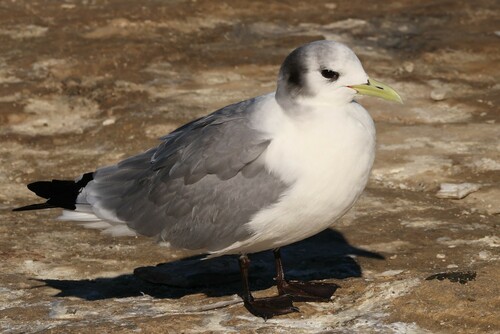 Dreizehenmöwe
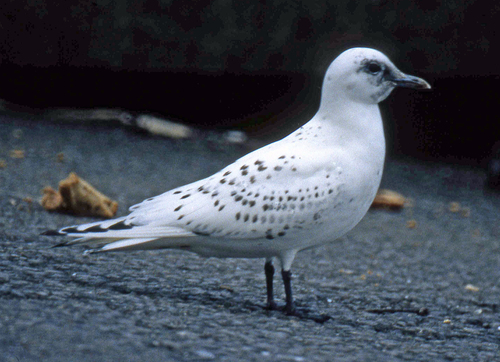 Elfenbeinmöwe
Kurz gesagt
The most reliable field mark to separate Black-legged Kittiwake from Ivory Gull, especially in immature birds, is the striking black 'W' pattern across the upperwings of juvenile kittiwakes, which Ivory Gulls never show. Adult Ivory Gulls are pure white with no grey or black in the wings or back, while adult kittiwakes have grey upperwings with solid black wingtips. Structure also helps: Ivory Gulls are bulkier, with a thicker, blue-based bill and a pigeon-like jizz, while kittiwakes are slimmer and more gull-like. Both species have black legs as adults, but bill and plumage differences are more reliable. In flight, note the longer, broader wings and pure white look of Ivory Gull versus the more typical gull patterning of kittiwake.
Bestimmungstipps
- Juvenile/immature wing pattern: Juvenile Black-legged Kittiwake shows a bold black 'W' across the upperwings in flight, a black hind-neck collar, and a black tail band. Ivory Gull juveniles never show a 'W' pattern; instead, they are mostly white with scattered black flecks and a dusky face.
- Bill color and shape: Adult kittiwake has a slender yellow bill (dusky-olive in winter); Ivory Gull has a thicker, blue-based bill with a yellow (sometimes reddish) tip. Juvenile kittiwake has a solid black bill; juvenile Ivory Gull's bill is not described as solid black.
- Adult wing and back color: Adult kittiwake has a grey back and grey wings with solid black wingtips; Ivory Gull is pure white with no grey or black on the wings or back at any age after second winter.
- Leg color: Both species have black legs as adults, so this is not diagnostic. Rare kittiwakes may show pinkish or reddish legs, but this is exceptional and should not be relied upon.
- Head pattern in winter: Winter kittiwake shows a dusky smudge behind the eye and a faint grey hind-neck collar; Ivory Gull may have a slightly dusky face as a juvenile, but adults are always pure white.
- Tail pattern: Juvenile kittiwake has a black tail band; Ivory Gull juveniles may have some black flecking in the tail but never a complete band.
- Mouth color: Kittiwake has a rich red mouth lining, sometimes visible during calls or aggressive displays; Ivory Gull does not show this feature.
- Structure and jizz: Ivory Gull is bulkier, with a pigeon-like stance, short legs, and a thick bill; kittiwake is slimmer and more graceful, with longer, narrower wings and a more typical gull posture.
- Flight style: Ivory Gull has long, broad-based wings and a strong, skua-like wingbeat; kittiwake's flight is lighter and more buoyant.
- Habitat: Ivory Gull is almost exclusively in high Arctic ice or snow habitats; kittiwake is found on sea cliffs, coastal ledges, and offshore waters in subarctic and temperate zones.
- Vocalizations: Kittiwake's 'kittee-wa-aaake' is distinctive; Ivory Gull's calls are harsher and more tern-like, but voice is rarely the sole reliable field mark.
- Age progression: Kittiwake takes four years to reach adult plumage, with gradual loss of black in the wings and tail; Ivory Gull reaches adult plumage in two years, becoming pure white.
- Potential pitfalls: Rare kittiwakes with pinkish legs may cause confusion, but overall structure and wing pattern should resolve the ID. Juvenile kittiwake's black 'W' is unique and not matched by Ivory Gull at any age.
- Context: A pure white gull in the high Arctic is almost always an Ivory Gull; a grey-backed gull with black wingtips on a sea cliff is a kittiwake.
- Sex and seasonal variation: No significant sexual dimorphism in either species; seasonal changes mostly affect kittiwake's head and bill color, not Ivory Gull.
Größe
Ivory Gull is noticeably heavier and slightly larger overall, with a body mass averaging 562 g compared to the kittiwake's 418 g. Ivory Gull's wingspan is also longer (108–120 cm vs. 91–105 cm for kittiwake), and its body length is a bit greater (40–43 cm vs. 37–41 cm). In the field, Ivory Gull appears bulkier and more robust, while kittiwake is slimmer and more delicate. However, size alone is not always reliable at a distance or in mixed flocks.
Gefieder
Juvenile and immature plumage is the most diagnostic: juvenile Black-legged Kittiwake shows a bold black 'W' across the upperwings in flight, black hind-neck collar, and a black tail band, with a solid black bill. This pattern is unique and not matched by Ivory Gull at any age. Juvenile Ivory Gulls are mostly white but have a dusky face and variable black flecking in the wings and tail, lacking any 'W' pattern or tail band. As Ivory Gulls age, they lose the flecking and become entirely white by their second winter. Adult kittiwakes have a clean white head and body, grey back, grey wings with solid black wingtips, and black legs; in winter, they show a dusky smudge behind the eye and a faint grey hind-neck collar. Adult Ivory Gulls are pure white everywhere, with no grey or black on the wings or back, and have a blue-based bill with a yellow (sometimes reddish) tip. Both species have black legs as adults, but kittiwake's bill is yellow (dusky in winter), while Ivory Gull's is blue with a yellow tip.
Verhalten
Ivory Gulls often appear more pigeon-like in posture and movement, with short legs and a robust, upright stance. Their flight is strong and direct, with broad-based wings and a wingbeat reminiscent of skuas. Kittiwakes are more typical gulls in flight, with a slimmer, more graceful appearance and longer, narrower wings. On the ground, kittiwakes are more likely to be seen perched on cliffs or ledges, while Ivory Gulls often walk or stand on ice or snow, sometimes resembling ptarmigan in posture.
Lebensraum
Ivory Gulls are true high Arctic specialists, usually found on sea ice, near glaciers, or in the far north, often far from land. Black-legged Kittiwakes breed on sea cliffs and coastal ledges, often in large colonies, and are more widespread in subarctic and temperate zones. Away from breeding sites, kittiwakes are pelagic and can be seen offshore, but rarely venture into the high Arctic pack ice where Ivory Gulls are common. Context can help: a pure white gull on Arctic ice is almost certainly an Ivory Gull, while a grey-backed gull on a temperate sea cliff is a kittiwake.
Stimme
Kittiwake's call is a shrill, repeated 'kittee-wa-aaake', which is distinctive and gives the species its name. Ivory Gull's main flight call is a harsh, tern-like 'keeeer', and it also gives a warbling 'fox-call' and a plaintive begging call during courtship. Calls are quite different, but both are high-pitched and can be masked by wind or distance in the field.