

Dreizehenmöwe vs Bonapartemöwe
Rissa tridactyla gegen Chroicocephalus philadelphia
Ein Quiz mit Dreizehenmöwe und Bonapartemöwe spielen
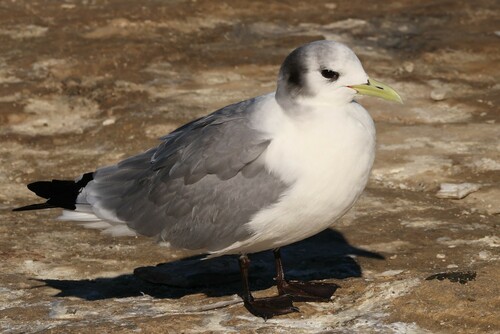 Dreizehenmöwe
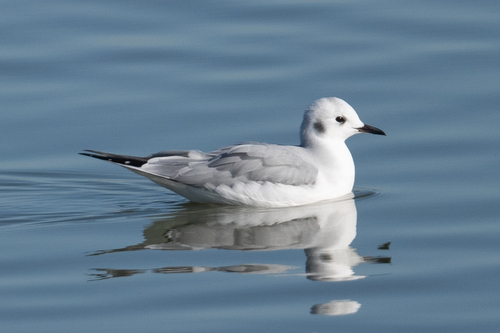 Bonapartemöwe
Kurz gesagt
The most reliable field mark to separate Black-legged Kittiwake from Bonaparte's Gull, especially in flight and among immatures, is the wing pattern: juvenile kittiwakes show a bold black 'W' across the upperwing, while Bonaparte's Gull juveniles have a brown bar across the forewing and lack the striking 'W'. Adults differ in leg color (black in kittiwake, pinkish-red/orange-red in Bonaparte's), bill structure, and overall size, with kittiwake being noticeably larger and heavier. Kittiwake adults have solid black wingtips above, whereas Bonaparte's show black-and-white striped wingtips. In winter, kittiwake develops a dusky hind-neck collar and smudge behind the eye, while Bonaparte's loses its dark hood but retains a pale grey nape. Both species can be confused in non-breeding plumage, but careful attention to wing pattern, leg color, and structure will resolve most field identifications.
Bestimmungstipps
- Juvenile/Immature Wing Pattern: Look for the bold black 'W' across the upperwing in juvenile and first-year Black-legged Kittiwake; Bonaparte's Gull never shows this, instead displaying a brown bar across the forewing. This is the single most reliable mark for immatures in flight.
- Tail Pattern (Immatures): Kittiwake juveniles have a black terminal band on the tail; Bonaparte's also shows a black tip, but the overall pattern is less bold and lacks the strong 'W' on the wing.
- Bill Color (by Age): Juvenile kittiwakes have a solid black bill, which becomes greenish in second year and yellow by adulthood. Bonaparte's Gull has a thin black bill throughout all plumages, never turning yellow.
- Leg Color: Adult kittiwake legs are black; Bonaparte's Gull legs are pinkish-red in winter and orangish-red in summer. Rare kittiwakes may show pinkish legs, but this is exceptional.
- Adult Wingtip Pattern: Kittiwake adults have solid black wingtips above; Bonaparte's adults have black-and-white striped wingtips, with the outer four primaries white with black tips and the rest grey with black tips.
- Head Pattern (Non-breeding): In winter, kittiwake shows a dark smudge behind the eye and a grey hind-neck collar; Bonaparte's loses its hood but retains a pale grey nape and clean white face.
- Bill Structure: Kittiwake's bill is thicker and yellow (adult), while Bonaparte's is always thin, short, and black.
- Size and Structure: Kittiwake is much larger, bulkier, and longer-winged; Bonaparte's is smaller, daintier, and more tern-like in flight and proportions.
- Mouth Color (Kittiwake): If seen well, kittiwake has a rich red mouth lining, especially when calling or gaping; Bonaparte's does not show this feature.
- Flight Jizz: Kittiwake flies with steady, purposeful wingbeats and glides, often far out to sea; Bonaparte's is more buoyant, with quick, fluttery wingbeats, often over inland waters.
- Habitat: Kittiwake is almost always marine; Bonaparte's is common on inland lakes and rivers, especially during migration.
- Breeding Plumage: Bonaparte's has a full black hood in breeding season; kittiwake never shows a hood, always white-headed in summer.
- Sex Differences: Both species are similar between sexes; size difference is subtle and not useful in the field.
- Vocalization: Kittiwake's loud 'kittee-wa-aaake' is distinctive; Bonaparte's calls are softer and higher-pitched.
- Potential Pitfalls: Rare kittiwakes with pinkish legs can be confusing; always check wing pattern and bill color for confirmation, especially in immatures.
Größe
Black-legged Kittiwake is substantially larger and heavier than Bonaparte's Gull. Kittiwake averages 418 g in body mass, with a length of 37–41 cm and a wingspan of 91–105 cm [wikidata][wikipedia]. Bonaparte's Gull is much lighter (180–225 g), shorter (28–38 cm), and has a smaller wingspan (76–84 cm) [wikipedia]. In the field, kittiwake appears bulkier, longer-winged, and larger-headed, while Bonaparte's is daintier and more tern-like.
Gefieder
Juvenile and immature plumages are the most diagnostic for separation:
- Juvenile/First-year: Black-legged Kittiwake fledglings and first-years show a broad, bold black 'W' across the upperwing in flight, with white secondaries and primaries behind the 'W', a black hind-neck collar, and a solid black bill. Bonaparte's Gull juveniles have a brown, not black, bar across the forewing, patchy brown on the head, and a black-tipped tail; their bill is also black, but the wing pattern is never as bold or as sharply 'W'-shaped as kittiwake.
- Second/Third-year: Kittiwake immatures retain some black on the coverts and tail, with a greenish bill and a fading hind-neck collar. Bonaparte's first-years retain the brown forewing bar and blackish tail tip, and only a small minority show a dull hood in first summer.
- Adults: Kittiwake adults have pure white heads in summer, black legs, yellow bill, and solid black wingtips above; in winter, a dark smudge appears behind the eye and a grey hind-neck collar develops, with the bill turning dusky-olive. Bonaparte's adults in breeding plumage have a slaty black hood, pinkish to orangish-red legs, and a thin black bill; in non-breeding plumage, the hood is lost, but the nape remains pale grey and the bill and legs retain their color. The upperwing of Bonaparte's shows black-and-white striped wingtips, not solid black as in kittiwake.
Verhalten
Both species are agile and buoyant in flight, but Black-legged Kittiwake often appears more purposeful and direct, with longer, narrower wings suited for pelagic soaring. Bonaparte's Gull is more tern-like, with quick, fluttery wingbeats and a lighter, more delicate jizz. When perched, kittiwake stands taller and bulkier, while Bonaparte's is more compact and dainty.
Lebensraum
Black-legged Kittiwake is a strictly marine gull, rarely seen inland, and is most often encountered along ocean coasts, cliffs, and at sea. Bonaparte's Gull is more versatile, found on lakes, rivers, and coastal habitats, and is a regular migrant through inland waters. If observed far from the sea, Bonaparte's is much more likely.
Stimme
Kittiwake is named for its distinctive, shrill 'kittee-wa-aaake' call, which is loud and carries over colonies. Bonaparte's Gull is generally quieter, with higher-pitched, softer calls that are less likely to draw attention in the field.